I get the AI slop problem, but not accepting all public prs won’t solve it and feels like a dick move. A vouch system like Ghostty would’ve been a more understandable path.
I think this is a mistake. Ladybird would’ve been an obscure niche hobby project if it wasn’t framed as an opportunity to contribute to a real new browser and a way to learn from Andreas, now that the project is on its feet, they decides to ditch their roots.
Ladybird is moving into a new phase as we work toward our first alpha release.
We are tightening how code enters the project: going forward, code changes will only be introduced by project maintainers, and we will no longer accept public pull requests.
https://t.co/iauF4r9f3q
Empowering people to own and change their software was the open source slogan for decades. Now the grand democratization finally arrives, and it's all "yeah, but not like that" 🙄
@pauliusztin_@pydantic If you're into composable harnesses, check out Ossature, though calling it a "harness" might be underselling it, it's basically a full build system for spec-driven code gen ;)
Also built on @Pydantic AI under the hood (absolute banger of a lib btw) https://t.co/kVmIvwy8Sw
@dbreunig I think it’s a sign of early optimization, or at least the wrong place to start? The more we anthropomorphize the less use cases we’ll find. LLMs we have now are quite powerful, we need better ideas for deterministic tooling and systems to build around them, to make most use.
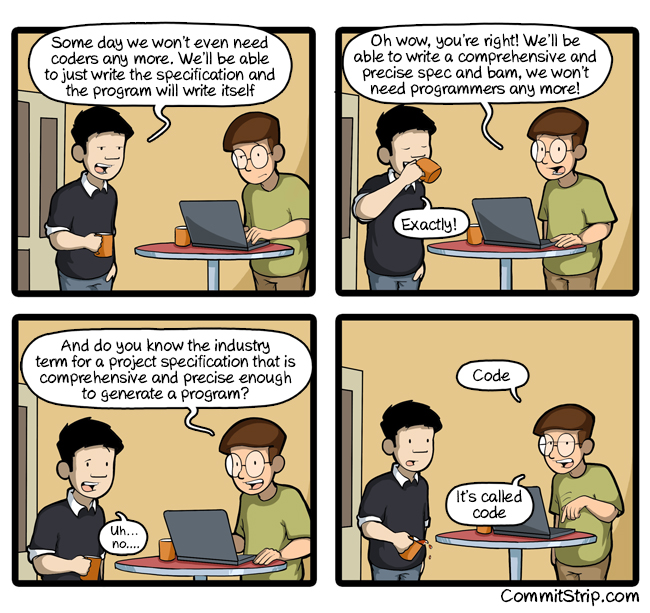
@DavidKPiano I think the point can be made whether you start with a prototype or spec. You do need to know what you’re doing/using to know how to write the spec well, but I don’t think you can feed that to an LLM. Code is one interpretation of a spec:
https://t.co/R5jbhsUdhQ
@dok2001@momito I’ve been working on Ossature for a few months and a lot of ideas are similar I think, but the corner stone for me is the spec to structure the intent https://t.co/ccOzFR70RT
Maybe people who talk about this have always worked in perfect teams? My experience is different. People write crap code sometimes too. Besides, the spec captures intent, code captures one implementation of it.
“That tension is roughly what specs become for AI-generated code. The spec has to be detailed enough that the agent doesn't have to invent the parts you actually care about, but it shouldn't be a thousand-line waterfall document trying to predict every branch”
@dbreunig Some kind of a mix of the following: Start with a new context for every task when implementing a feature. Specs > Memory. Write behavioral contracts.
@trq212 Agreed. I think that the true benefit would be when prompting itself (or free-form prompting at least) is no longer needed by providing structure around how the user interacts with the model. Actually useful AI workflows will fade AI into the background.