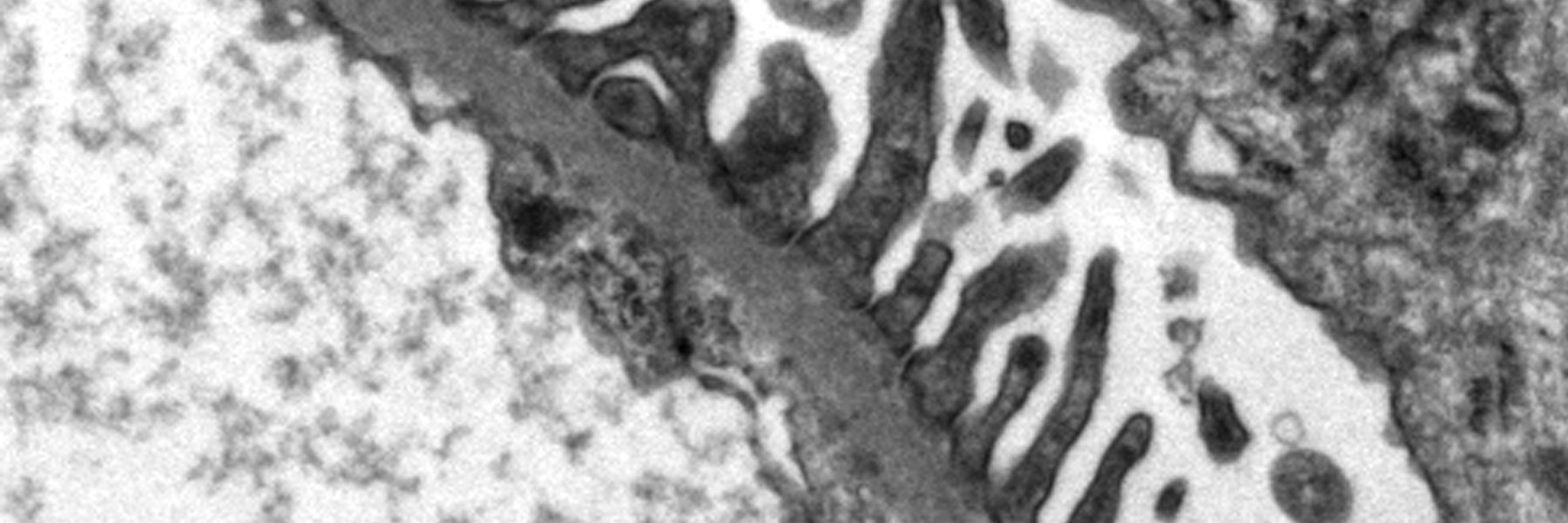
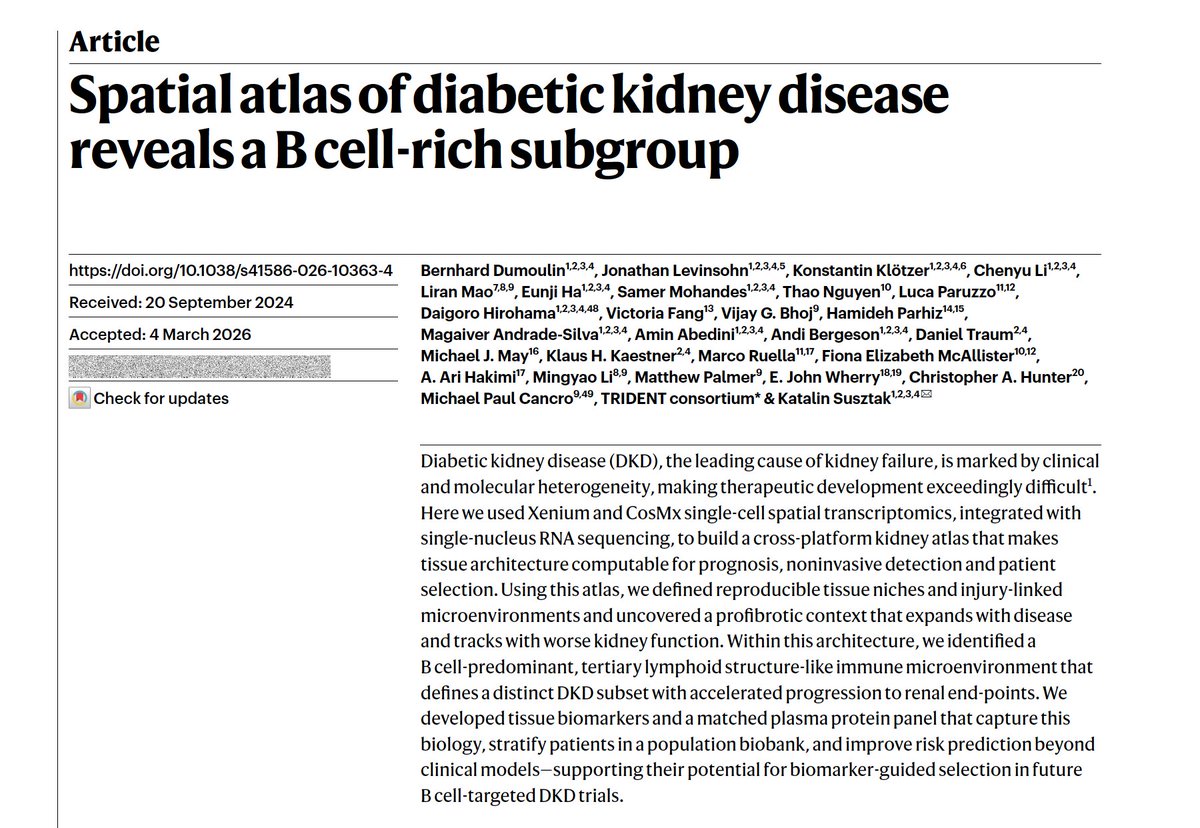
🗞️📸🌟🤩Beautiful work led by @BernhardDumoul1 with the team builds a single cell spatial atlas of human DKD using Xenium + CosMx + snRNA-seq. @Nature This is not incremental. This is a new layer of pathology. Diabetic kidney disease (DKD) is still treated as one disease. That is the problem. Patients look similar clinically but behave very differently. We asked: is there a biologically distinct subgroup we are missing?
https://t.co/Au83tayvR9
🚨 Our new paper just dropped !!! Proteomic risk score for early prediction of kidney disease progression in individuals with APOL1 high-risk genotypes https://t.co/4WCXVKst5S
Still time to apply to TWO! PhD opportunities (one for a clinician at ST4 or above), both offering projects in our group, come and work with us using spatial multi-omics to dissect immune mediated kidney disease. https://t.co/9DwCJnIYK3
https://t.co/bHaY6pOKBn
A new round of Oxford-GSK Clinical DPhil applications are open, deadline Dec 2nd. If you are ST4 and above, check out the projects in neurodegeneration, liver, respiratory and fibrotic pathology. https://t.co/o7L1ZbqpPo
@ukkidney.org anaemia in #CKD guidelines head-to-head with @kdigo.org draft statements at #UKKW25 debate in Bournemouth. Exact Hb threshold to initiate ESA/HIF-PHI may be as low as 9 g/dL (or as high as 10.5!)
Our Wycombe Renal Unit, a satellite of the Oxford Kidney Unit, recently celebrated its 25th anniversary ✨
Thank you, team, for providing exceptional compassionate care to countless patients in the South Bucks area and making a significant impact on their lives 💙
Great to see this fascinating paper out, now I want to know what the B cells are doing @fgissa@trig_oxford@olivermccallion@brookmatt @https://www.sciencedirect.com/science/article/pii/S2666634024004550
Pleased to welcome @LBKrone, the Staines fellowship @ExeterCollegeOx is a great opportunity and really supported my development as I built my research independence. Make the most of it!
Joining forces to build capacity in #NeurodegenerativeDisease research, we'd like to welcome the new Oxford-GSK Fellows, Dr Steph Fowler, Dr Martina Hallegger and Dr Charmaine Lang to @HumanGeneticsOx! 👋🧬 @slfwlr@martinahallegg1
Find out more 👉 https://t.co/HXMTBSD3Ag
🚨Excited to share our @LiangXiuejie latest paper in @NatureComms! We identified #TET2 as a novel risk gene for kidney disease. By linking GWAS with single-cell and CRISPR studies, we reveal how TET2 impacts DNA repair and activates cytosolic nucleotide sensors. 🧵👇https://t.co/oT0mO0SSGv