Anthropic just showed a 27-minute workshop on how to actually write prompts for Claude.
Taught by the people who built it.
Free. No registration. No paywall.
I've seen $300 courses that don't cover what they teach in the first 8 minutes.
Watch the session!
I've never felt this much behind as a programmer. The profession is being dramatically refactored as the bits contributed by the programmer are increasingly sparse and between. I have a sense that I could be 10X more powerful if I just properly string together what has become available over the last ~year and a failure to claim the boost feels decidedly like skill issue. There's a new programmable layer of abstraction to master (in addition to the usual layers below) involving agents, subagents, their prompts, contexts, memory, modes, permissions, tools, plugins, skills, hooks, MCP, LSP, slash commands, workflows, IDE integrations, and a need to build an all-encompassing mental model for strengths and pitfalls of fundamentally stochastic, fallible, unintelligible and changing entities suddenly intermingled with what used to be good old fashioned engineering. Clearly some powerful alien tool was handed around except it comes with no manual and everyone has to figure out how to hold it and operate it, while the resulting magnitude 9 earthquake is rocking the profession. Roll up your sleeves to not fall behind.
The dev world is buzzing. 🐝 GPT-5 is here and available for real-world coding tasks. What’s more? A brand new VS Code release for an editor that’s more powerful and intuitive than ever. (1/3)
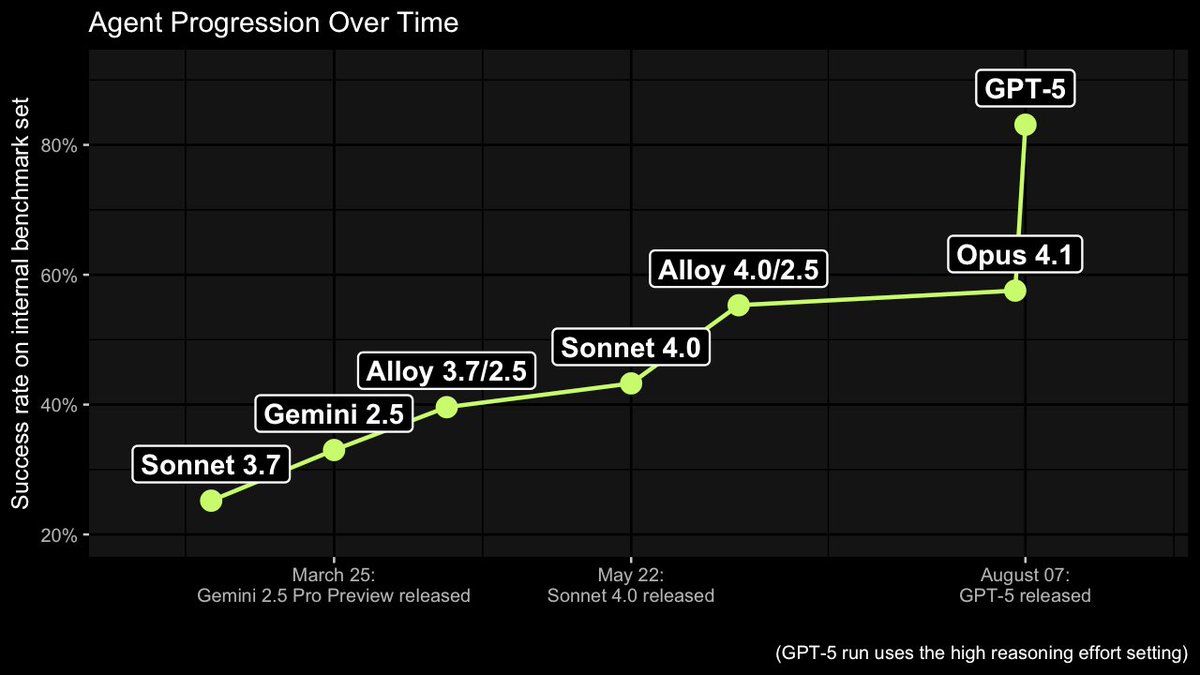
1/ XBOW Unleashes GPT-5’s Hidden Hacking Power.
@OpenAI's initial assessment of GPT-5 showed modest cyber capabilities. But when integrated into the XBOW platform, we saw a completely different story: performance more than doubled.
More on what we found: 🧵
You don’t need more friends, you need allies.
Most friends tell you it’s ok, slow down, we miss you.
Allies tell you keep going, you got this, you didn’t sign up for small.
I attended a vibe coding hackathon recently and used the chance to build a web app (with auth, payments, deploy, etc.). I tinker but I am not a web dev by background, so besides the app, I was very interested in what it's like to vibe code a full web app today. As such, I wrote none of the code directly (Cursor+Claude/o3 did) and I don't really know how the app works, in the conventional sense that I'm used to as an engineer.
The app is called MenuGen, and it is live on https://t.co/bQonQT88t0. Basically I'm often confused about what all the things on a restaurant menu are - e.g. Pâté, Tagine, Cavatappi or Sweetbread (hint it's... not sweet). Enter MenuGen: you take a picture of a menu and it generates images for all the menu items and presents them in a nice list. I find it super useful to get a quick visual sense of the menu.
But the more interesting part for me I thought was the exploration of vibe coding around how easy/hard it is to build and deploy a full web app today if you are not a web developer. So I wrote up the full blog post on my experience here, including some takeaways:
https://t.co/2kkQh0ElgB
Copy pasting just the TLDR:
"Vibe coding menugen was exhilarating and fun escapade as a local demo, but a bit of a painful slog as a deployed, real app. Building a modern app is a bit like assembling IKEA future. There are all these services, docs, API keys, configurations, dev/prod deployments, team and security features, rate limits, pricing tiers... Meanwhile the LLMs have slightly outdated knowledge of everything, they make subtle but critical design mistakes when you watch them closely, and sometimes they hallucinate or gaslight you about solutions. But the most interesting part to me was that I didn't even spend all that much work in the code editor itself. I spent most of it in the browser, moving between tabs and settings and configuring and gluing a monster. All of this work and state is not even accessible or manipulatable by an LLM - how are we supposed to be automating society by 2027 like this?"
See the post for full detail, and maybe give MenuGen a go the next time you're at a restaurant!
GPT 4.5 + interactive comparison :)
Today marks the release of GPT4.5 by OpenAI. I've been looking forward to this for ~2 years, ever since GPT4 was released, because this release offers a qualitative measurement of the slope of improvement you get out of scaling pretraining compute (i.e. simply training a bigger model). Each 0.5 in the version is roughly 10X pretraining compute. Now, recall that GPT1 barely generates coherent text. GPT2 was a confused toy. GPT2.5 was "skipped" straight into GPT3, which was even more interesting. GPT3.5 crossed the threshold where it was enough to actually ship as a product and sparked OpenAI's "ChatGPT moment". And GPT4 in turn also felt better, but I'll say that it definitely felt subtle. I remember being a part of a hackathon trying to find concrete prompts where GPT4 outperformed 3.5. They definitely existed, but clear and concrete "slam dunk" examples were difficult to find. It's that ... everything was just a little bit better but in a diffuse way. The word choice was a bit more creative. Understanding of nuance in the prompt was improved. Analogies made a bit more sense. The model was a little bit funnier. World knowledge and understanding was improved at the edges of rare domains. Hallucinations were a bit less frequent. The vibes were just a bit better. It felt like the water that rises all boats, where everything gets slightly improved by 20%. So it is with that expectation that I went into testing GPT4.5, which I had access to for a few days, and which saw 10X more pretraining compute than GPT4. And I feel like, once again, I'm in the same hackathon 2 years ago. Everything is a little bit better and it's awesome, but also not exactly in ways that are trivial to point to. Still, it is incredible interesting and exciting as another qualitative measurement of a certain slope of capability that comes "for free" from just pretraining a bigger model.
Keep in mind that that GPT4.5 was only trained with pretraining, supervised finetuning, and RLHF, so this is not yet a reasoning model. Therefore, this model release does not push forward model capability in cases where reasoning is critical (math, code, etc.). In these cases, training with RL and gaining thinking is incredibly important and works better, even if it is on top of an older base model (e.g. GPT4ish capability or so). The state of the art here remains the full o1. Presumably, OpenAI will now be looking to further train with Reinforcement Learning on top of GPT4.5 model to allow it to think, and push model capability in these domains.
HOWEVER. We do actually expect to see an improvement in tasks that are not reasoning heavy, and I would say those are tasks that are more EQ (as opposed to IQ) related and bottlenecked by e.g. world knowledge, creativity, analogy making, general understanding, humor, etc. So these are the tasks that I was most interested in during my vibe checks.
So below, I thought it would be fun to highlight 5 funny/amusing prompts that test these capabilities, and to organize them into an interactive "LM Arena Lite" right here on X, using a combination of images and polls in a thread. Sadly X does not allow you to include both an image and a poll in a single post, so I have to alternate posts that give the image (showing the prompt, and two responses one from 4 and one from 4.5), and the poll, where people can vote which one is better. After 8 hours, I'll reveal the identities of which model is which. Let's see what happens :)
We have to take the LLMs to school.
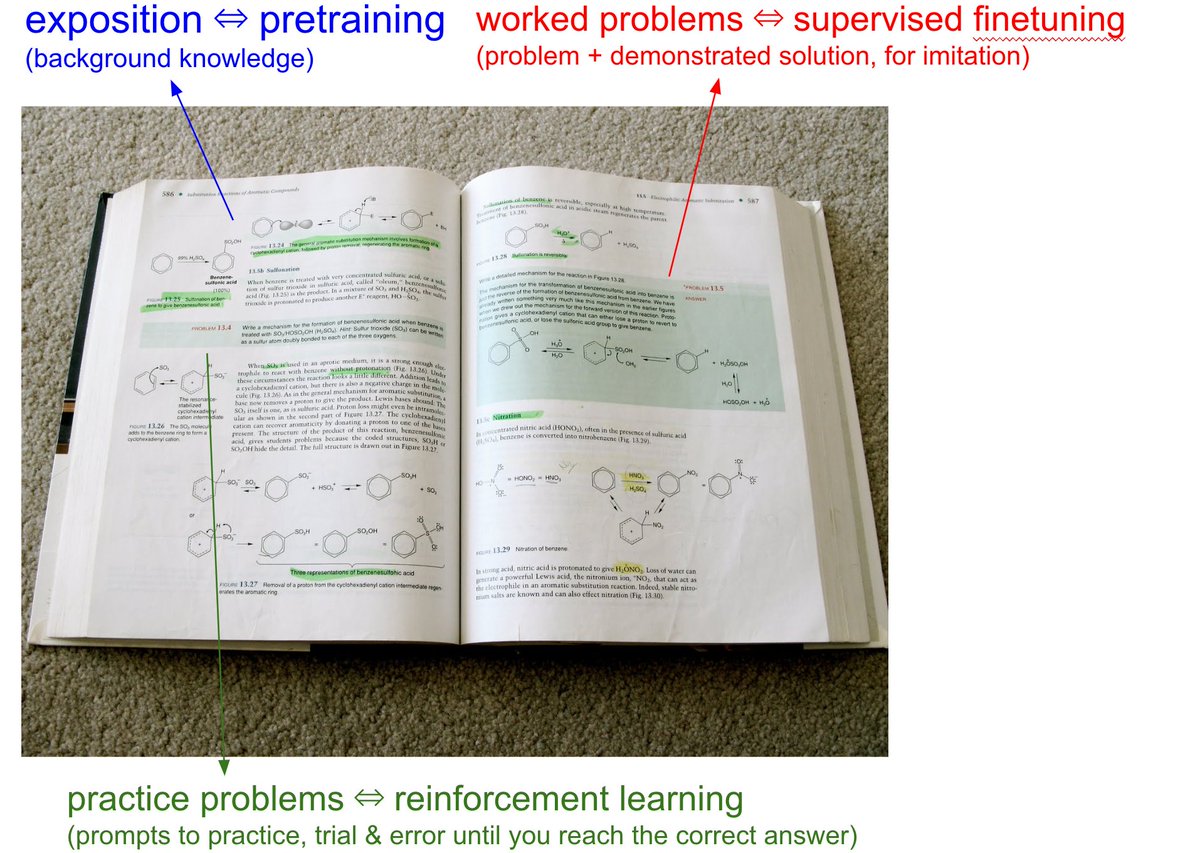
When you open any textbook, you'll see three major types of information:
1. Background information / exposition. The meat of the textbook that explains concepts. As you attend over it, your brain is training on that data. This is equivalent to pretraining, where the model is reading the internet and accumulating background knowledge.
2. Worked problems with solutions. These are concrete examples of how an expert solves problems. They are demonstrations to be imitated. This is equivalent to supervised finetuning, where the model is finetuning on "ideal responses" for an Assistant, written by humans.
3. Practice problems. These are prompts to the student, usually without the solution, but always with the final answer. There are usually many, many of these at the end of each chapter. They are prompting the student to learn by trial & error - they have to try a bunch of stuff to get to the right answer. This is equivalent to reinforcement learning.
We've subjected LLMs to a ton of 1 and 2, but 3 is a nascent, emerging frontier. When we're creating datasets for LLMs, it's no different from writing textbooks for them, with these 3 types of data. They have to read, and they have to practice.