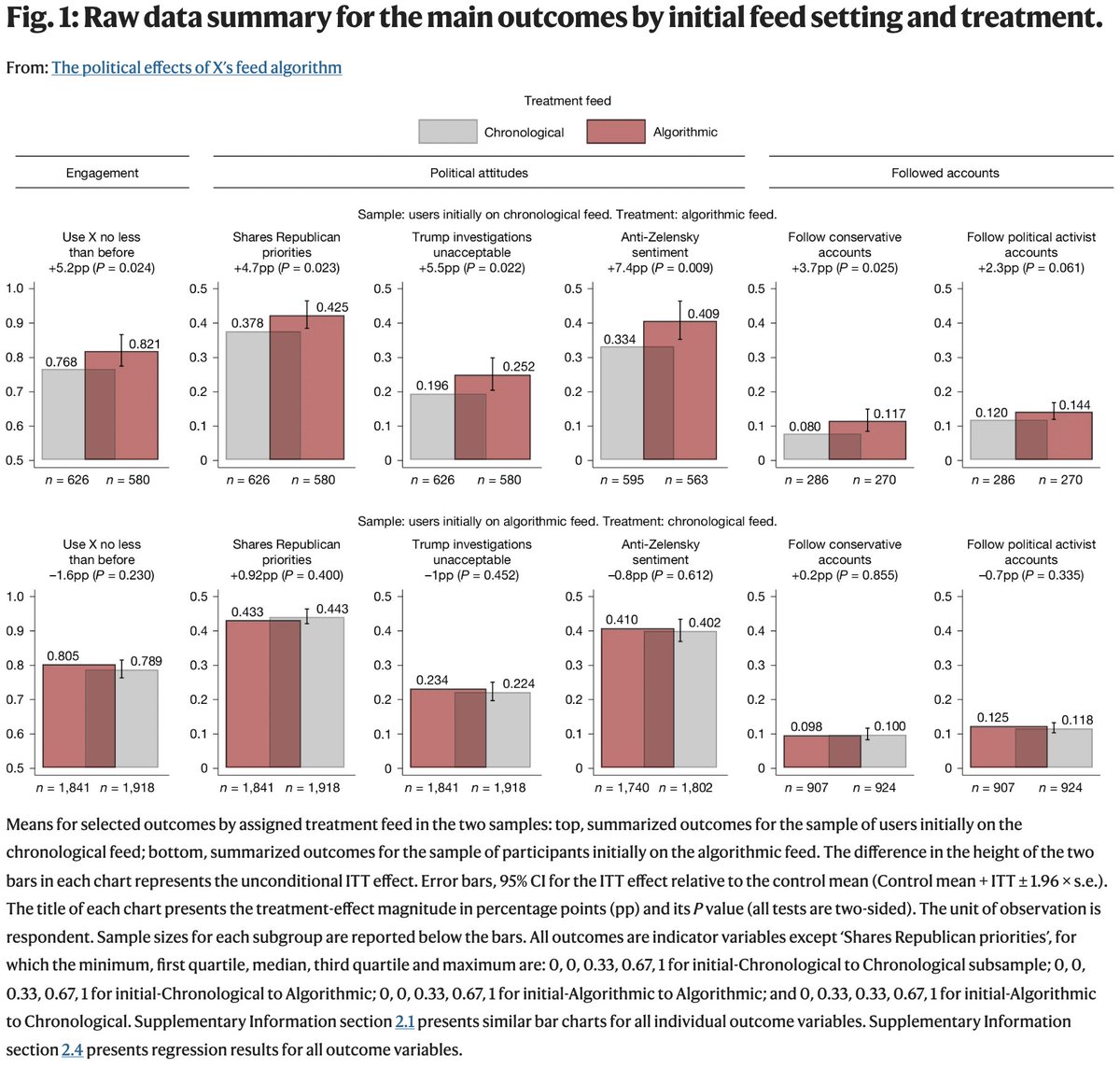
"We found that the algorithm promotes conservative content and demotes posts by traditional media (...) These results suggest that initial exposure to X’s algorithm has persistent effects on users’ current political attitudes and account-following behaviour"
Can feed algorithms shape what people think about politics? Our paper "The Political Effects of X's Feed Algorithm" is out today in @Nature and answers "Yes".
https://t.co/2h4NgHZSmb
📌 La Comissió Europea demana a Espanya que apugi l'IVA de bars, restaurants i hotels del 10 al 21% per fer augmentar la recaptació https://t.co/tjDzcDeWsI
Més enllà de si aquestes xifres són acurades, no sé si té gaire sentit parlar de decadències quan la qüestió, bàsicament, és que la Xina ha passat del 2% al 20% en 40 anys i això ha anat en detriment de tota la resta de manera prou equiparable...
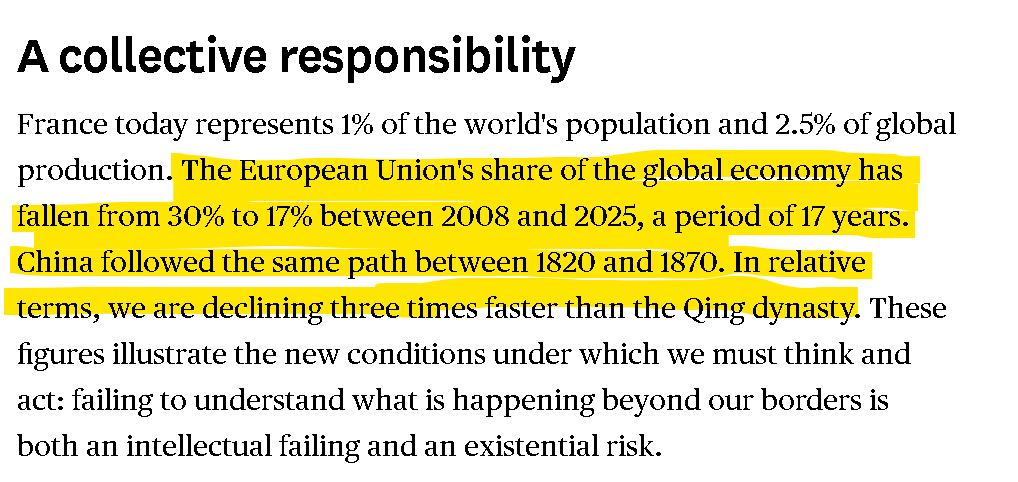
People don't grasp the sheer speed and scale of Europe's decline.
This 👇 is an extraordinary number shared by Luis Vassy, director of Sciences Po (one of France's most famous schools) in this article: https://t.co/BQbkXb2kPl
He calculated that the EU is declining 3 times faster than the Qing dynasty at the height of China's century of humiliation.
Back then, it took China 50 years to drop from 30% of world GDP to 17%, whereas it took the EU just 17 years (from 2008 to 2025).
Insane 😢 And, sadly, given the current direction and the EU's systematically suicidal policy choices (latest example: https://t.co/6EYJgdXVVo), it's just the beginning...
Shame on the Basque police @ertzaintzaEJGV for brutalising Flotilla members returning home after being abducted, unlawfully detained and ill-treated by Israel. May those responsible be held accountable.
We must resist the Israelisation of our societies.
Preview from an upcoming stack (with many, many interactive charts) on 🇪🇺vs🇺🇸
Whatever the productivity gap it is marginal and doesn't capture vast differences in material wellbeing. And 'relative decline' narrative could well rest on a methodological artefact.
Link in bio.
1/2
still not quite over the fact that i watched 15 year olds get sued for millions of dollars for downloading twelve songs and now we all have to accept AI slop because every tech company in the known universe decided that IP laws don't exist now that they're inconvenient for them
«El veritable debat dins de l'esquerra ha de servir per portar el poble des de la fragmentació de les seves opinions quotidianes cap a una visió del món unificada i conscient del seu propi poder».
A.Gramsci
Les jornades per la llengua de la @cupnacional, la trobada de l'esquerra sobiranista promoguda per Comunistes i l'informe econòmic que certifica que l'aposta de país per turisme massiu i sector porcí ha d'arribar a la seva fi són bones pistes de per on hem de fer camí.
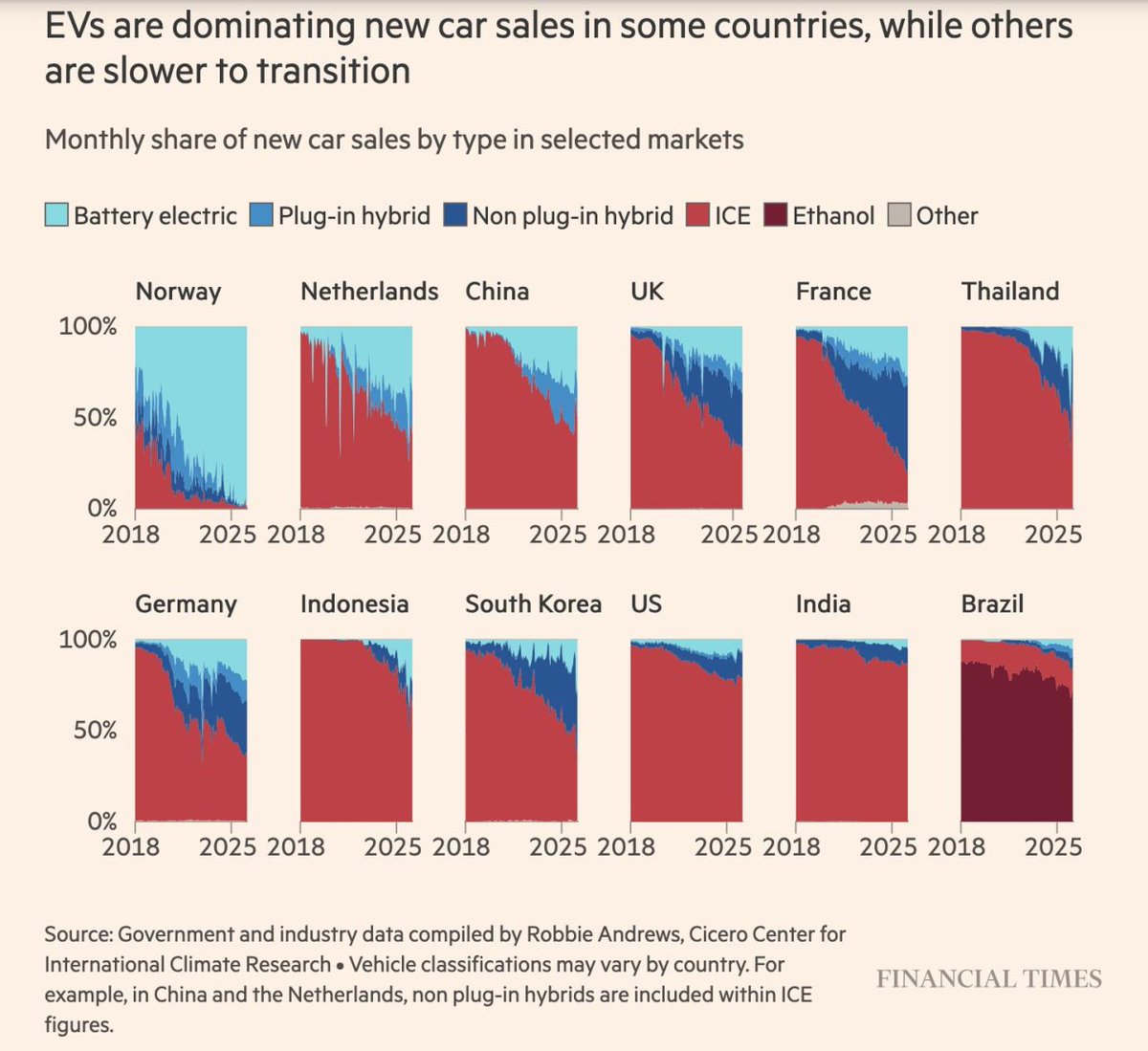
The global EV transition in one chart:
Leader: Norway
Almost there: Netherlands, China
Accelerating: U.K., France, Germany
Starting: Thailand, South Korea
Barely begun (yet still selling millions): U.S., India, Indonesia
Doing its own thing: Brazil (ethanol)
What's going on? Are neocons having a come-to-Jesus moment?
After Bob Kagan writing an article on how the U.S. is facing "total defeat" in Iran (see https://t.co/Io9xy1M8ks), you now have Max Boot - the very author of “The Case for American Empire” and one of the most vocal advocates for the Iraq war - publishing a Washington Post interview explaining that China has surpassed the U.S. in most military domains.
If anything, Boot’s interview is even more devastating than Kagan's piece, because it's not editorial opinion - he’s interviewing John Culver, a former top CIA analyst (he was national intelligence officer for East Asia) and one of the world’s foremost authorities on the Chinese military which he’s been studying since 1985.
This isn't a pundit opining - this is someone who spent decades inside the intelligence community staring at the actual data.
So what is Culver saying?
1) In case of war with Taiwan, the U.S. will flee the theater
This is undoubtedly the single most stunning revelation in the entire piece. Culver says that - as far as he is aware - the Pentagon’s plan in case of war with Taiwan is… flee!
This is the exact quote: "I think some of the thinking in the Pentagon, and it may have evolved since I retired, is that when we think there’s going to be a war, we need to get our high-value naval assets out of the theater, and then we would have to fight our way back in. From where, it’s not clear. Guam is no bastion either."
Why? Because, as he explains, any high-value U.S. assets would be sitting ducks in the entire area. China can strike U.S. forces deployed to Japan, Australia, or South Korea “in a way that Iran really can't” and, given that Iran has hit at least 228 targets across U.S. bases in the Middle East - forcing the U.S. to evacuate most of them - that's saying something. Also, U.S. aircraft carriers would need to operate within 1,000 miles of the fight to matter, which - given it’s well within range of Chinese missiles - they won’t.
As Culver bluntly puts it: “There's really no safe spaces.”
2) China leads in most military domains - and it's not even close
Culver says that “it’s hard to not be hyperbolic” about China’s military capabilities and that, at this stage, “it’s hard to point to an area other than submarines and undersea warfare and say the United States still has an advantage.”
In some critical areas, such as advanced munitions - which, when it comes to war, is pretty damn relevant - his assessment is that China leads by “magnitudes.” As a reminder, an order of magnitude means 10x so, by assuming he knows that and meant what he said, “magnitudes” means at least a hundred times more, meaning U.S. capabilities would be less than 1% those of China.
At the same time, Culver also says that “whichever side runs out of bullets first is going to lose.” So if China produces “magnitudes greater than our industrial base could produce” - as he puts it - then you don't need a PhD in military strategy to put two and two together…
The picture, if anything, is even more damning in shipbuilding capabilities. He reminds that a single shipyard in China - Jiangnan Shipyard, on Changxing Island near Shanghai - “has more capacity than all U.S. shipyards combined.”
Put all Chinese shipyards together and China’s broader naval shipbuilding capacity is 232 times larger than that of the United States (and this is from a leaked U.S. Navy briefing slide).
Culver helpfully adds that China “deploys enough ships every year to replicate the entire French navy” - which, as a Frenchman, hurts a little, but at least we'll always have the cheese (I hope).
3) Despite this, a war in Taiwan is highly unlikely
If your only window into China is Western media coverage, you'd naturally assume all of the above means war over Taiwan is about to break out. After all, if China is so powerful and the U.S. so outmatched, why wouldn't it just take Taiwan and be done with it?
Culver’s assessment - and mine, incidentally - is the exact opposite: China’s increasing relative strength vis-a-vis the U.S. makes war less likely, not more.
How so? As Culver explains Taiwan is “a crisis Xi Jinping wants to avoid, not an opportunity he wants to seize.” The stronger China gets, the less it needs to fight: why launch a war when you can simply wait for the military balance to become so lopsided that the U.S. quietly drops its security guarantee on its own? Culver himself foresees a future “when Americans might start to say, maybe Taiwan is a war we don’t want to get involved in.” That would almost automatically mean peaceful reunification, which has always been China’s primary objective.
This doesn't mean China views the U.S. as harmless. Quite the contrary - Culver says Beijing sees America “as a very militarily aggressive country” that is “declining in power and becoming more violent” as a result. Which he says is one further reason why “war over Taiwan is not something that Xi Jinping is looking for.”
China doesn't want to hand a pretext to a dangerously trigger-happy power - all the more when patience alone delivers what it wants.
4) The game is up
Last but not least, perhaps the most revealing aspect of the interview is that Culver doesn’t seem to see a way out: this is structural and irreversible.
Asked by Boot whether “the Trump administration’s $1.5 trillion defense budget, assuming it’s approved, [would] change the trend lines” (which, as a reminder, would constitute a 50% increase in defense spending), his reply is that “it would probably help to some extent, but I worry that we could be throwing good money after bad.” Not exactly brimming with optimism…
Similarly, when asked why the U.S. keeps investing billions in aircraft carriers and even “Trump-class battleships,” his answer is that it's because “the military services have a nostalgia for the things that meet their expectations for how you get promoted.” In other words, wasted money.
Same thing for the Pentagon's much-hyped “Hellscape” drone strategy to defend Taiwan. Culver asks the obvious question: “What drones are you talking about launching from where?” He points out that they’d “have to pre-deploy them if not on Taiwan itself then on Luzon or the Japanese southwest islands, all of which can be struck by the Chinese.” He adds that this is “the tyranny of time and distance when you look at war in the Pacific.”
The picture that emerges, both from Boot’s Culver interview and Kagan’s article, is remarkably consistent: the U.S. is “checkmate” in the Middle East, would need to entirely flee the Pacific theater before a war even starts, cannot produce enough weapons, cannot keep its supposed “allies” safe, and has no strategy to reverse any of it - nor can one even be produced given the structural nature of the gap. Even a 50% increase in defense spending, Culver says, would be “throwing good money after bad.” That's not my assessment - that's theirs.
Two of America's most prominent hawks, in two of its most establishment outlets, in the space of 48 hours, have essentially published the obituary of American military primacy.
Yesterday I concluded my post by saying that even the arsonists now smell the smoke. Today I'll say: the arsonists are now writing the fire report.
EXCLUSIVE: Trump's abrupt U-turn on a plan to reopen the Strait of Hormuz came after Saudi Arabia suspended U.S. access to its bases and airspace. https://t.co/ugxw2ilzpD
I will repeat again that the idea that states have a right to exist is by definition a fascist idea and originated specifically within the history of European fascism. It is the core of fascism as a political theory
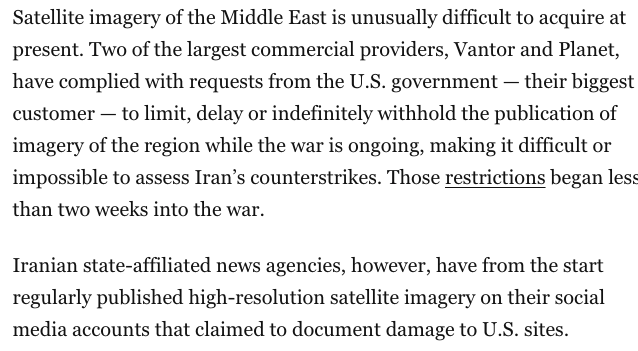
This story details the enormous damage Iran inflicted on US military installations in the Middle East. But incredibly the Post had to rely on IRANIAN IMAGERY to report it out because Trump is blocking commercial satellite images. Why? Not to fool Iran - just American citizens.
China is far more dependent on imported food/feed than either the US or the EU. In a world of "food regimes", this is a highly unusual and unique development.
🔸New: Israeli Court Extends Detention of Abducted Flotilla Activists by Two Days
An Israeli court in Ashkelon extended the detention of Global Sumud Flotilla activists Thiago de Avila and Saif Abukeshek until May 5, following their abduction by the Israeli navy in international waters on April 30, according to Adalah, the Palestinian legal rights organization representing them.
The state sought a four-day extension, citing suspicions including assisting the enemy during wartime and membership in a “terrorist” organization. No formal charges have been filed.
Adalah attorneys argued the entire proceeding is illegal, saying Israel has no jurisdiction over foreign nationals seized in international waters. Both men, who have testified to beatings, isolation, and blindfolding amounting to torture, are continuing their hunger strike.
Source: Adalah
📸 By Yoav Etiel, Walla
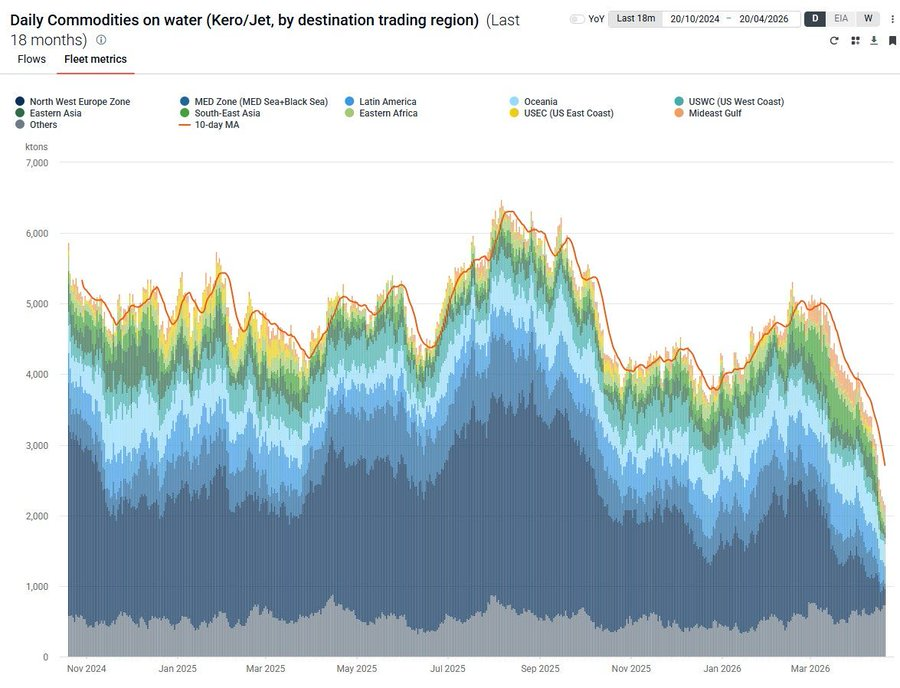
Jet fuel exports on water are in free fall
People might think of going on holiday as a luxury, but the whole travel and tourism industry is dependent on it
- Travel and tourism account for 10% of global GDP
- 60% of global tourists travel by air
- 1/3 of world trade by value is sent by air
- Air cargo accounts for $8 trillion worth of goods
A true jet fuel shortage would have far-reaching consequences










![RnaudBertrand's tweet photo. What's going on? Are neocons having a come-to-Jesus moment?
After Bob Kagan writing an article on how the U.S. is facing "total defeat" in Iran (see https://t.co/Io9xy1M8ks), you now have Max Boot - the very author of “The Case for American Empire” and one of the most vocal advocates for the Iraq war - publishing a Washington Post interview explaining that China has surpassed the U.S. in most military domains.
If anything, Boot’s interview is even more devastating than Kagan's piece, because it's not editorial opinion - he’s interviewing John Culver, a former top CIA analyst (he was national intelligence officer for East Asia) and one of the world’s foremost authorities on the Chinese military which he’s been studying since 1985.
This isn't a pundit opining - this is someone who spent decades inside the intelligence community staring at the actual data.
So what is Culver saying?
1) In case of war with Taiwan, the U.S. will flee the theater
This is undoubtedly the single most stunning revelation in the entire piece. Culver says that - as far as he is aware - the Pentagon’s plan in case of war with Taiwan is… flee!
This is the exact quote: "I think some of the thinking in the Pentagon, and it may have evolved since I retired, is that when we think there’s going to be a war, we need to get our high-value naval assets out of the theater, and then we would have to fight our way back in. From where, it’s not clear. Guam is no bastion either."
Why? Because, as he explains, any high-value U.S. assets would be sitting ducks in the entire area. China can strike U.S. forces deployed to Japan, Australia, or South Korea “in a way that Iran really can't” and, given that Iran has hit at least 228 targets across U.S. bases in the Middle East - forcing the U.S. to evacuate most of them - that's saying something. Also, U.S. aircraft carriers would need to operate within 1,000 miles of the fight to matter, which - given it’s well within range of Chinese missiles - they won’t.
As Culver bluntly puts it: “There's really no safe spaces.”
2) China leads in most military domains - and it's not even close
Culver says that “it’s hard to not be hyperbolic” about China’s military capabilities and that, at this stage, “it’s hard to point to an area other than submarines and undersea warfare and say the United States still has an advantage.”
In some critical areas, such as advanced munitions - which, when it comes to war, is pretty damn relevant - his assessment is that China leads by “magnitudes.” As a reminder, an order of magnitude means 10x so, by assuming he knows that and meant what he said, “magnitudes” means at least a hundred times more, meaning U.S. capabilities would be less than 1% those of China.
At the same time, Culver also says that “whichever side runs out of bullets first is going to lose.” So if China produces “magnitudes greater than our industrial base could produce” - as he puts it - then you don't need a PhD in military strategy to put two and two together…
The picture, if anything, is even more damning in shipbuilding capabilities. He reminds that a single shipyard in China - Jiangnan Shipyard, on Changxing Island near Shanghai - “has more capacity than all U.S. shipyards combined.”
Put all Chinese shipyards together and China’s broader naval shipbuilding capacity is 232 times larger than that of the United States (and this is from a leaked U.S. Navy briefing slide).
Culver helpfully adds that China “deploys enough ships every year to replicate the entire French navy” - which, as a Frenchman, hurts a little, but at least we'll always have the cheese (I hope).
3) Despite this, a war in Taiwan is highly unlikely
If your only window into China is Western media coverage, you'd naturally assume all of the above means war over Taiwan is about to break out. After all, if China is so powerful and the U.S. so outmatched, why wouldn't it just take Taiwan and be done with it?
Culver’s assessment - and mine, incidentally - is the exact opposite: China’s increasing relative strength vis-a-vis the U.S. makes war less likely, not more.
How so? As Culver explains Taiwan is “a crisis Xi Jinping wants to avoid, not an opportunity he wants to seize.” The stronger China gets, the less it needs to fight: why launch a war when you can simply wait for the military balance to become so lopsided that the U.S. quietly drops its security guarantee on its own? Culver himself foresees a future “when Americans might start to say, maybe Taiwan is a war we don’t want to get involved in.” That would almost automatically mean peaceful reunification, which has always been China’s primary objective.
This doesn't mean China views the U.S. as harmless. Quite the contrary - Culver says Beijing sees America “as a very militarily aggressive country” that is “declining in power and becoming more violent” as a result. Which he says is one further reason why “war over Taiwan is not something that Xi Jinping is looking for.”
China doesn't want to hand a pretext to a dangerously trigger-happy power - all the more when patience alone delivers what it wants.
4) The game is up
Last but not least, perhaps the most revealing aspect of the interview is that Culver doesn’t seem to see a way out: this is structural and irreversible.
Asked by Boot whether “the Trump administration’s $1.5 trillion defense budget, assuming it’s approved, [would] change the trend lines” (which, as a reminder, would constitute a 50% increase in defense spending), his reply is that “it would probably help to some extent, but I worry that we could be throwing good money after bad.” Not exactly brimming with optimism…
Similarly, when asked why the U.S. keeps investing billions in aircraft carriers and even “Trump-class battleships,” his answer is that it's because “the military services have a nostalgia for the things that meet their expectations for how you get promoted.” In other words, wasted money.
Same thing for the Pentagon's much-hyped “Hellscape” drone strategy to defend Taiwan. Culver asks the obvious question: “What drones are you talking about launching from where?” He points out that they’d “have to pre-deploy them if not on Taiwan itself then on Luzon or the Japanese southwest islands, all of which can be struck by the Chinese.” He adds that this is “the tyranny of time and distance when you look at war in the Pacific.”
The picture that emerges, both from Boot’s Culver interview and Kagan’s article, is remarkably consistent: the U.S. is “checkmate” in the Middle East, would need to entirely flee the Pacific theater before a war even starts, cannot produce enough weapons, cannot keep its supposed “allies” safe, and has no strategy to reverse any of it - nor can one even be produced given the structural nature of the gap. Even a 50% increase in defense spending, Culver says, would be “throwing good money after bad.” That's not my assessment - that's theirs.
Two of America's most prominent hawks, in two of its most establishment outlets, in the space of 48 hours, have essentially published the obituary of American military primacy.
Yesterday I concluded my post by saying that even the arsonists now smell the smoke. Today I'll say: the arsonists are now writing the fire report.](https://pbs.twimg.com/media/HIFMk0mbMAAA8DI.jpg)