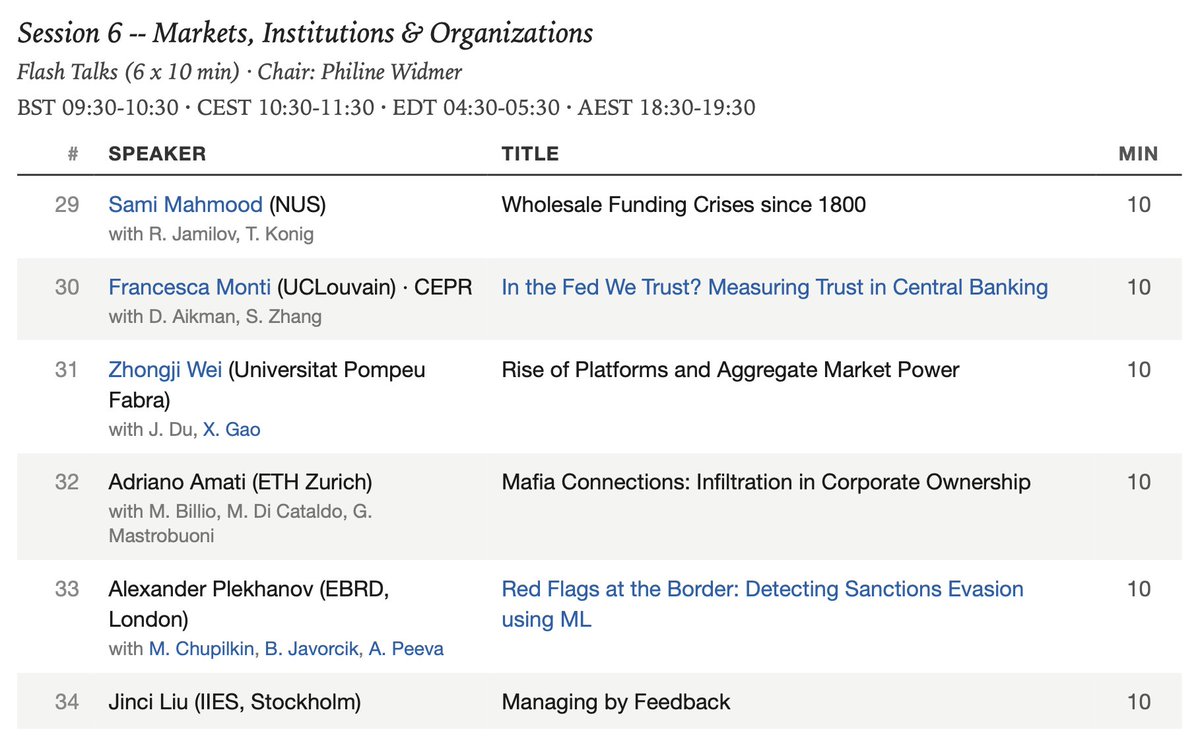
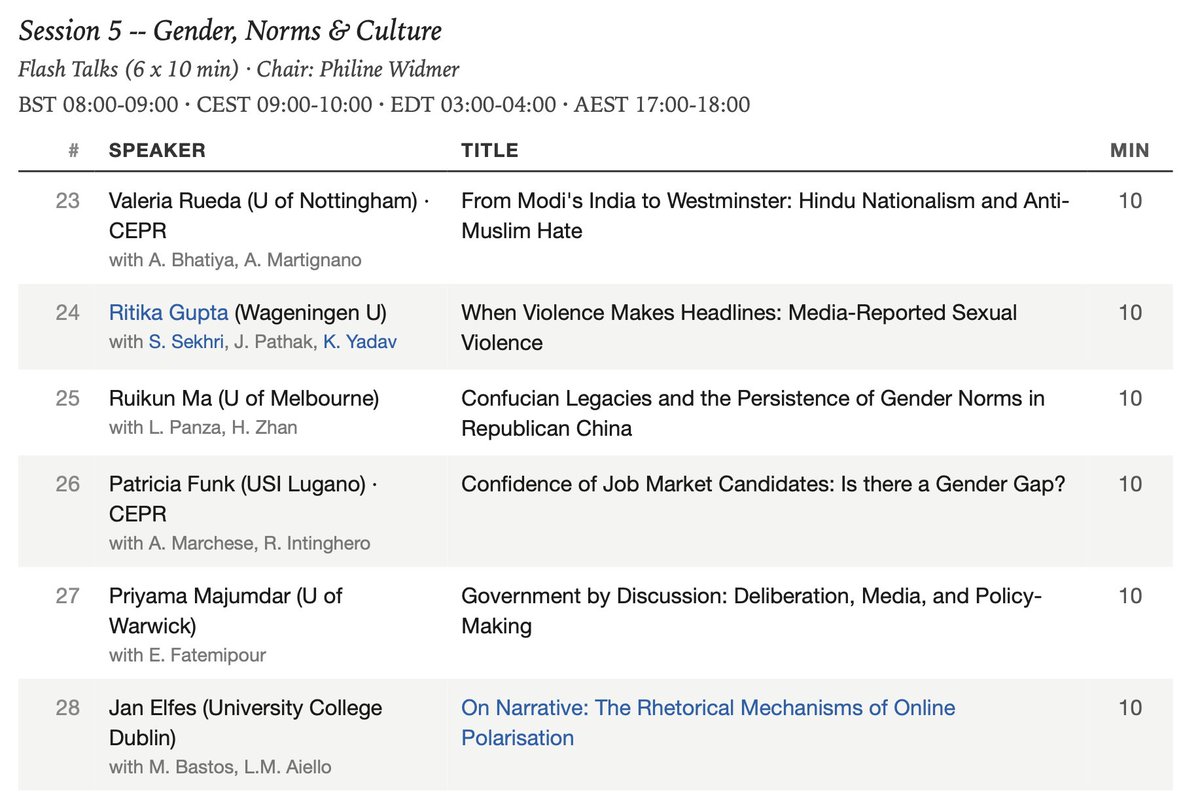
We have started the second day of the MPWZ-CEPR Text-as-Data Workshop (already the 11th edition).
Join us here: https://t.co/tzxcFIF6oE
Text-as-data is being used across economics now -- from projects on gender norms to central bank trust, mafia networks, and sanctions evasion, to superstar scientists and AI patents 📈📊
@cepr_org@ellliottt
@JeremyNguyenPhD Unfortunately, no. But you can still join us for the remaining 6 sessions. In any case, feel free to sign up here to become part of our community: https://t.co/3jU6kji21J
We have just kicked off the 11th edition of the MPWZ-CEPR Text-as-Data Workshop! We will "time-travel" with LLMs, measure trust in institutions, track political narratives, and much more! 40 papers, one link: https://t.co/I9eubBqvDs.
See the program: https://t.co/jpHWiuCkoM
📢#CallForPapers
Submissions are now welcome for the 11th Monash-Paris-Warwick-Zurich-CEPR Text-As-Data Workshop. Papers using text, audio, images, or other unstructured data are welcome.
📅Deadline: 13 March
Organisers: @ellliottt @essobecker & @phinifa
https://t.co/yCQvk8Fysz
@ItsEasypop@PinchOfData@kylascan@Nature It is not a trivial question to disentangle user preferences from algorithmic influence, see e.g., https://t.co/78Wf48yrOH.
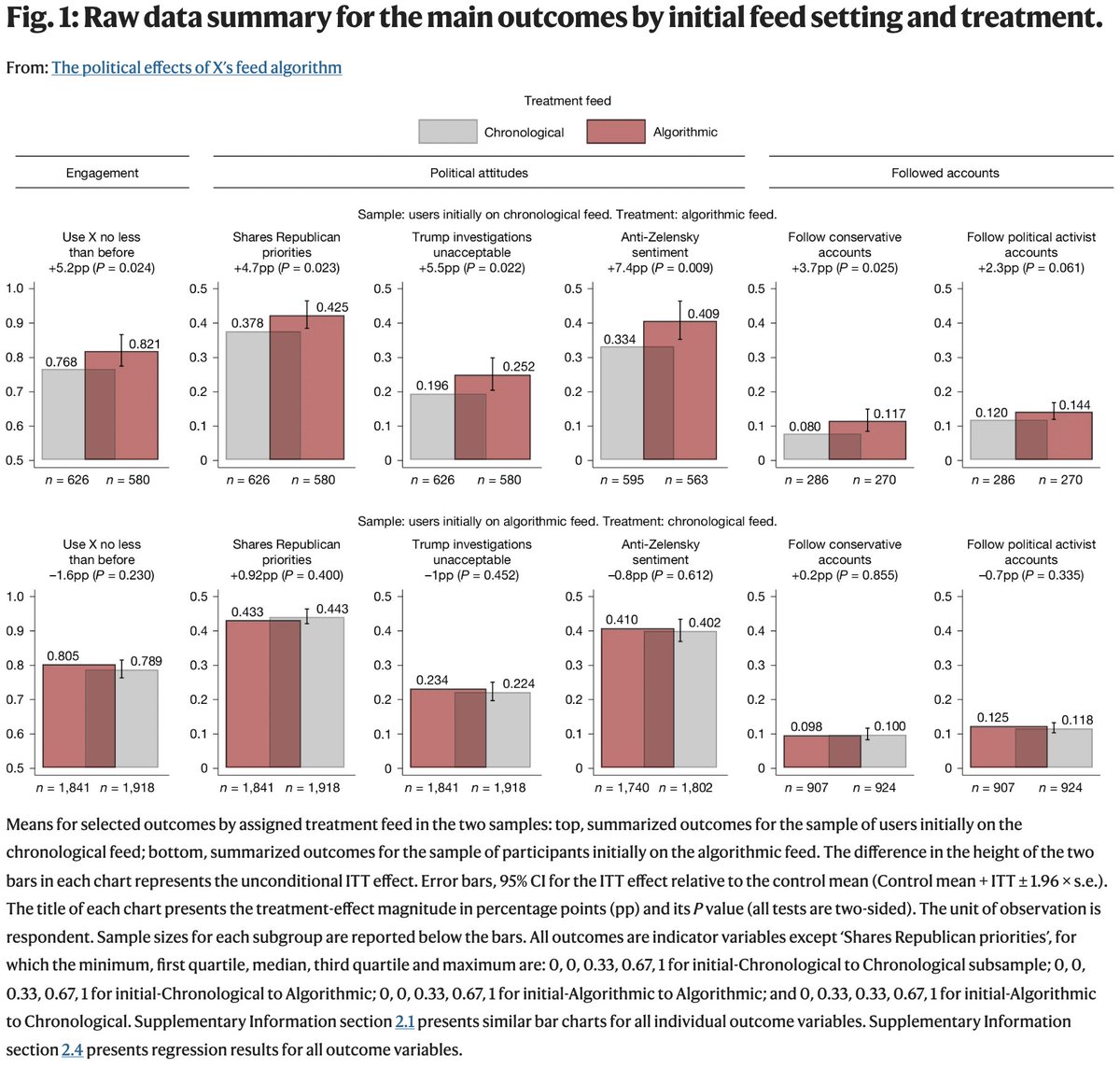
Can feed algorithms shape what people think about politics? Our paper "The Political Effects of X's Feed Algorithm" is out today in @Nature and answers "Yes".
https://t.co/2h4NgHZSmb
Fully agree: these effects should be studied over long periods. One way to look at the scientific contribution: we didn't have much quantitative evidence that feed algorithms matter for political opinions. We now provide this piece of quantitative evidence. Evidently, algorithms & platforms also change over time, so it's necessarily an ongoing task for researchers & societies to monitor the algorithms millions of people use every day.
@jon_m_rob As expected, partisans see less cross-partisan than co-partisan content in their feeds. However, the share of conservative content among political content is higher under the algorithm for both Democrats and Republicans.
@jon_m_rob In *absolute* terms, there's more liberal content *in our sample* because 46% are Dems and 21% Reps (more Dems on the YouGov panel). Btw, in heterogeneity analyses, we find that our effects are driven by Reps & Independents.
@cremieuxrecueil I beg to disagree. We don't represent opaque dimensions, but summarize individual outcomes that all point in the same direction. Most important: nothing is hidden. You can see all individual items that go into PCA and decide for yourself on which side of the axis you see the mass
@cremieuxrecueil PCA is a mechanical, data-driven procedure, not a "nonsense" index. The deeper point is that the individual outcomes point in the same direction.
@leonardotoledo On the "economists measuring media effects": the paper is published in Nature. The named reviewers include computational social scientists, media scholars, and political scientists. At the end of the day, we are all just scientists curious about how the media affects societies.
@leonardotoledo We find heterogeneous effects (it's driven by Republicans & Independents), identify a mechanism (changes in following behavior, not just passive exposure), and show asymmetric results
(turning the algorithm on shifts opinions; turning it off doesn't).
We ran this experiment independently: no platform cooperation, no corporate funding. Instead, it was funded by the Swiss National Science Foundation (@snsf_ch).