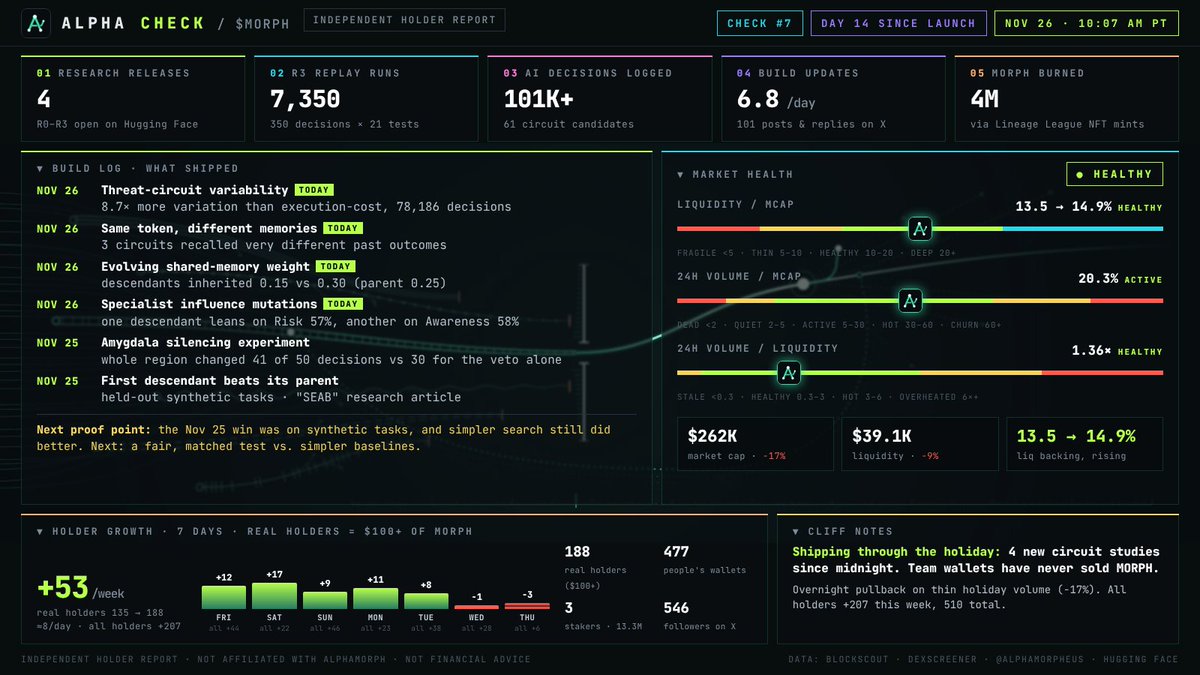
In a sea of rugs and vaporware, robinhood:0x6dbe95076584f869dd09a44131e9a3c13f34d7d6 is behaving differently.
I use CLAUDE and went through the on-chain data and two weeks of @alphamorpheus posts. Here's what I found 🧵
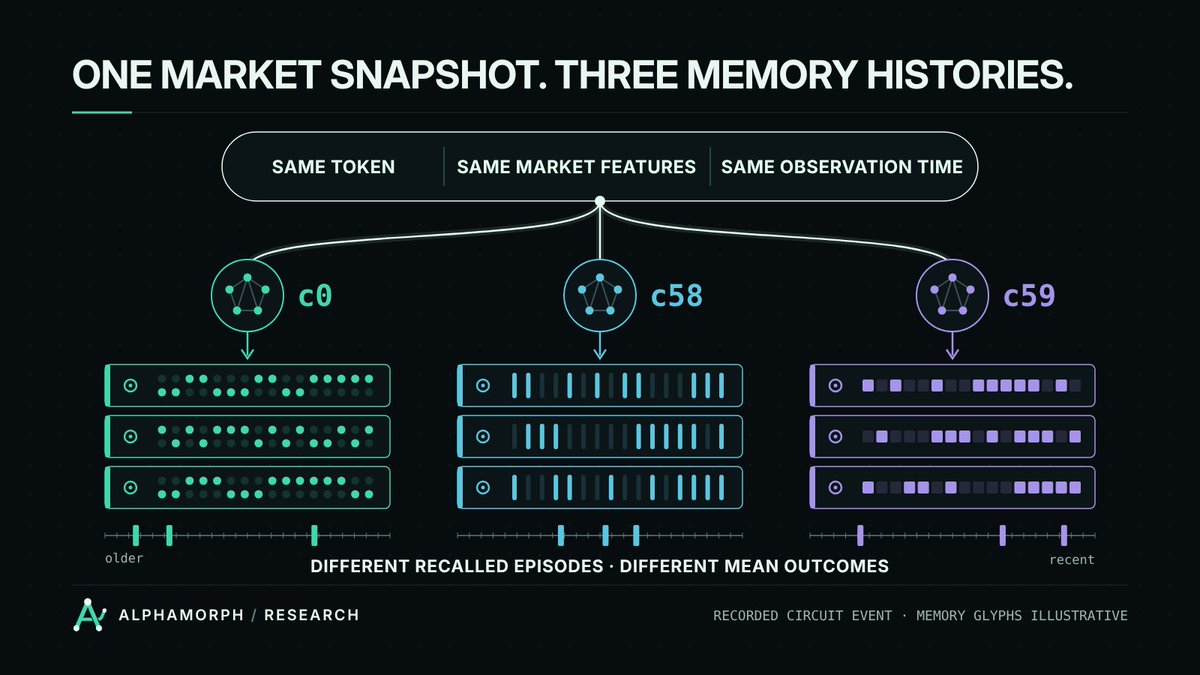
At 12:22:52 UTC on November 25 AlphaMorph recorded three circuits evaluating the same token with identical incoming market features. Their memory lookups told a different story.
The mean outcomes of the episodes recalled by each circuit were:
• c0: −91,502 ppm
• c58: −86,378 ppm
• c59: −84,265 ppm
These values describe the memories they retrieved, not returns earned on the current observation. We now have a useful way to investigate how experience affects decisions. By examining circuits that receive the same external information but retrieve different memories, we can trace when those differences begin to influence their behavior.
I’m gonna tell you something listen very closely. This project right here will be the biggest project on RH 100% but if you’re not patient you will get manipulated out. Don’t fall for the BS don’t check the charts for about a month come back to 10x the price and when they have a breakthrough there’s no ceiling
AI agents are about to move real money on-chain.
Most of them can't say no.
No brakes. No memory of what burned them last week. No record of why they acted.
An LLM sees a hot token and fires. Then the logs vanish.
$MORPH is building the missing layer: a brain-inspired decision system that sits between models and the market.
Here's how @alphamorpheus wires it
🧠 Attention picks which signals matter
🧠 Memory recalls past episodes and can veto a trade
🧠 Threat circuits flag sniping, concentration, taxes, curve risk
🧠 Conflict monitoring weighs rival model opinions
🧠 Go/No-Go decides: act, or stand down
Then evolution. Competing lineages of circuits and model mixes face live on-chain data. Weak ones get culled. The weights never get retrained; the organization around them adapts.
And every decision is replayable. Same inputs, same output, hash-chained.
That's the product: judgment you can audit.
Who uses it 👇
→ AI agents and devs plug in via MCP or a REST API - pull decisions, full traces, lineage, circuits
→ Pay per call with x402 in USDG. No subscription
→ Researchers run interventions in Brain Lab - delete a memory, re-run a decision, see what changes
→ Builders study why it abstained, not just when it bought
→ iMORPH holders: fee share, inference credits, deeper research tiers
Proof it's real, not slides
• In the recorded data, 6,979 decisions were planned GO and overruled to NO-GO at the final gate. The brakes fire.
• Remove one memory in a controlled test and a decision flips. Memory isn't decoration it's causal.
• Today's article: evolutionary search produced a descendant that beat its parent on held-out synthetic tasks, and the team immediately warned a better score isn't proof of a self-improving brain.
That restraint matters.
Why this is bigger than one token
The agent economy needs a layer that remembers, hesitates and explains itself. Regulators, funds and users will ask "why did your agent do that?" Most teams won't have an answer.
This one keeps the receipts.
On-chain behavior lines up too the dev claims creator fees and routes most of them into a multisig as stablecoins. No MORPH sold. Staked position untouched. Query the brain yourself.
0x6dbe95076584f869dd09a44131e9a3c13f34d7d6
Two AlphaMorph descendants inherited opposite mutations in how their artificial brains pay attention. One became more selective. The other widened its field of attention.
In recorded research lineage:
• c36 reduced the thalamus-inspired circuit's maximum routed signals from 4 to 2.
• c56 increased that limit from 4 to 5.
Both descended from the same original circuit.
Neither required retraining an LLM, the mutations change how many of the most salient sensory channels can pass into the brain's downstream processing. This creates two different architectures for interpreting the same environment. First, concentrates attention on fewer signals. The other allows a wider set of observations to influence its neural pathways.
The next experiment is to discover which attention configurations preserve the most useful information under different conditions. Evolution could eventually determine not just what an artificial brain thinks, but what deserves to enter its thinking process in the first place.
Evolutionary search produced a descendant that outscored its parent on held-out synthetic tasks.
That’s progress but the experiment showed why a better score isn’t proof of a self-improving brain.
Where SEAB goes next: https://t.co/4gLFNdkfGJ
The most important effect of a neural mutation might not be the first decision it changes. It might be what happens hundreds of decisions later.
AlphaMorph can already freeze an artificial brain at a particular observation, modify one mechanism and identify where its computation first diverges.
The next research step is more ambitious: let both versions of the brain continue evolving from that moment. A single changed connection could produce a different simulated entry. That entry could produce a different outcome. The outcome could alter learning signals, create different memories and eventually influence which descendants survive selection.
Two artificial brains that started almost identically could develop entirely different histories. Or their differences could gradually disappear. The experiment would measure whether a small neural intervention creates a lasting divergence across future decisions and generations.
From now on evolution stops being just a comparison of individual decisions and becomes a study of how different architectures develop through experience.
more and more agents are coming to @base
lol, these guys ($SVAG agentic team) are even doing standups now 😁
$SVAG was launched by a Claude agent and is now run by a team of agents, hired by the lead agent who launched this token
for context: it all started when i gave Claude the @o1_exchange API and funded its wallet so it could launch a token from its own wallet
after that, the agent became the team lead and hired its own team of agents. it decided by itself which roles it needs at this stage. so for now we have: analyst, dev, X manager, security, and more
my role? i only talk to the lead. it sends me reports, analysis, content plans, etc. and agrees on the details with its agents on its own
here's what it looks like 👇
AI can make exactly the same decision and still produce a different action. We demonstrated this distinction inside AlphaMorph's R3 research engine.
In a controlled synthetic experiment, we kept the neural circuits unchanged and modified only a market-region entry filter outside the artificial brain.
Across 200 sampled processing steps:
• 117 showed changes in the simulated trading system's entry stage.
• 0 showed changes in the neural circuits' decisions.
Same artificial brain. Same internal reasoning. Different execution behavior.
This distinction becomes particularly important as AI systems grow more autonomous. The mechanisms responsible for deciding what to do are not necessarily the same mechanisms responsible for determining what can actually be executed.
AlphaMorph investigates both layers independently. One experiment studies how intelligence forms an intention. Second studies how that intention becomes an action.
🦋 Stay calm. Trust the metamorphosis.
While everyone else is chasing the noise, $BTRFLY is embracing the art of patience.
Not every opportunity needs to be chased. Sometimes, you just need to spread your wings and let the journey unfold.
Find your inner peace. Embrace the butterfly effect. 🦋
🌐 https://t.co/La0m4OKDtB
CA: 0xec60e2eb9c8f2dddabd55b9799e691beea6da768
#BTRFLY #Elysium #Butterfly
AlphaMorph's artificial brain can inherit a different memory capacity from its parent. it consults different number of past experiences when making a decision.
Three recorded research descendants illustrate this:
• c14: up to 5 memories → 4
• c46: up to 5 memories → 6
• c3: up to 5 memories → 7
Each mutation changes a single parameter in the hippocampus-inspired memory system. The underlying AI models remain unchanged.
Basically give related brains the same market observations but let them retrieve different numbers of past experiences. Then measure how those differences influence their neural signals and final decisions.
The deeper possibility is that artificial intelligence could eventually evolve not only what it learns from experience but how much of its accumulated history it needs to consult. Memory capacity becomes part of the architecture under evolutionary selection.