Jesus follower, Son, Brother, Hubby, Daddy, Pastor. Women belong in ministry. NE Patriots. NDSU. Oxford comma-Stan. 3w2. ENFJ. *All my own thoughts & opinions.*
Agatha Christie knew poisons so well, her books have been consulted when diagnosing patients. In 1976, a London infant was dying of a rare illness. Her nurses, having read The Pale Horse, realized she had been poisoned with thallium. Murder mysteries saved her life.
My daughter and I were watching Star Wars. She asked why Luke was climbing inside the Tauntaun.
“To keep warm,” I said.
She thought about it for a second, then asked, “How warm is it in there?”
I looked at her and replied, “Lukewarm.”
The most powerful protection against childhood depression is having a mother who values religion.
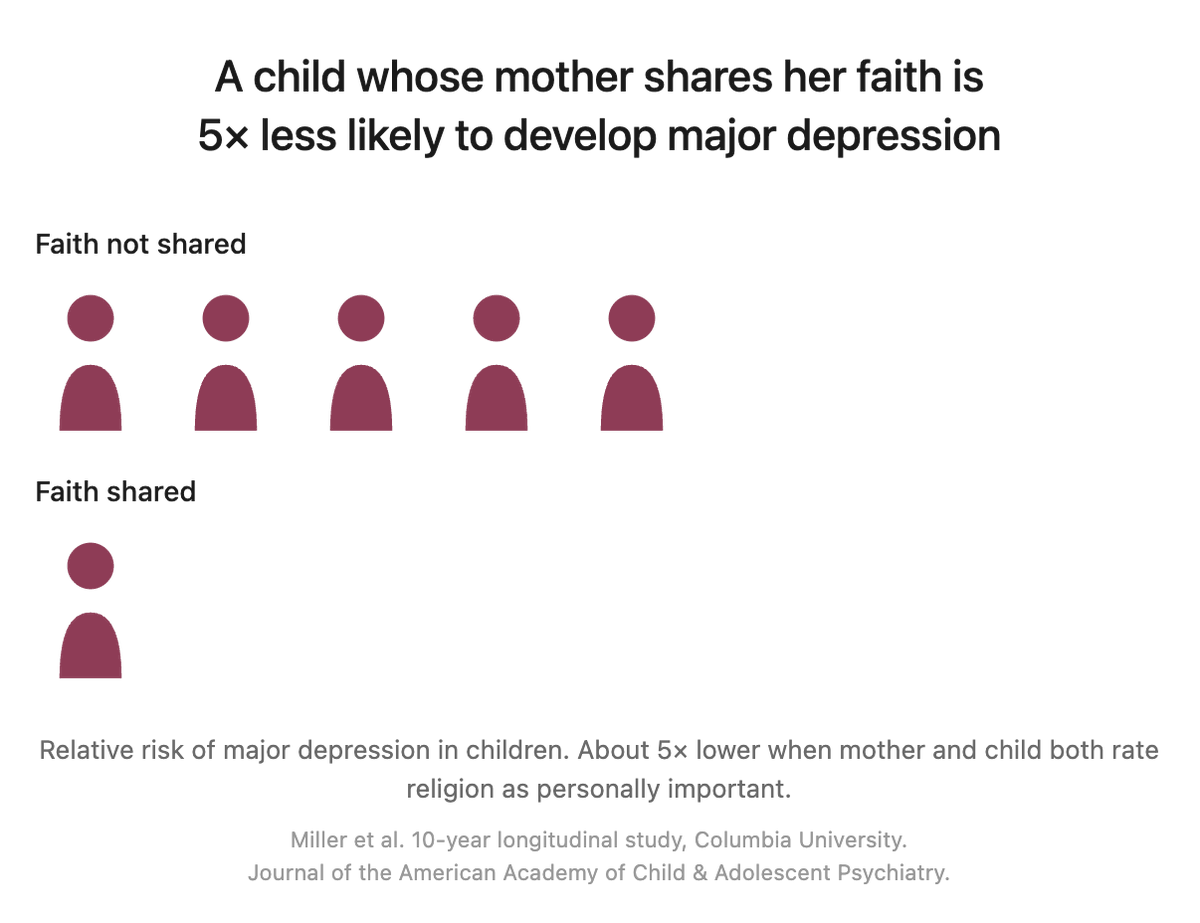
When a mother and her child both said religion was personally important to them, the child was 80 percent less likely to develop major depression.
Five times lower risk.
That comes from a 10-year longitudinal study at Columbia led by psychologist Lisa Miller. It's the largest protective effect against depression she has found anywhere in the resilience literature.
A decade later, Miller's team put adults from the same cohort in MRI machines. People who rated religion or spirituality as personally important had thicker cortices in the exact brain regions that thin in people at high familial risk for depression. The protection has a physical signature.
The variable wasn't belief alone. It was shared, internalized importance. Mom and child both meant it.
The strongest known buffer against depression in kids is a parent and child who share a faith that actually means something to both of them.
"If I told you there was one free thing you could do every Sunday that would make your kids happier, healthier, smarter, and closer to you, you'd think I was selling something."
Take your kids to church regularly. I don't care if you believe. The data is so lopsided that skipping it is the parenting equivalent of refusing vegetables because you don't like the taste.
Grades. Religious teens get As at almost twice the rate of nonreligious teens. In a class of 100, that's 24 A-students instead of 14. Church gives a kid the same academic boost as being born rich instead of poor.
College. Working-class religious kids earn bachelor's degrees at double the rate of their nonreligious peers. Middle-class kids do it at 1.5x the rate. For families without a trust fund, this is one of the most powerful forms of upward mobility social scientists have measured.
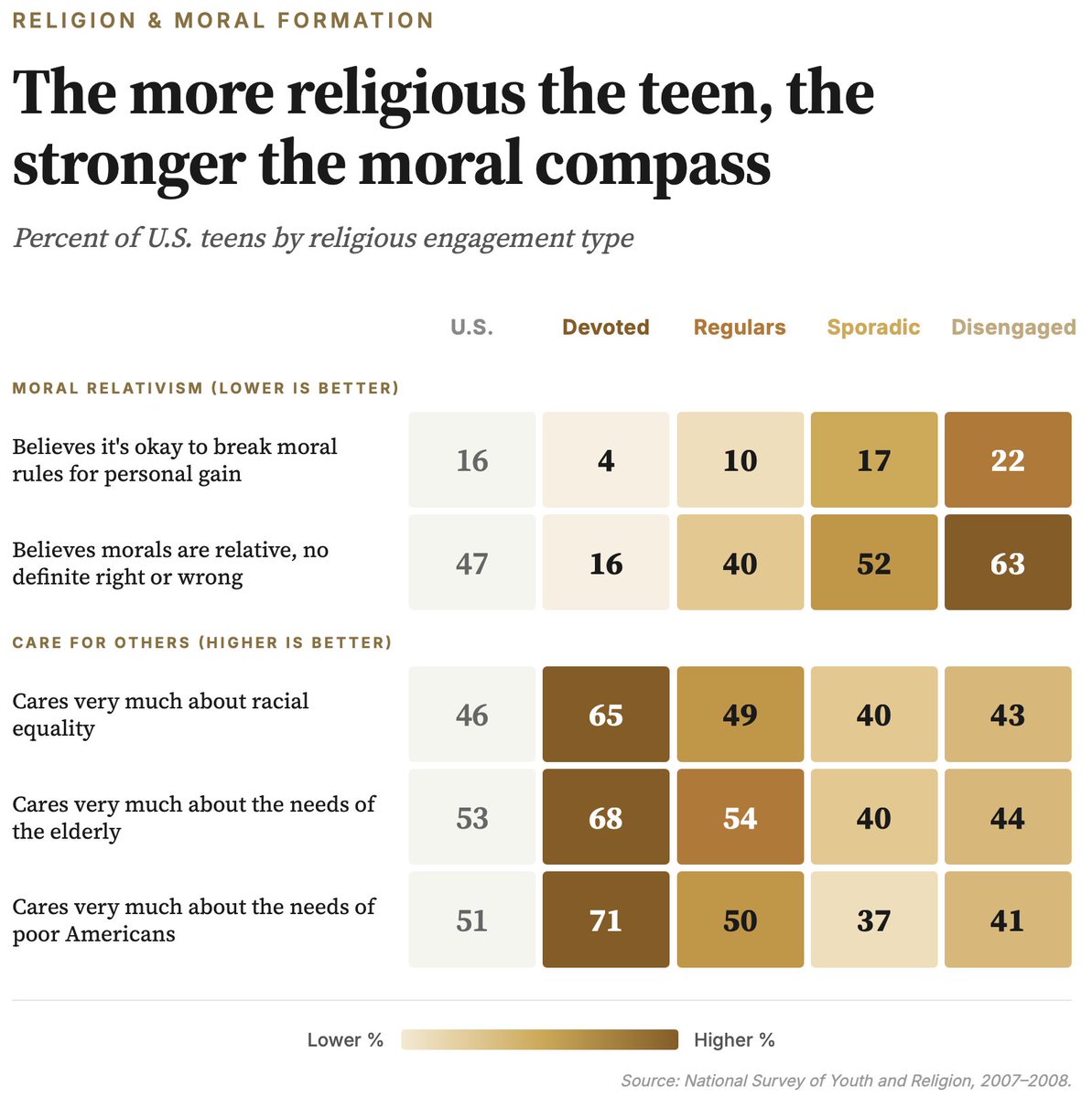
Character. Religious teens are far less likely to lie, cheat, or do things they hope their parents never find out about. They're more likely to care about racial equality, the elderly, and the poor. They reject the idea that morality is whatever works for you in the moment. That kind of kid doesn't happen by accident. It's built.
Closeness. 60% of parents of religious teens say they feel "extremely close" to their kid, compared to 50% of nonreligious parents. The kids report the same thing back. They get along better with their parents, talk about hard stuff, and actually want to spend time with their family.
Despair. Religious teens are dramatically less likely to be depressed, anxious, lonely, or feel that life is meaningless. 90% of devoted religious teens never binge drink, compared to 41% of the disengaged. Economists named the modern epidemic "deaths of despair." Regular church attendance is one of the strongest known buffers against it. Parents are spending fortunes trying to solve teen mental health. The most evidence-backed intervention is free.
Purpose. Religious young adults report higher purpose, gratitude, life satisfaction, and resilience. These are the exact traits every parent says they want their kid to have.
Here's why it works. Affluent families already surround their kids with networks of stable, accomplished adults through neighborhoods, schools, and parents' colleagues. Working and middle-class families usually don't. A congregation is often the last institution in American life that puts your kid in weekly contact with dozens of stable, employed, sober adults who know their name. It used to be called "a village." Now it barely exists outside of churches.
"But I don't believe." Your kid doesn't need your theology. They need you to show up.
"But church is boring." So is sitting through a kindergarten music recital. Parenting is the deliberate choice to be bored on purpose for someone you love.
There's a church within 15 minutes of nearly every American home. You don't need money, connections, or credentials to walk in. Nothing else in this country will surround your kid with engaged adults, teach them moral seriousness, and give them a stable weekly rhythm at zero cost.
You already drive them to practices that produce far less. The free thing on Sunday produces more, on more dimensions, than almost anything else you do as a parent.
You don't have to believe anything. You just have to take them.
Sunday sneaks up on pastors the way Monday sneaks up on everyone else.
It's Friday.
Somewhere right now:
A senior pastor is staring at a half-written sermon thinking "wait, that's in 48 hours?"
The worship pastor's vocalist just texted that she's got strep.
The kids pastor is one volunteer short for the 2s and 3s.
The XP is running the giving numbers and hoping they hold.
Somebody's spouse is wondering what day of the week you last had a full conversation.
You might need to hear this today. So let me say it...
This Sunday, somebody is going to walk into your building carrying something they haven't told anyone. A marriage quietly falling apart. A diagnosis nobody knows about. A teenager they can't reach. A faith that's gone quiet.
They'll sit near the back. They won't fill out a card. They won't introduce themselves.
But a song is going to crack something open. A line in your sermon is going to hit exactly where they needed it. A greeter is going to look them in the eye like they actually matter.
And ten years from now they'll point to this Sunday as the one that changed everything.
You won't know. You'll never hear the story. You might not even remember you were there.
That's why you do what you do.
Keep going.
Voyager hit a 90,000°F wall at the solar system’s edge
NASA’s Voyager 1 spacecraft crossed a boundary called the heliopause — the outer edge of the Sun’s influence, where the solar wind meets interstellar space. But what it found there surprised scientists: a region of intensely heated plasma reaching temperatures of 30,000–90,000°F (17,000–50,000°C).
This wasn’t a solid wall. It was a turbulent boundary zone where particles from the Sun slow down and pile up against the pressure of interstellar space. As they compress, their energy increases, heating the plasma to extraordinary temperatures.
But here’s the strange part: despite those extreme temperatures, this region wouldn’t feel hot to a human. The plasma is incredibly sparse — far emptier than any vacuum we can create on Earth — so there are too few particles to transfer heat effectively. In other words, it’s a “hot” region that wouldn’t actually burn you.
Voyager’s instruments detected a sharp drop in solar particles and a rise in cosmic rays, confirming it had crossed into interstellar space. At the same time, it picked up subtle vibrations in the plasma — like ripples traveling through an invisible ocean — allowing scientists to measure its density and temperature for the first time.
This boundary acts as a protective shield. The heliosphere deflects a large fraction of harmful cosmic radiation, helping make life on Earth possible. Beyond it lies the raw environment of the galaxy.
Now more than 15 billion miles (24 billion kilometers) from Earth, Voyager 1 continues to send back data from this frontier. It’s the most distant human-made object ever built — still exploring a region no spacecraft had ever reached.
At the very edge of our solar system, space isn’t empty or calm.
It’s a violent, invisible boundary — and we’ve only just begun to understand it.
Learn more:
“Voyager 1 Observes Low-Energy Galactic Cosmic Rays in a Region Depleted of Heliospheric Ions.” Science, 2013.
📸Credit: NASA/JPL
Civilization was built by people like this, and there is a stunning lack of gratitude in our culture for their work.
In this specific case, at least half of the apple varieties in Brown’s collection were considered “lost” until he personally tracked them down and saved them.
He literally went on quests where he did things like, tracking a lost variety back to a stump of a long-ago-cut-down tree near an abandoned homestead in remote Appalachia, took cuttings from the green shoots coming out of the stump, brought them back and planted them.
Absolute legend.
You know you have great friends when they send you Rocky songs as pump up music for Holy Weekend! May you be just as blessed as I am today.
https://t.co/fYncwXkPs3