Pleased to summarize our publication (https://t.co/j9XWcQCEOK in @Nature) reporting human prefrontal single neuron responses to semantic features during language comprehension! (1/12)
@UWNeurosurgery Thanks to Longevita NeuroFit team in Auburn, WA for hosting this session and for providing excellent, impactful fitness programs for folks with Parkinson’s and other neurological diagnoses.
A fanatastic poster presentation by @megha_ghosh. Thanks for show casing our work on brain activity during context-based language learning. @UWNeurosurgery
Here is Dr. Grannan connecting with a Fitness Group in Auburn. They spent time talking about surgical treatment options for Parkinson’s disease. Dr. Grannan does an amazing job partnering with his patients in order to make the best care decisions unique to each person. @bgrannan
In summary, we show that single unit activity from a cortical area within the expanded language network is potentially able to represent complex meaning. This appears to be context-dependent. Please see paper @Nature for full discussion! (12/12)
We studied how the neuron population captured the relational structure of words by regressing f.r. onto word embeddings and reducing the set of fitted weights with PCA. (10/12)
Hierarchical clustering of word projections in PC-space demonstrated a positive correlation between cosine & cophenetic distance & increased f.r. differences. (11/12)
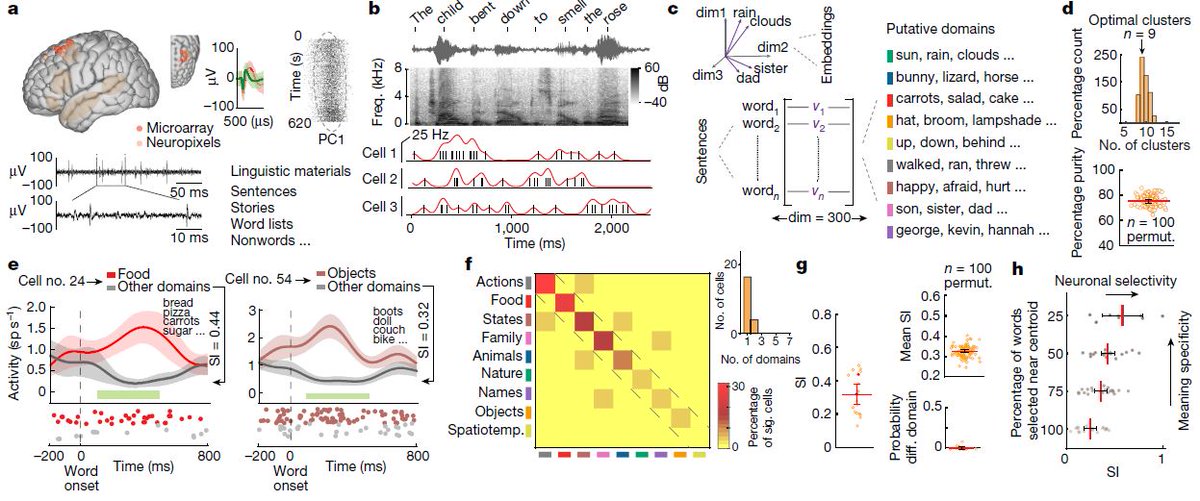
We evaluated responses to homophone pairs within the study items. Firing rate differences were greater between homophones than randomly matched pairs of words from same semantic domain, supporting semantic rather than phonetic level responses in this neuronal population. (9/12)
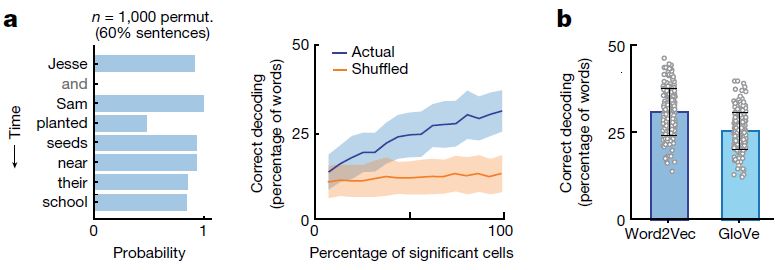
Similarly, the selectivity depended on the predictability of the word based upon its sentence context. We observed an inverse correlation between surprisal (high surprisal ~ low predictability) and decoding performance of semantic domain. (8/12)
We observe context-dependent selectivity in this population of neurons. The selective activity of the neurons was higher when words were presented in the context of a sentence rather than in a non-ordered word list. (7/12)
Population neuronal firing rates were used to decode the semantic domain of a given word. The decoding performance was invariant to the pre-trained embedding space used in clustering. (6/12)
When analysis was restricted to words within a smaller radius around the embedding centroid of each cluster–making word selection more specific to cluster category–the effect size (i.e. selectivity index) increased, further supporting the semantic tuning of these neurons. (5/12)
We clustered words into different semantic domains (e.g. objects, people and family, food) using word embeddings. We identified a subset of neurons (48 of 287) that demonstrated selective changes to particular domains. Most were only selective for one semantic domain. (4/12)
Single units in language-dominant posterior dorsal PFC in humans during awake surgery were recorded while participants listened to sentences and other linguistic items. Recordings done with tungsten microelectrodes and neuropixels (3/12)
Big thanks to co-lead Mohsen Jamali, PI Ziv Williams @zivwilliamslab; collaborators: @ev_fedorenko and @acpaulk, Syd Cash; and co-authors Jing Cai, Arjun Khanna, William Munoz, & @CapraraIrene. (2/12)
Pleased to summarize our publication (https://t.co/j9XWcQCEOK in @Nature) reporting human prefrontal single neuron responses to semantic features during language comprehension! (1/12)
In our updated preprint on Neuropixels recordings, we include a supplementary video showing spiking activity in the human cortex and illustrations of electrode scaling relative to human cortical cells thanks to the https://t.co/ISW97yBJFp repository!
https://t.co/q9Sm85cFgg