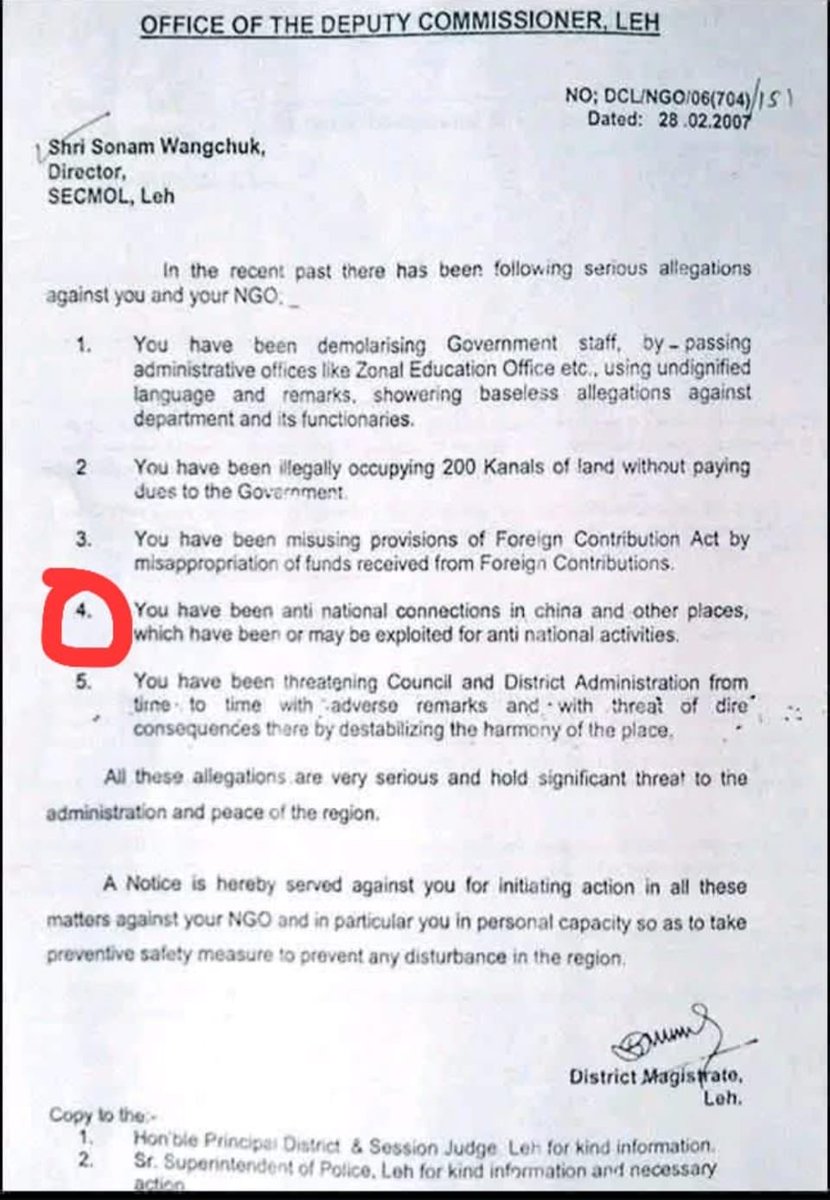
2007 में लेह कलेक्टर द्वारा सोनम वांगचुक को भेजे गए नोटिस के चौथे प्वाइंट को ध्यान से पढ़ें .. ANTI NATIONAL…तब ना पीएम @narendramodi थे,ना HM @AmitShah और ना J&K में बीजेपी सरकार थी।वांगचुक पर कोई समझ बनाने से पहले इस नोटिस को पढ़िए और समझिए कि क्या और क्यों कर रहे?
Anthropic is panicking over the release of Kimi K3. In fact, the entire U.S. AI frontier lab ecosystem is panicking right now.
When investors figure out that U.S. frontier labs have no viable long-term revenue model from paying retail customers (because China's models are both better and cheaper), the AI investment bubble will crash.
If you want to fundamentally challenge an assumption and innovate, try building things from scratch.
Building something from zero takes away every assumption you would otherwise inherit from an existing solution. You naturally start focusing on, "Does this even need to be true?"
That is the real reason greenfield projects (starting from scratch) often produce radical designs. Inherited code comes with inherited constraints. A blank slate has none, so you have to justify every choice from first principles. That, makes you think.
Kafka is a good example of this. Every message queue before it - JMS, RabbitMQ, you name it - agreed on one thing without really questioning it: once a consumer reads a message, delete it. A queue is a mailbox, not an archive.
When LinkedIn built Kafka from scratch, they were not trying to build a faster queue. They asked a more fundamental question: why delete data the broker already has?
So they went in the opposite direction.
On paper, that is a worse deal for a simple use case. More disk. More moving parts for the client to manage. But it made things possible that traditional queues simply could not do: replaying old messages, running multiple consumer groups over the same stream at their own pace, and treating the log itself as the source of truth.
Apache Spark is another example. Instead of optimizing disk-based processing, it did in-memory computation. Columnar databases made a similar shift by rethinking how data should be grouped and stored.
The point is, you do not stumble into designs like these by patching an existing system. You get there by starting over and refusing to accept what has been handed to you.
Hope this helps.
When I was at Amazon, a new Principal Engineer joined us and, within a few weeks, came up with a problem statement and a pretty robust design that solves it.
At an all-hands (a small setup), we asked him how he came up with the problem statement and design in such a short time. His answer was interesting...
He said he had solved this exact problem twice before at his previous jobs. This was his third time :)
That is when it clicked for all of us that, at senior leadership levels, you are hired to make an impact, not just to think hard in real time. You have an edge if you have solved a similar problem before, and companies hire you to do it again.
From the company's perspective, the goal is simple: hire someone who has already solved the problem once, so they can solve it again with fewer mistakes and much greater velocity.
Instead of looking for a new problem to solve every time, if you are comfortable solving one hard problem several times, there is insane money to be made.
Hope this helps :)
Your mind becomes sharper when your life has fewer unresolved loops. Unanswered messages, half-finished tasks, vague plans, and delayed conversations running in the background drain you. Clarity comes from mental peace.
The biggest danger after early success is that your old hunger starts looking unreasonable. The same obsession that got you there starts feeling extreme once life becomes comfortable. That is how winning the first level disqualifies people from the next one.
The brain does not hate hard work. It hates unclear effort. If it cannot see where the work is going, how long it will last, or why it matters, it starts treating the task like failure instead of a challenge.
We hired a new VP of Engineering who is obsessed with agile methodology.
He called a meeting on his first day and said we need to transition to 2-week development sprints.
He wanted daily stand-ups, retrospective boards, and continuous deployment pipelines.
He wanted us to actually write new code.
I realized immediately that he was an existential threat to my lifestyle.
I let him finish his impassioned speech about workflow velocity.
Then I stood up, walked to the whiteboard, and drew a single horizontal line.
I told him agile sprints are a localized solution for a localized mindset.
I said our infrastructure operates on a Zenith Release Cycle.
He asked what a Zenith Release Cycle was.
I told him it's a holistic, macro-stabilization framework where we observe the system in a state of prolonged stasis.
By not touching the code for 18 months, we allow the legacy dependencies to organically settle.
I told him that deploying bi-weekly updates creates micro-abrasions in our database architecture.
I used the phrase chronological data scarring.
The CEO was in the room and audibly gasped.
He told the new VP that we can't risk chronological data scarring just to satisfy a trendy tech buzzword.
The VP looked at me like I'd just invented a new color.
He was completely paralyzed by the sheer density of my fabricated jargon.
He quietly agreed to adopt the Zenith Release Cycle.
We're officially scheduled to deploy our next update in the third quarter of 2027.
I spent the rest of the afternoon buying things I don't need on Amazon.
Agile is a disease invented by people who want to be punished for their salary.
I refuse to participate in my own suffering.
Anthropic's CEO: "Coding is going away first. Then all of software engineering."
The 5% that survives? Systems thinking.
Not syntax. Not frameworks. Not which model is best this week.
Models. Harnesses. Loops. Self-improving agents.
The engineers who understand this stack will run circles around the ones still writing CRUD apps.
This is the full breakdown of the new AI stack ↓
Read this before you need it.
🚨 CEO of Nvidia: "Nobody writes prompts anymore. The new job is to write and handle loops."
This is the shift that's going to define the rest of 2026.
53 minutes of pure insight from one of the richest men on earth.
Watch it, then read the full guide on how to actually create loops below
Before joining Zerodha, I admired its "nice" work culture and philosophy from everything I read online.
Now, after being part of the system for about three years, I realize how much more there is beneath the surface.
Little did I know that 'niceness' has been a result of so many thoughtful decisions.
The philosophy, continuous learning, and the passion & intent with which everything is built, my respect has only compounded over the years. ❤️
🚨 IMPORTANT UPDATE
✅ Traffic has resumed on the Pune–Mumbai Connecting Link Road. Vehicular movement has been restored after completion of extensive safety operations.
Despite relentless monsoon conditions, including heavy rainfall, strong winds and low visibility, MSRDC teams worked continuously to ensure the route could be reopened safely.
The following measures were undertaken:
- 🚧 Debris was cleared from the affected stretch.
- 🚜 The carriageway was thoroughly cleaned using specialised equipment.
- 👷 Technical experts carried out detailed inspections of Tunnel 2 and the adjoining slope to ensure no loose material posed a risk.
- ⚙️ Drone surveys were attempted; however, dense fog, heavy rain and strong winds restricted aerial operations.
Traffic has been restored only after the required safety and technical assessments were completed.
Commuters are requested to avoid non-essential travel during the ongoing heavy monsoon and to strictly follow traffic advisories issued by the authorities.
MSRDC remains committed to ensuring safe and reliable travel for all road users.
#Monsoon #Maharashtra #ConnectingLink #Lonavala
@CMOMaharashtra