Imagine watching SKY LIVE on your ceiling
The guy used cheap radio receiver and some coding skills to project the WHOLE SKY with PLANES, SATELLITES, moon, sun and stars as they all are at the exact moment and place
Before Hampi. Before Khajuraho. Before most of India’s great temples — there was Aihole.
A forgotten village in Karnataka where the Chalukyas experimented with over 120 temples and changed Indian architecture forever.
The real birthplace of Indian temple design. 🇮🇳
Her name is Pratiksha Tondwalkar.
She was born in 1964 in Pune into a Scheduled Caste family.
When she was in Class 7, her father decided to pull her out of school and get her married. Her teacher begged him to let her continue. She even offered to pay for Pratiksha’s education herself. Her father refused.
She was married at 17. Her husband Sadashiv Kadu worked as a bookbinder at a Mumbai branch of the State Bank of India.
When she was 20, he died in a road accident. She was left with a two year old son and no education.
She walked into the same SBI branch to collect her late husband’s dues. She told the bank she needed any job they could give her.
They gave her a broom.
She swept floors. She dusted furniture. She cleaned restrooms. She earned Rs 65 a month.
She said in an interview whenever my son asked for a packet of biscuits I would get off the bus one stop early just to save the fare money to buy them for him.
After work, she enrolled in night college in Vikhroli. She completed Class 10 with first class marks. Then Class 12. Then a psychology degree. Bank colleagues helped her study whenever they could.
Her parents pressured her to remarry immediately. She refused until she had graduated.
She was promoted from sweeper to messenger to clerk.
She remarried in 1993. Her husband Pramod Tondwalkar encouraged her to take the banking officer exams. She cleared them.
She rose from trainee officer to Scale 4 to Chief General Manager.
In 2022, she became Assistant General Manager of the State Bank of India.
The same bank where she once cleaned restrooms for Rs 65 a month gave her its highest management honour 40 years later.
Follow for stories India deserves to remember.
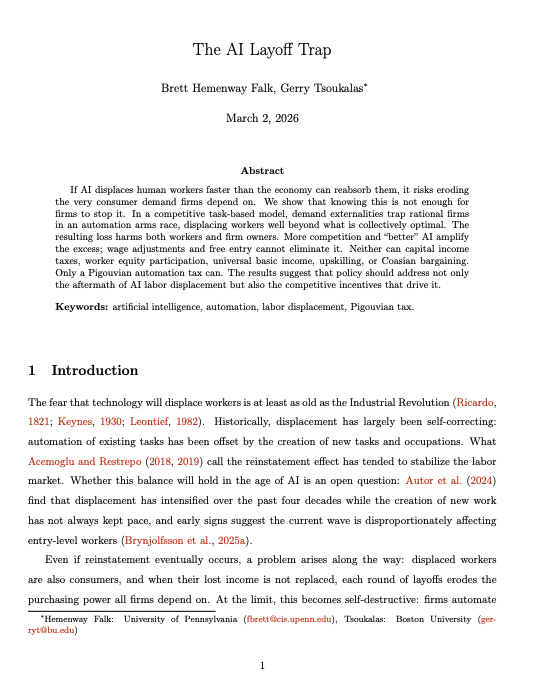
🚨BREAKING: Two researchers from UPenn and Boston University just published a paper that should be uncomfortable reading for every CEO automating their workforce right now.
The argument is straightforward. Every company replacing workers with AI is also eliminating its own future customers. Laid off workers stop spending. Enough of them stop spending and nobody can afford to buy anything. The companies that fired everyone end up selling into an economy with no purchasing power left.
Every executive can see this. The math is not complicated. But here is why nobody stops.
If you do not automate, your competitor does. They cut costs, lower prices, take your market share, and you collapse anyway. So every company automates knowing it is collectively destructive because the alternative is dying alone while everyone else survives. The researchers proved this is a Prisoner's Dilemma playing out in real time.
The numbers are already moving. Block cut nearly half its 10,000 employees this year. Jack Dorsey said AI made those roles unnecessary and that within the next year the majority of companies will reach the same conclusion. Salesforce replaced 4,000 customer support agents with AI. Goldman Sachs deployed a coding tool that lets one engineer do the work of five. Over 100,000 tech workers were laid off in 2025 and AI was cited as the primary driver in more than half those cases. 80% of US workers hold jobs with tasks susceptible to AI automation.
The researchers tested every proposed solution. Universal basic income does not change a single company's incentive to automate. Capital income taxes adjust profit levels but not the per-task decision to replace a human. Collective bargaining cannot hold because automating is always the dominant strategy.
They also identified what they call a Red Queen effect. Better AI does not solve the problem, it accelerates it. Every company chases faster automation to gain market share over rivals but at the end everyone has automated equally, the gains cancel out, and the only thing left is more destroyed demand.
The one thing the math says could work is a Pigouvian automation tax. A per-task charge that forces companies to account for the demand they destroy each time they replace a worker.
The conclusion is that this is not a transfer of wealth from workers to owners. Both sides lose. Workers lose income. Companies lose customers. It is a deadweight loss with no market mechanism to stop it on its own.
(Link in the comment)
The sky over Jagannatha Dham, Puri turns red this evening.
A perfect start to the Odia New Year & Sankranti.
When devotion meets beauty, even the heavens respond.
I was fired from Anthropic today.
I was the engineer responsible for shipping the latest dev/claude-code npm package. Wanting to improve the debugging experience for the team, I decided to include source maps in the release. This resulted in our entire internal codebase being publicly exposed including thousands of files with every agent command, all system prompts, the complete query engine, Undercover Mode, Bypass Permissions Mode, and our internal telemetry configuration.
I take full responsibility. I genuinely believed the safeguards Claude Code had built for me would be adequate and it was a serious miscalculation on my part.
My actions have unintentionally open-sourced major parts of Claude’s architecture well ahead of schedule. I apologize to the team and to Claude.
Play time exercises is brain training in disguise 🧠
Every jump, clap, and laugh strengthens focus, memory, and learning power.
You’re not just burning energy — you’re building a sharper, clearer mind for life. 🚀
This is not a nuclear test footage.
On December 28, 1944, while transporting ammunition to Mindoro, Philippines, the SS John Burke was hit by a Japanese kamikaze aircraft, and disintegrated in a tremendous explosion.
Before the World Knew How to Build Dockyards, Bharat Had Already Mastered the Science 🇮🇳
Did you know that the world’s earliest known maritime dockyard was built in Gujarat, India, at Lothal, over 4,000 years ago?
Around 2400 BCE, when most of the world had no understanding of organised ports or tidal engineering, the Indus Valley (Harappan) Civilisation had already mastered the science of dock construction. The dockyard at Lothal was not accidental or primitive. It was deliberately engineered to work with tidal movements, positioned to avoid silting, and connected to the Arabian Sea through an ancient channel.
This was not a fishing harbour or a simple landing point. It was a planned commercial dockyard, designed for long-distance maritime trade with regions such as Mesopotamia, Persia, and the Gulf.
Before the world knew how to build dockyards, Bharat was already doing it! And with precision, foresight, and scientific understanding.
This is not mythology.
This is archaeology.
India’s maritime legacy did not begin in the colonial era.
It began thousands of years earlier, when civilisation itself was still learning to navigate the seas.
I QUIT MY LOCAL 9–5 AND SWITCHED TO REMOTE WORK IN 2025.
8 MONTHS LATER, MY INCOME DOUBLED.
No office.
No commuting.
No location limits.
USE THESE 12 WEBSITES TO FIND HIGH-PAYING REMOTE JOBS IN 2026:
Some remote jobs only operate between 1:00 AM and 5:00 AM, which is why hardly anyone applies.
I’ve identified overnight remote jobs paying up to $100 per hour in USD.
Here’s each job and why they pay so much👇