Huge thanks to @xCryptoParadise for covering Ravenhood during their latest stream.
Always great to see $RVH getting more exposure and reaching new people.
Really appreciate the continued support and coverage.
Watch the Ravenhood segment
https://t.co/xPTQgcicdG
Idle capital shouldn’t stay idle. 👀
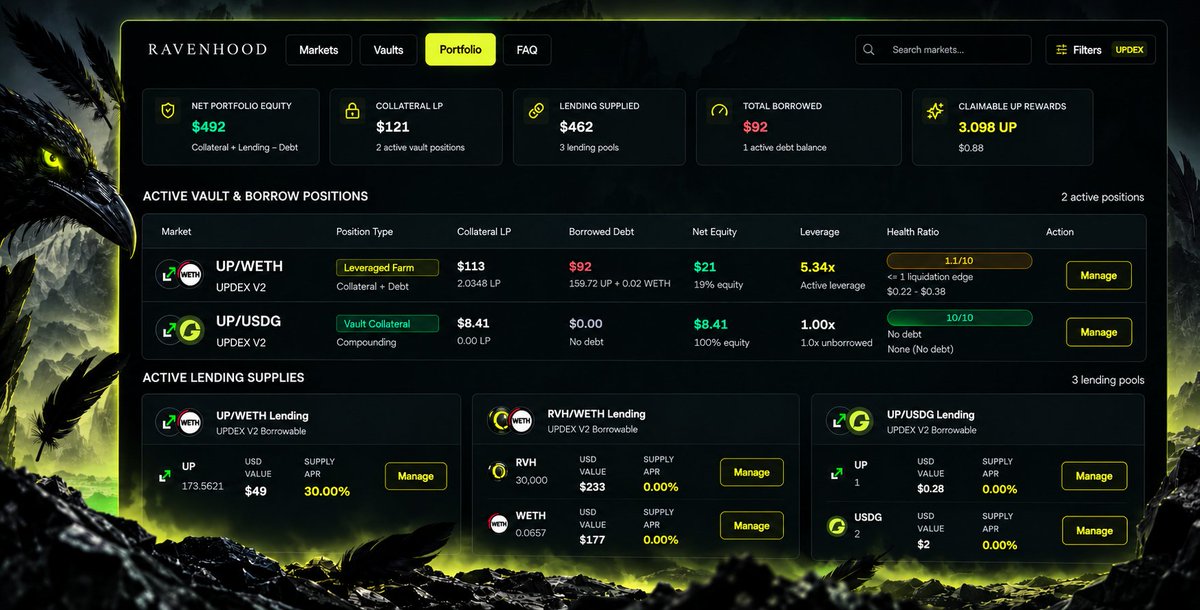
Flock Manager bringing lending, borrowing, leverage and yield into one place on Robinhood Chain is a pretty interesting step for the Ravenhood ecosystem.
$RVH 🐦⬛
The Flock is preparing something new. 🐦⬛
Lend. Borrow. Leverage. Manage.
One place to put idle capital to work across Robinhood Chain.
Flock Manager is almost ready.
Soon, the capital hunts for yield.
@lordpemby@NetNetCap@uponrh@alandalexyz@root_giga@giga_dex
Most communities chase attention.
Ravenhood is building around it.
The more people create, discuss, and contribute meaningful content, the stronger the collective mindshare becomes.
That’s the part I’m watching closely.
$RVH
We’re teaming up with @BinanceWallet for DeFi Hold to Earn. Earn yield and share a 150,000 $U prize pool.
3 simple steps to participate:
→Tap [Join] on the activity page
→Activate $U in DeFi Hold to Earn via Binance Wallet
→ Swap & hold at least 100 $U in your wallet
Period: Sep 24, 00:00 – Oct 24, 23:59 (UTC)
Start earning today:
https://t.co/BpFL1nkFDX
Encryption protects the content, while privacy determines who can access or learn from it. Understanding that difference is crucial as AI and digital infrastructure continue evolving rapidly. 🔐
GM.
Two words that get used as if they were one, and shouldn't be.
Ours: encrypted and private. Encrypting something keeps its contents from being read by anyone without the key. Whether anyone can see that it happened at all is a separate question — and "private" gets used for both.
What's your pair?
AI is moving fast, but security needs to move just as fast. @DeepSafe_AI is working on building a safer and more trustworthy layer for the AI ecosystem. Definitely a project worth watching. #DeepSafe
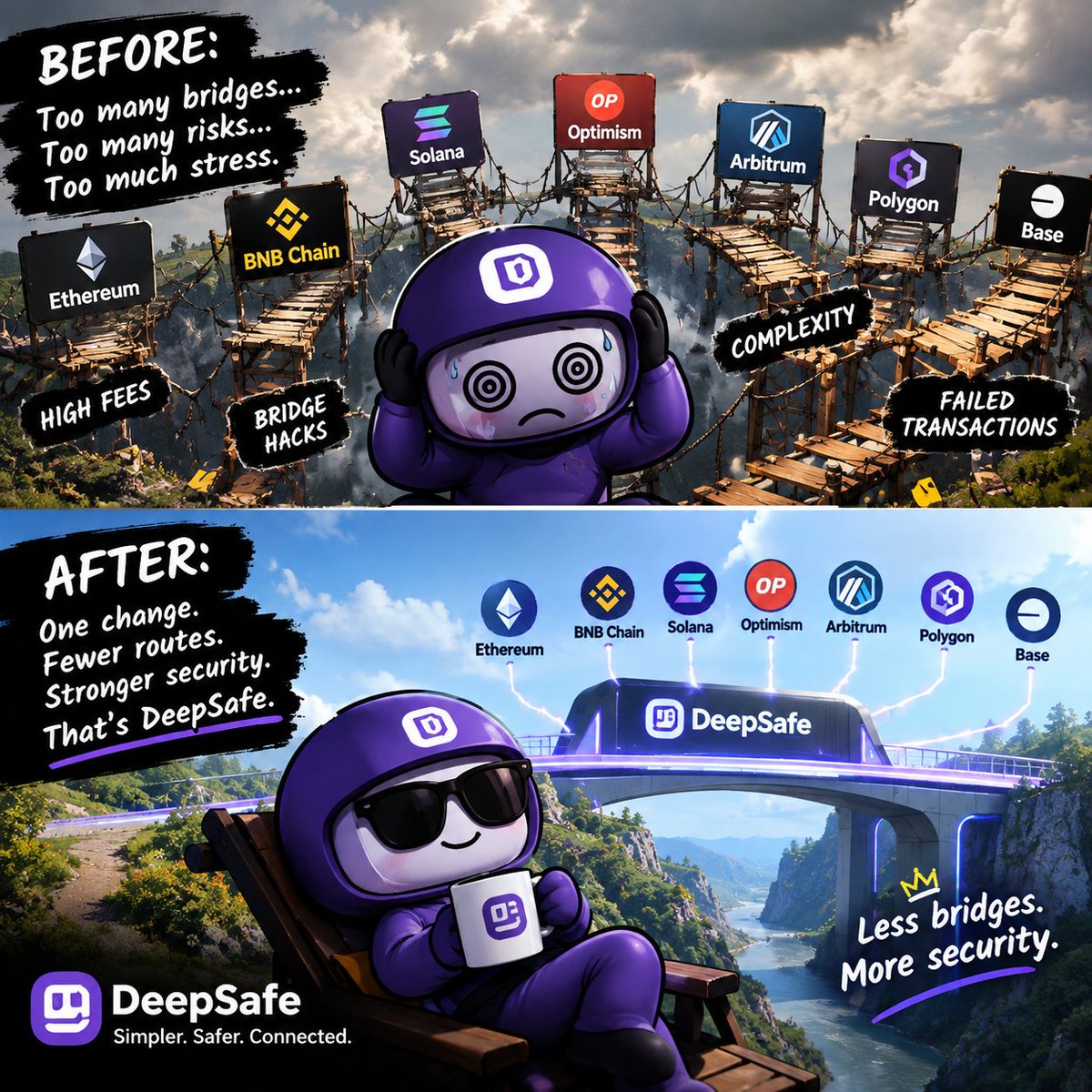
This is a meaningful infrastructure shift: fewer bridge routes can reduce complexity while concentrating security efforts where cross-chain value actually moves.
On 16 September, Lombard deprecated native minting and redemption of LBTC and BTC.b on five chains — TAC, Sonic, Katana, Berachain and Starknet. Holders on the first four are required to bridge balances to Ethereum by December 10. Starknet keeps its bridge, and its balances have no deadline.
Underneath that sits a second change, and it is the more interesting one.
Bridging moves to a hub and spoke model. From the docs: "every supported chain has a bridge lane to and from Ethereum, and a transfer between two other chains routes through Ethereum rather than directly." Minting from native BTC is unaffected. What changed is how already-minted assets move between chains.
The reason is stated plainly: "Fewer bridge contracts and message paths mean a smaller surface to secure and monitor, and security budget and engineering resources concentrate on the lanes that carry the most value."
Worth being precise about what actually shrank. Not the number of chains — every other chain continues, and you can still mint from native BTC on any of them. What shrank is the number of routes between them.
Those are different quantities. In a mesh, routes exist between pairs, so each chain added arrives with a new lane for every chain already there. In a hub and spoke, a chain arrives with one.
The count that goes in the announcement is chains supported. The count that has to be secured and monitored is lanes. A topology decides which of the two grows faster, and that is the decision this update actually makes.
https://t.co/99C3WipeAW
#DeepSafe #Web3Security