The new Wall Street is being built on Ethereum.
Last week, @get_optimum brought together some of the biggest institutional players to help shape the future of on-chain finance. Top of the Block was more than just an event, it was a clear signal that traditional capital is rapidly moving toward blockchain infrastructure.
Together with @BitMNR, @1kxnetwork, @Auros_global, and @BlockdaemonHQ, we're witnessing a new chapter being written on the world's leading smart contract platform.
The future of finance is no longer confined to the old Wall Street.
It's being built on Ethereum, and it's happening right now.
Are you ready to be part of it?
The new Wall Street is being built on Ethereum. Last week we brought together the institutional players who are making it happen.
This is Top of the Block with @BitMNR@1kxnetwork@Auros_global@BlockdaemonHQ.
AI can only scale if people keep contributing.
On @IBM's Making Data Simple, Story CPO @devrelius explains why the next generation of AI requires a trust layer between models and the humans behind their intelligence.
Transparency, attribution, and incentives ↓
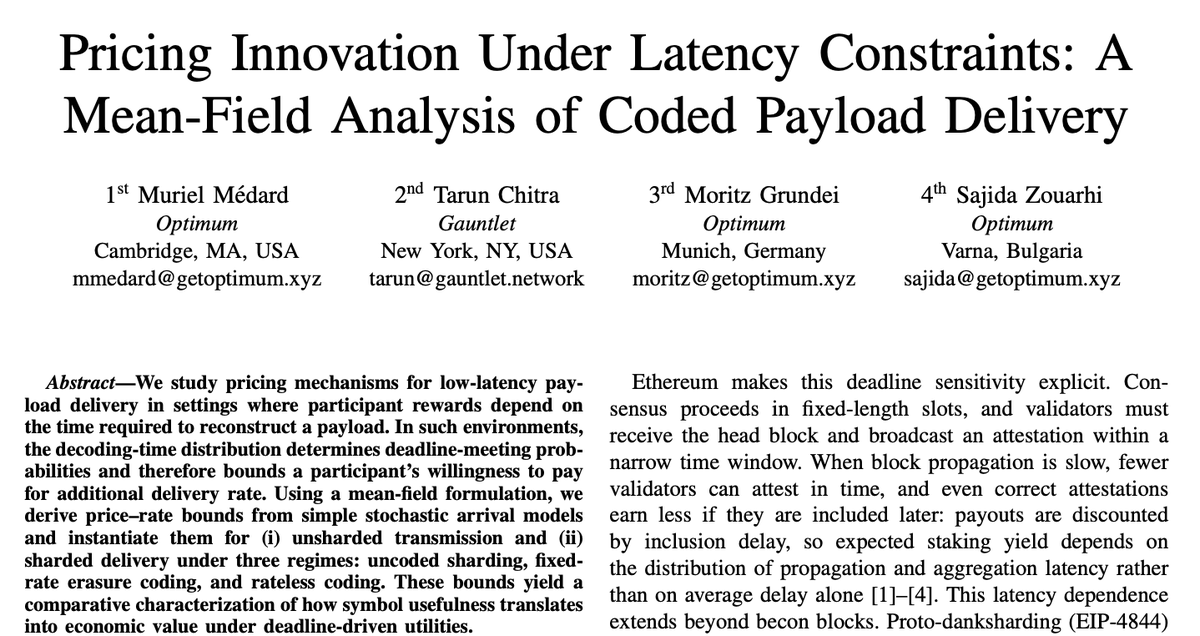
What stands out to me about @get_optimum latest research is that it finally gives latency a measurable economic value.
For years, blockchain infrastructure has treated propagation speed as a technical metric. Optimum shows that speed is actually an economic asset.
If receiving critical data just a few milliseconds earlier increases the probability of earning rewards, then lower latency becomes something participants are willing to pay for.
The concept of an RLNC-powered "fast lane" is particularly interesting because it doesn't replace existing propagation methods, it complements them.
In the future, bandwidth, latency, and data delivery may become markets of their own, and Optimum is positioning itself at the center of that transformation.
Everyone talks about scaling blockchains.
Very few projects are redefining the infrastructure that scaling itself depends on.
That's why I believe @get_optimum could become one of the most important game-changers in crypto.
Most blockchain projects require networks to adopt new architectures, modify consensus mechanisms, or migrate to entirely new environments. Optimum takes a completely different approach.
Instead of asking Ethereum, Solana, or future blockchains to change how they operate, Optimum works alongside them.
+ No hard forks.
+ No protocol redesigns.
+ No disruptive migrations.
It simply plugs into existing networks and immediately improves how information moves between participants.
That alone is powerful.
But the real disruption goes much deeper.
Today, blockchain performance is heavily influenced by communication speed. Faster access to information means fewer missed opportunities, better validator performance, and a healthier network.
Optimum transforms this challenge into an opportunity.
By dramatically reducing the cost of moving data across decentralized networks, it doesn't just improve performance—it creates economic value.
Validators benefit from faster block delivery.
Network operators can monetize unused bandwidth.
And an entirely new market emerges around latency itself.
Think about what Bitcoin did for computing power.
Think about what Filecoin did for storage.
Optimum is attempting to do something equally ambitious for bandwidth and real-time data delivery.
And this is only the beginning.
The long-term vision isn't just faster block propagation.
Optimum is building what could become the decentralized memory layer of Web3—a global, real-time data infrastructure that applications can access instantly.
If blockchains are the computers of the decentralized world, then Optimum aims to become their RAM.
A future where data is available everywhere, instantly, and without centralized intermediaries.
That is why Optimum is not merely optimizing blockchain infrastructure.
It is redefining how decentralized systems communicate.
And projects that redefine foundational infrastructure often become the ones that change the entire game.
Southeast Asia is one of the most mobile-first, multilingual regions in the world.
That matters for the future of voice AI.
Filipino, Indonesian, and Malay are now live on Numo.
Optimum’s Breakthrough Innovations Beyond RLNC
While Random Linear Network Coding (RLNC) is often recognized as the technological foundation of Optimum, the project's most transformative innovations extend far beyond its coding architecture. Optimum is not simply building a faster networking protocol; it is creating an entirely new economic and infrastructure layer for the blockchain industry.
One of Optimum’s most significant innovations is the introduction of Flexnodes, a new class of decentralized network participants dedicated to accelerating data movement across blockchain ecosystems. Unlike validators, Flexnodes do not secure consensus or produce blocks. Instead, they contribute bandwidth, routing capacity, and network resources to improve the speed and reliability of information distribution. This creates a specialized workforce focused exclusively on communication efficiency.
Another major breakthrough is the concept of the Latency Marketplace. Traditionally, latency has been viewed as an unavoidable cost of operating distributed systems. Optimum transforms latency reduction into a measurable and tradable service. Validators benefit financially from receiving critical data sooner, while Flexnode operators are rewarded for providing the infrastructure that enables those improvements. This creates a direct economic alignment between network performance and participant incentives.
Optimum is also pioneering the idea of Bandwidth as an Asset Class. Just as Bitcoin monetized computational power and Filecoin monetized storage capacity, Optimum aims to monetize unused internet bandwidth. Millions of individuals and organizations possess excess connectivity resources that remain idle. Optimum converts these underutilized resources into productive infrastructure capable of generating value for blockchain networks.
Perhaps the most ambitious aspect of the project is its chain-agnostic infrastructure strategy. Rather than serving a single blockchain, Optimum is designing a universal data acceleration layer that can support multiple ecosystems, including Ethereum, Solana, Monad, MegaETH, and future networks. This enables one decentralized infrastructure network to serve numerous blockchains simultaneously.
By combining Flexnodes, the Latency Marketplace, bandwidth monetization, and multi-chain infrastructure, @get_optimum is laying the foundation for a new decentralized economy where communication itself becomes a valuable resource. This vision positions Optimum not merely as a networking project, but as a foundational layer for the next generation of blockchain infrastructure.
Optimum: Building a New Blockchain Infrastructure Layer with RLNC Technology
When most people first encounter Optimum, they view it as a project focused on faster block propagation and more efficient blockchain networking. While this is true, it only scratches the surface of Optimum’s broader vision. Rather than simply optimizing how blocks move between validators, Optimum is building an entirely new infrastructure layer where bandwidth, latency, and data movement become valuable economic resources.
At the core of this architecture is Random Linear Network Coding (RLNC), a technology that fundamentally changes how blockchain data is transmitted. In traditional networks, validators must receive specific packets in the correct form to reconstruct a block. Missing packets create delays, retransmissions, and inefficiencies. Optimum replaces this model by encoding block data into mathematical equations. Validators no longer need every original packet; they only need a sufficient number of independent coded equations to reconstruct the block.
This shift changes the optimization target completely. Instead of focusing on moving a block from one point to another as quickly as possible, the network focuses on helping validators reach the decoding threshold faster. The result is greater resilience to packet loss, improved bandwidth utilization, and lower propagation latency.
To accelerate this process, Optimum introduces Flexnodes, specialized participants that receive RLNC-encoded data, generate additional coded equations through recoding, and forward them across multiple network paths. Unlike validators, Flexnodes do not participate in consensus. Their sole purpose is to maximize data availability and speed up information flow throughout the network.
This architecture forms the foundation of Optimum’s Latency Marketplace. Validators benefit from faster block propagation, reduced orphan risks, improved attestation performance, and better opportunities for MEV capture. Meanwhile, Flexnode operators contribute unused internet bandwidth and receive rewards for improving network performance.
Ultimately, @get_optimum aims to create a global data acceleration network for blockchains. Just as Bitcoin monetized hashpower and Filecoin monetized storage, Optimum seeks to monetize bandwidth and latency. Through RLNC, Flexnodes, and its incentive-driven marketplace, the project is transforming unused internet capacity into productive infrastructure capable of supporting Ethereum, Solana, Monad, MegaETH, and future blockchain ecosystems.
Optimum: Building a New Blockchain Infrastructure Layer with RLNC Technology
When most people first encounter Optimum, they view it as a project focused on faster block propagation and more efficient blockchain networking. While this is true, it only scratches the surface of Optimum’s broader vision. Rather than simply optimizing how blocks move between validators, Optimum is building an entirely new infrastructure layer where bandwidth, latency, and data movement become valuable economic resources.
At the core of this architecture is Random Linear Network Coding (RLNC), a technology that fundamentally changes how blockchain data is transmitted. In traditional networks, validators must receive specific packets in the correct form to reconstruct a block. Missing packets create delays, retransmissions, and inefficiencies. Optimum replaces this model by encoding block data into mathematical equations. Validators no longer need every original packet; they only need a sufficient number of independent coded equations to reconstruct the block.
This shift changes the optimization target completely. Instead of focusing on moving a block from one point to another as quickly as possible, the network focuses on helping validators reach the decoding threshold faster. The result is greater resilience to packet loss, improved bandwidth utilization, and lower propagation latency.
To accelerate this process, Optimum introduces Flexnodes, specialized participants that receive RLNC-encoded data, generate additional coded equations through recoding, and forward them across multiple network paths. Unlike validators, Flexnodes do not participate in consensus. Their sole purpose is to maximize data availability and speed up information flow throughout the network.
This architecture forms the foundation of Optimum’s Latency Marketplace. Validators benefit from faster block propagation, reduced orphan risks, improved attestation performance, and better opportunities for MEV capture. Meanwhile, Flexnode operators contribute unused internet bandwidth and receive rewards for improving network performance.
Ultimately, @get_optimum aims to create a global data acceleration network for blockchains. Just as Bitcoin monetized hashpower and Filecoin monetized storage, Optimum seeks to monetize bandwidth and latency. Through RLNC, Flexnodes, and its incentive-driven marketplace, the project is transforming unused internet capacity into productive infrastructure capable of supporting Ethereum, Solana, Monad, MegaETH, and future blockchain ecosystems.
Community members → we want to hear from you.
If you've been building, testing, tasking, or showing up for Story in any way, you're a contributor.
Let's make sure you're on our radar ↴