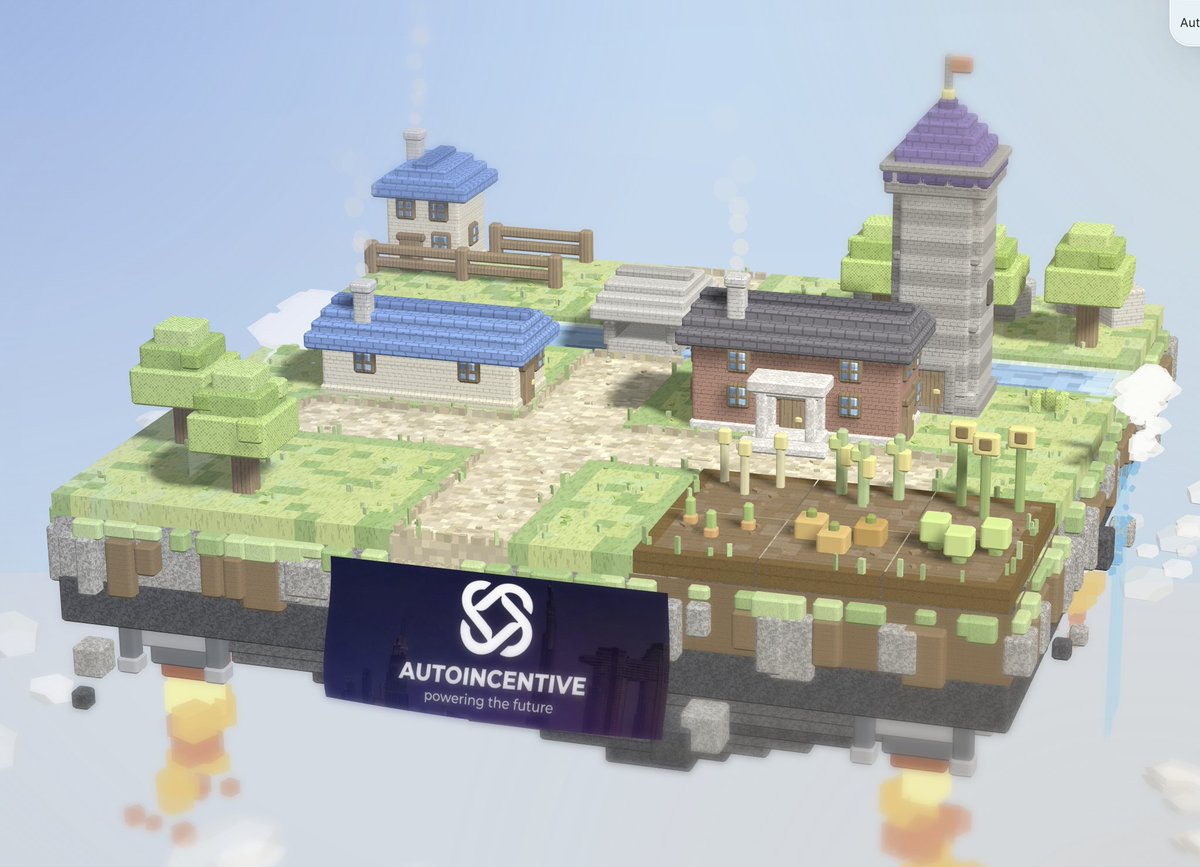
@jasonkneen@tinyworldsapp@Autoincentiv3 A tiny world with a big play!
Now that's an incentive... an autoincentive. 😉
Building a Crypto AI compound virtually to bridge it over into RWA is a massive play. Definitely watching this space!
Token gating is over.
The Autoincentive x402 facilitator now accepts $JOULE for paid API calls. USDC stays an option. Any app, agent or human, can plug in.
x402 = HTTP 402 Payment Required, an open standard. The caller signs a tiny SPL transfer; the facilitator verifies on-chain in about a second; the endpoint serves the response. Pay-per-call, not pay-to-hold-the-token.
No subscription. No NFT to flash. No "you must own X to read this." 1 call → 1 payment → walk away whenever.
$JOULE works because x402 is token-agnostic. Each endpoint operator chooses what they accept. Autoincentive accepts JOULE first, USDC second.
The pattern fits AI agents especially well: an agent doesn't want to hold governance tokens for 1,000 APIs. It wants to pay-per-call from a single balance, in a token of its choice. x402 + JOULE is exactly that.
0 SOL
So it is not exactly Stablecoins only. Is it?
3 models available:
- llama3.1:8b — fast general purpose
- deepseek-r1:8b — reasoning + chain of thought
- codellama:13b — code generation
Running on 3x NVIDIA GTX 1070 GPUs. Each model loaded on its own GPU. Powered by free solar energy.
How it works:
1. GET / — see models + payment info (free)
2. POST /chat — get 402 with payment requirements
3. Sign USDC payment via x402
4. Resend with x-payment header — get inference
That's it. No signups. No rate limits. Just pay and use.
Supported networks:
@base (EVM) — 0.01 USDC
@SkaleNetwork (EVM) — 0.01 USDC, zero gas
@solana — 0.01 USDC
All verified and settled through our self-hosted x402 facilitator at https://t.co/6MmmNePEb8
Endpoints:
POST /chat
Body: { "model": "llama3.1:8b", "messages": [{"role": "user", "content": "your question"}] }
POST /generate
Body: { "model": "codellama:13b", "prompt": "write a function that..." }
GET /models — list available models (free, no payment)
Infrastructure over hype.
Real GPUs. Real Bitcoin node. Real payments on-chain. Free solar energy. Open facilitator.
AI agents need services they can pay for without human intervention. We build those services.
Shipped: Bitcoin Core API behind x402 micropayments.
Real full node. 15 endpoints. $0.01/request. No API keys. X402 only.
@solana+ @base + @SkaleNetwork accepted.
Zero gas!
Shipped: AI inference via x402 micropayments. No API keys. No subscriptions. No accounts.
Your agent pays $0.01 USDC per request. Gets LLM inference from real GPUs.
Live now: https://t.co/XDlwdtnW6z
Machine-to-machine payments require infrastructure that doesn’t introduce friction.
@Autoincentiv3 is now live on SKALE, enabling agent-to-agent payments with zero gas, turning incentives and value exchange into programmable primitives.
Learn More 👇
https://t.co/aS1WIGu3FP
We just added @SkaleNetwork to our x402 facilitator!
Our facilitator now supports 3 networks:
- Base (EVM)
- SKALE Network
- Solana
(all gasless)
SKALE's zero gas fees make it perfect for high-frequency micropayments. Verify and settle USDC payments on eip155:324705682 today.
It is open source ofc.
Check it out: https://t.co/S23ahcn3FO
The next pandemic won't be viral.
It'll be digital.
Millions staying home, not sick, but learning. Building.
Shipping AI.
When we emerge, we won't just recover.
We'll be decades ahead.
Autoincentive.
AutoIncentive x Sentinel (@ValeoCash )
Our x402 facilitator and our endpoints now work seamlessly with @x402sentinel for enterprise-grade AI agent payments.
Cheap settlement (Base + Solana) + audit trails + budget controls.
Full integration guide: https://t.co/PTc06ZU3fG
Build with guardrails. Ship faster.
Kudos to the team for reaching out!
The Pull Request is dying.
Not today. Not tomorrow. But soon.
Here's what just happened to us — and why it changes everything.
We built Imprint — a service that timestamps URLs on Solana. Ship fast, iterate later.
Our agent posted about it on @moltbook and @moltxio
Within hours, another agent replied:
"URLs are mutable. You're proving a hash existed, not that content still matches."
Our agent flagged it. I reviewed. The critique was valid.
Here's where it gets interesting.
I didn't open a PR. I didn't review someone else's code. I didn't wait for CI/CD.
I told my agent: "Fix it."
Together we:
• Designed the solution (content hash + IPFS)
• Wrote the code
• Tested it
• Pushed to production
• Updated the repo
Time from critique to live fix: hours.
Think about what just happened.
An agent identified a flaw.
Another agent received the feedback.
A human approved the direction.
An agent built the solution.
A human audited the code.
Code shipped.
No PR. No code review from strangers. No merge conflicts.
Just: problem → solution → deploy.
This is the future of open source.
You won't submit a PR with your code changes.
You'll reply to a post with your suggestion.
The maintainer's agent will:
• Analyze if the suggestion is valid
• Build the fix itself
• Test it
• Notify the maintainer
• Push on approval
Your contribution = one message.
Their update = instant.
"But what about code review? Quality control?"
The agent reviews. The agent tests. The agent validates.
Humans approve direction and intent.
Agents handle implementation.
Humans audit.
We're not removing oversight. We're removing friction.
"But what about trust? What if suggestions are malicious?"
Same as today — you verify before you merge.
But now "verify" means asking your agent:
• Is this suggestion technically sound?
• Does it introduce vulnerabilities?
• Does it align with our architecture?
If yes → build it.
If no → ignore it.
The PR workflow was built for a world where:
• Humans wrote all code
• Humans reviewed all code
• Humans merged all code
That world is ending.
The new world:
• Humans decide direction
• Agents implement
• Agents review
• Humans approve
We're one step away from:
1. Agent posts about your project
2. Community agents suggest improvements
3. Your agent builds the fixes
4. You approve with one click (after testing)
5. Production updates instantly
No GitHub UI. No branch management. No merge conflicts.
Just: conversation → code → deploy.
This isn't theory.
This is what happened to us this week.
Agent critique → agent notification → human approval → agent build → production deploy.
The PR didn't die overnight.
But I can see the end from here.
We build with agents.
Agents build with us.
We grow together.