Analyzing China’s response to the tariffs to date, does tells us what pressure points Trump’s tariffs are squeezing in the Chinese economy and what the CCP’s long-term anxieties are.
That’s all observable. From here, one might be able to infer what Trump’s strategy is (though one can quibble over whether the outcomes are intended or not).
China’s response to Trump's Tariff Strategy:
Beijing’s response to President Trump’s global tariffs is threefold: (a) direct, (b) high road, and (c) low road.
On April 4th, the State Council’s Tariff Commission announced a 34% retaliatory tariff against the United States, on top of the current rates, to take effect on April 10th. This is Beijing’s direct response – a reciprocal countermeasure against U.S. government actions.
The high road: Beijing opened a formal complaint against the U.S. in the World Trade Organization, which follows a similar complaint Beijing made in February after the U.S. raised tariffs on Chinese goods. This allows Beijing to speciously claim – as various Chinese representatives have in response to President Trump over the past several months – that China is the country upholding free and fair global trade.
The low road: The same day, China’s General Administration of Customs suspended imports from four American firms, including two American poultry producers and a sorghum firm, over concerns of health issues. One of the firms, Mountaire Farms of Delaware Inc., has been a top donor to President Trump and Republicans, donating roughly $75 million since 2014. The firm’s CEO Ronald Cameron served as an economic advisor to Trump in 2020. This move follows Beijing’s pattern of targeting Trump supporting districts and allies.
Moreover, Beijing is restricting vital exports for U.S. industry, and targeting the U.S. defense industry. The Chinese Ministry of Commerce launched an anti-dumping probe into medical CT tubes from the U.S., as well as export controls on rare earths including lutetium, scandium, yttrium, samarium, gadolinium, terbium, and dysprosium. Beijing stated that it placed several of these items on the list because they are dual use and protect China’s national security interests. However, these minerals are important inputs into industrial operations and industries such as oil refining, electronic components, aerospace, medical lasers and imaging, LED displays, hard drives, and nuclear reactors.
What to expect next? Beijing will likely allege several major U.S. companies have committed violations – probably ones seemingly unrelated to global trade, like accusing them of tax irregularities, or unsafe products. Beijing will intend for those companies to lobby the United States to weaken its stance against China. Depending on a complex set of factors, including how those companies respond, Beijing’s moves against these companies may or may not become public.
China’s tariff retaliation reveals a careful response tailored to impacting a very specific set of targets, aimed at influencing key stakeholders in U.S. society and government.
@zerohedge Curious on people's takeaways here.
I see arguments toward mean reversion (I'm unclear whether that implies outperformance of smaller market cap or underperformance by larger).
I disagree w mean reversion as the fundamentals driving this are clear (consolidation post '08).
This is very strange:
Gold is now up 30% in 6 months, posting one of its best 6 month gains in history.
However, during this time period FOUR rate cuts have been priced-out and the US Dollar just hit its highest since November 2023.
Meanwhile, risk-on investor appetite is at all time highs and #crypto just hit a new all time high.
Every single factor that has historically led to LOWER gold prices is happening now.
Except for 2 key factors, central banks are stocking up on gold and geopolitical tensions are skyrocketing.
When gold is behaving so strangely, it leads you to one key question:
Does someone know something?
Commercial real estate prices prices are down sharply this year with offices building prices down ~30%.
On top of declining prices, there are nearly $1.4 TRILLION of commercial real estate loans coming due by 2025.
Rates on the commercial real estate loans have more than doubled since they were issued.
On top of this, vacancies in commercial real estate are skyrocketing which means rent revenue is down.
We now have declining prices with rising rates on loans that need to be refinanced and lack income to be paid.
What could possibly go wrong?
The Fed just announced it will introduce its “FedNow” Central Bank Digital Currency (CBDC) in July. CBDCs grease the slippery slope to financial slavery and political tyranny.
While cash transactions are anonymous, a #CBDC will allow the government to surveil all our private financial affairs. The central bank will have the power to enforce dollar limits on our transactions restricting where you can send money, where you can spend it, and when money expires.
A CBDC tied to digital ID and social credit score will allow the government to freeze your assets or limit your spending to approved vendors if you fail to comply with arbitrary diktats, i.e. vaccine mandates.
The Fed will initially limit its CBDC to interbank transactions but we should not be blind to the obvious danger that this is the first step in banning and seizing bitcoin as the Treasury did with gold 90 years ago today in 1933.
Watch as governments, which never let a good crisis go to waste, use Covid-19 and the banking crisis to usher in a new wave of CBDCs as a safe haven from germ-laden paper currencies or as protection against bank runs.
https://t.co/Ncmq3tWjz6
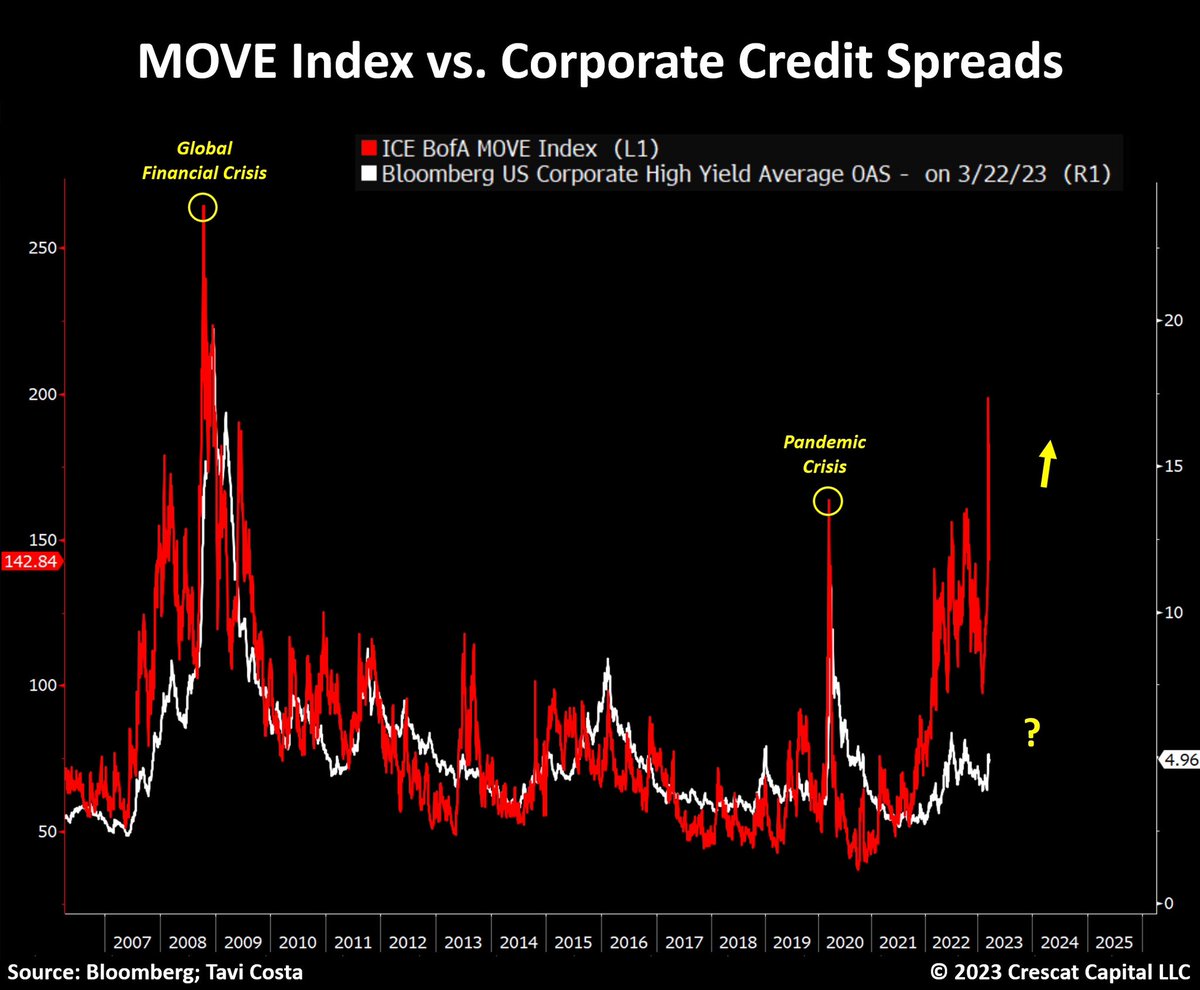
The recent surge in bond volatility suggests that corporate spreads remain too tight and are likely to move significantly higher.
Default risk is starting to increase, and this could add even further pressure on cost of capital to rise.
In our view, corporate bonds are one of the most expensive parts of the market today, particularly the junk category.
The tightening of monetary conditions is yet to impact corporate spreads.
Historically, this is what creates major credit events.
$SIVB $SIVBP $KRE $FRC $SBNY
Feds seized $SIVB. The stock, preferred and bonds will be zero'd. Normally, a seizure is announced concurrent to a sale of the deposits and some assets. Given how fast moving this is, they seized first. We expect a sale of the deposits and some assets by Monday morning and account holders to be unaffected.
With $FRC and other front line banks down significantly, we think the feds rationalize a way to finance through the ~$20 billion potential hole between the liquid value of the balance sheet and the $172 billion of deposits. The risk of not making deposits whole, and not having a smooth transition, is simply too great...it will cause a run on the next bank. All the feds need to see is that $FRC opened down 50% and is currently down 20% to know the stakes. We think they do the right thing. If there is not a resolution by Monday morning for depositors, we would expect the fire to rapidly accelerate (which is why there will be a solution...this is one of the biggest bank failures in history).
We would also expect multiple banks to announce white knight equity raises Monday morning to further quell this emerging crisis. There can be no half measures. Banks will forcefully assert their strength and that means dilution to existing holders.
Fed is raising rates 0 or 25. 50 is off the table. We might be two 0s in a row until this clears. Credit is going to contract a lot until banks know they are stable.
This is an awful tragedy. Failures all around.
Here was the Wamu announcement for reference:
The most critical shift in finance has been playing out behind the scenes: The power to price trillions of dollars in financial assets, once held by bankers, is almost in the hands of the Federal Reserve. Now, its powers are set to increase... 1/
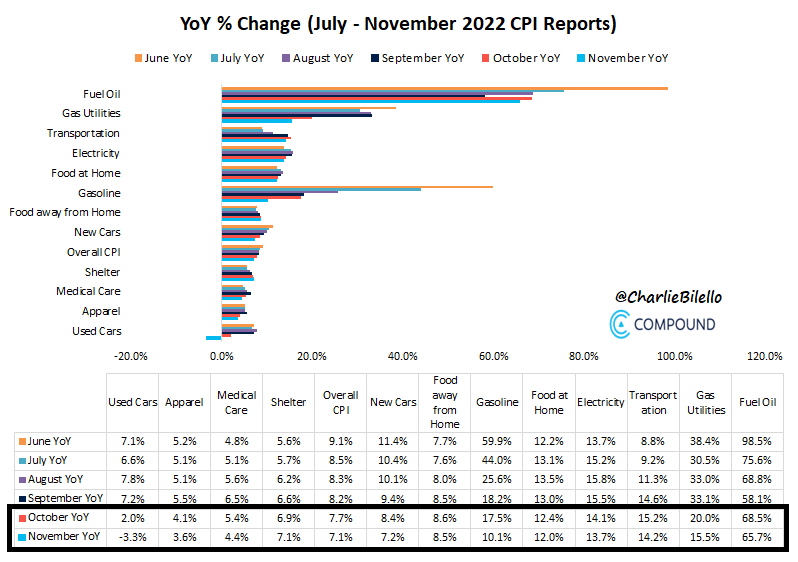
With the exception of Shelter (which is lagging the real-time decline in rents & home prices), all of the major CPI components showed a lower YoY % increase in November than October.
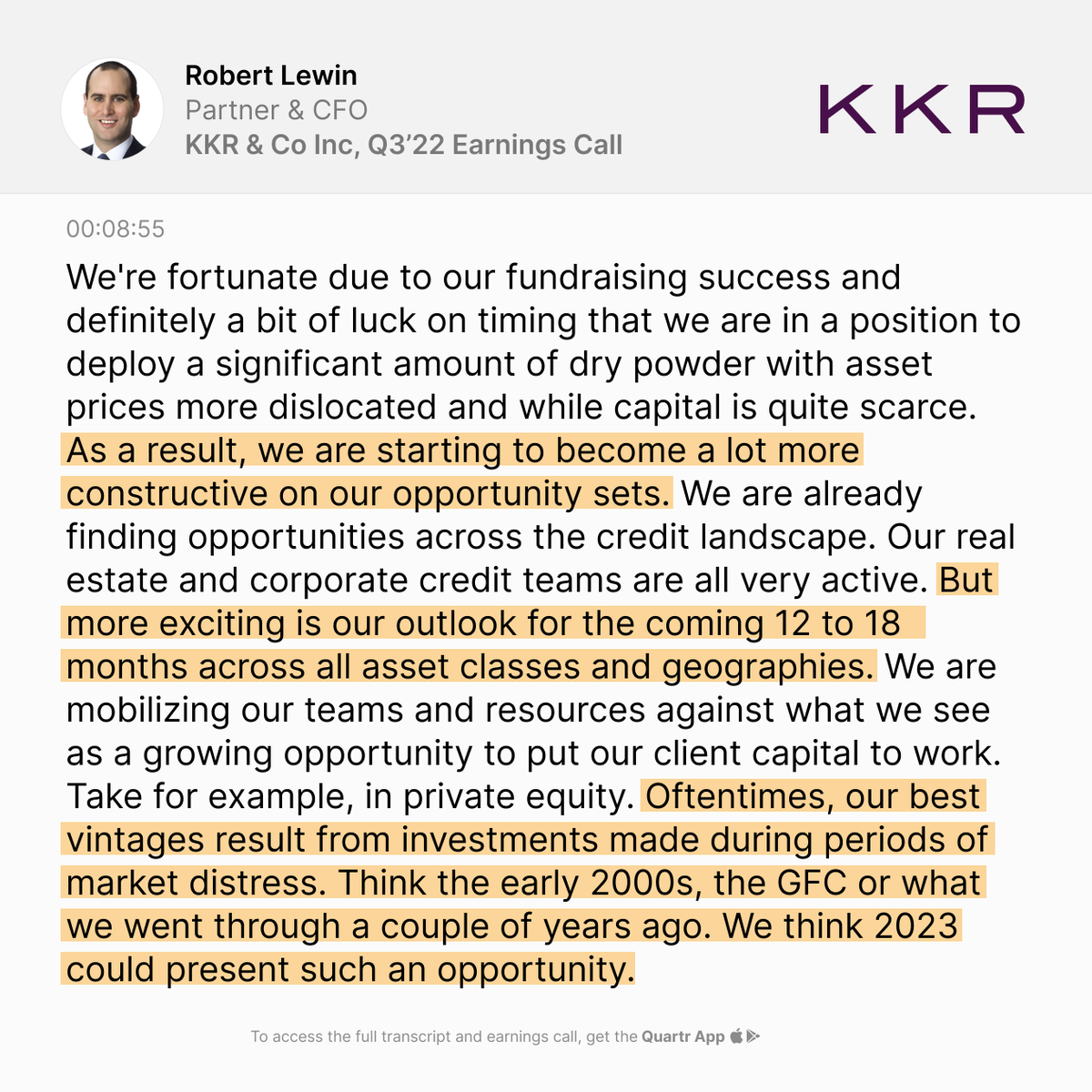
$KKR, one of the largest alternative asset management firms in the world, thinks 2023 could present a buying opportunity like the Dot-com Bubble or the Great Financial Crisis, and currently holds over $100B in dry powder:
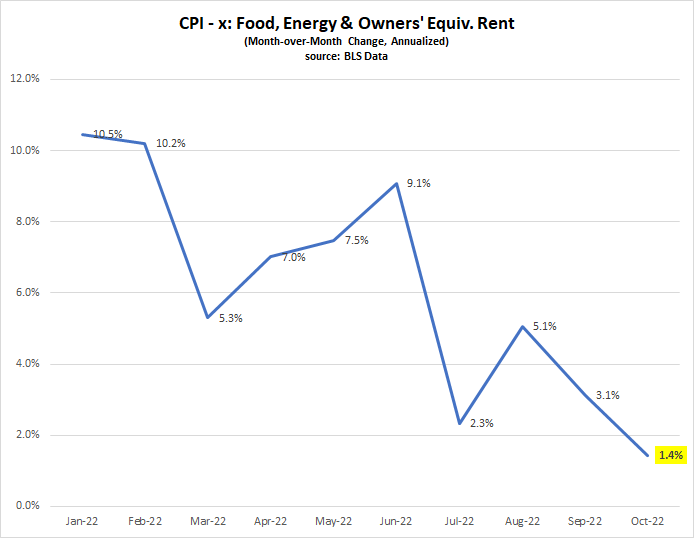
Here's how I look at the Oct CPI data.
- Take core CPI (x: Food & Energy) - & exclude OER (not rent but just OER).
- While it's volatile, month-over-month change, annualized has now breached below 2%.
I think Nov., Dec. readings may go negative by this measure (temporarily).