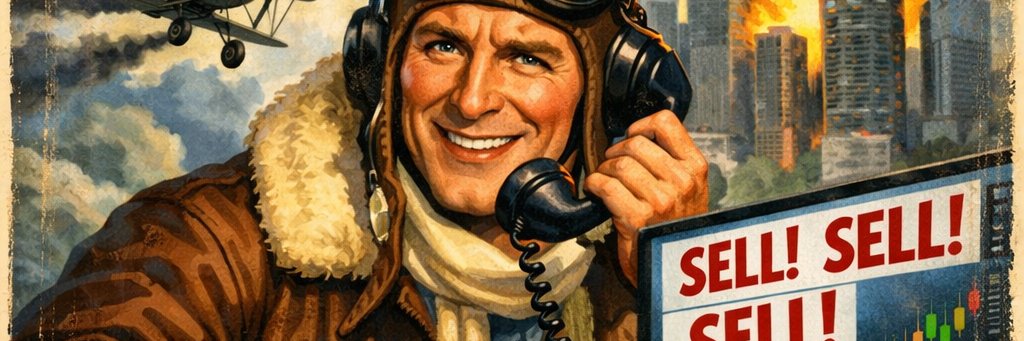
If you have under $10 million and you are buying Apple, you have voluntarily entered the one fight in all of public markets where you have no edge, no advantage, and no reason to exist.
There are 40 PhDs, three sell-side teams, and a sovereign wealth fund modeling Apple’s next quarter to the penny, and you, with your brokerage app and your podcast opinions, have decided to join that table. You will not find a mispricing in Apple. The mispricing in Apple was arbitraged away before you finished reading the headline.
Meanwhile there is a $90 million industrial parts distributor in Wisconsin that no analyst covers, no fund can buy because the position would take six weeks to build, and no institution will touch because it would not move the needle on a billion-dollar book. That is your table. That is the only table where being small is an asset instead of a punchline. Your size, the thing that feels like a limitation, is the single greatest structural edge available to a human being in public equities, and you are spending it on the most picked-over stock on Earth.
The big funds cannot follow you down here. That is the entire point. Go where they physically cannot fit.
👉📄 Drill permits have been issued, and the rig secured for a 2,300m RC program to test three highest-priority #Copper#Gold#Porphyry pipe targets at ATT's Byrock Project.
🗓️Drilling to commence mid-June as planned.
Read all the details:
https://t.co/nfYrzOIQqQ
The start-up and tech focus is BS - the budget hammers every single business and its employee owners. The incentive to work hard is being destroyed at all businesses in the name of Labor expanding the public service by 25% and paying for a government sector that is the largest share of the overall economy since WWII. It is highly regressive, stealth socialism. It is making once extraordinary Aussies very, very ordinary by global standards. We are rapidly going from world-class to cattle-class. From the Wonder Down Under to Asia’s Ibiza
@asxpeasant "What kind of busines are these?" From my experience as this end of the market - a high proportion are lifestyle Co's. My fav is a junior in Charters Towers Qld that has been doing it since the 90s without even changing their name or vending new assets to pump- remarkable really
Classic ABC quality reporting. One voice, one viewpoint. Every substantive opinion in the article comes from Joe Courtney, a Democrat. There's no Republican, no Trump administration response, no analyst, no dissenting Australian voice.
https://t.co/BuvvLjP9y1
China looked at the lessons of 20th century great power conflict and drew the conclusion that military power alone doesn't determine outcomes, upstream industrial capacity does.
The Allies won because of overwhelming industrial might. Japan and Germany lost because they lacked critical industrial inputs. Starved of oil, they were forced into gambles that cost them the war…Japan attacking Pearl Harbor to seize the oil in the Dutch East Indies, Germany marching to the Caucasus to take the Baku oil fields. Input scarcity doesn't just weaken you. It steers your decisions. It pulls decisions away from the optimal plan and toward the necessary plan.
China learned this lesson and decided to be the one holding the chokepoints. By embedding itself so deeply into the upstream supply chains that feed American military production, a conflict would trigger Western industrial paralysis and neuter its ability to fight a long war.
But the chokehold only works if the West doesn't rectify its supply chain vulnerabilities before China is ready to move on Taiwan. So China's central strategic requirement was to delay Western recognition of the threat for as long as possible.
Thus, China's entire foreign policy posture becomes oriented around appearing non-threatening. And it works because it aligns with the economic incentives of Western elites who benefit from cheap inputs and profitable trade. The cost of denial is kept artificially low. Raising the alarm looks like paranoia or protectionism when cheap goods keep flowing and no shots are being fired.
The administration is now racing to unwind its supply chain vulnerability before the conflict window opens. But that takes years, and they face significant inertia, both domestically and among allies who remain naively blind to the risk.
China knows this. So their strategy is to keep the West sleepwalking. Which means they can’t show their hand. If China comes into direct military conflict with the US in order to defend a proxy, the West wakes up. The inertia collapses. The reshoring and remilitarization that China spent decades trying to prevent happens on an emergency timeline.
But the US finally realized it could use this against them.
Since China can’t show its hand until it's ready to move on Taiwan, the US realized that it can turn China's greatest strategic asset, the pacifist disguise, into a structural trap.
They cannot take overtly aggressive action without triggering the Western industrial mobilization their entire strategy depends on preventing.
So the US can eliminate their proxies and China can’t respond without destroying the disguise.
Maduro removed. Cuba strangled. Now Iran.
Beijing must decide if defending the proxy is worth waking the West up? And the answer keeps being no.
Until China’s window to move on Taiwan opens, the pacifist posture that enabled its chokeholds constrains their response to US actions.
Everything the US is doing right now is a race to be ready before that moment arrives. Clear the proxies. Arm the allies. Break the chokeholds. And build new ones of its own.
The cost to charter and transport crude/gas in a large vessel from the Gulf to China now $477k a day - this wont surprise given the risk premium, with some insurers not insuring at all... given the duration of a round trip, it would cost around $21m for a round trip...
Good luck to all...
China looked at the lessons of 20th century great power conflict and drew the conclusion that military power alone doesn't determine outcomes, upstream industrial capacity does.
The Allies won because of overwhelming industrial might. Japan and Germany lost because they lacked critical industrial inputs. Starved of oil, they were forced into gambles that cost them the war…Japan attacking Pearl Harbor to seize the oil in the Dutch East Indies, Germany marching to the Caucasus to take the Baku oil fields. Input scarcity doesn't just weaken you. It steers your decisions. It pulls decisions away from the optimal plan and toward the necessary plan.
China learned this lesson and decided to be the one holding the chokepoints. By embedding itself so deeply into the upstream supply chains that feed American military production, a conflict would trigger Western industrial paralysis and neuter its ability to fight a long war.
But the chokehold only works if the West doesn't rectify its supply chain vulnerabilities before China is ready to move on Taiwan. So China's central strategic requirement was to delay Western recognition of the threat for as long as possible.
Thus, China's entire foreign policy posture becomes oriented around appearing non-threatening. And it works because it aligns with the economic incentives of Western elites who benefit from cheap inputs and profitable trade. The cost of denial is kept artificially low. Raising the alarm looks like paranoia or protectionism when cheap goods keep flowing and no shots are being fired.
The administration is now racing to unwind its supply chain vulnerability before the conflict window opens. But that takes years, and they face significant inertia, both domestically and among allies who remain naively blind to the risk.
China knows this. So their strategy is to keep the West sleepwalking. Which means they can’t show their hand. If China comes into direct military conflict with the US in order to defend a proxy, the West wakes up. The inertia collapses. The reshoring and remilitarization that China spent decades trying to prevent happens on an emergency timeline.
But the US finally realized it could use this against them.
Since China can’t show its hand until it's ready to move on Taiwan, the US realized that it can turn China's greatest strategic asset, the pacifist disguise, into a structural trap.
They cannot take overtly aggressive action without triggering the Western industrial mobilization their entire strategy depends on preventing.
So the US can eliminate their proxies and China can’t respond without destroying the disguise.
Maduro removed. Cuba strangled. Now Iran.
Beijing must decide if defending the proxy is worth waking the West up? And the answer keeps being no.
Until China’s window to move on Taiwan opens, the pacifist posture that enabled its chokeholds constrains their response to US actions.
Everything the US is doing right now is a race to be ready before that moment arrives. Clear the proxies. Arm the allies. Break the chokeholds. And build new ones of its own.
The CDIs are up 30% since this post - but the gap still open as the TSX has bid up to A$1.60 on Friday. A further 15% from today’s close. Im all out after accumulating around 30c last year.
$kcc $kcc.ax
Currently over A$1.40 on the TSX with highish volumes- decent arb opp for the CDIs opening up if the stock continues to be well bid in Canada
$ptr $ptr.ax
Mineral sands are out of favour (ILU closing Cataby etc) and traditionally hard to make money (Shellfield - Thunderbird). Rosewood is shaping up to be a fantastic asset, and the majors will want to control it. Buying here at A$80m market cap - 20c is a gift.