SMB owner, ETA, woman, small business, inventor, marketer, avid learner, do-gooder, lover of life and all things positive, Kellogg MBA, Penn engineering grad
Great news! I was skeptical, but I just received confirmation from a lender that they've been able to get new $5 million loan SBA-approved for different NAICs for Personal Guarantors who've already maxed out their $5 million SBA.
Different NAICS, frees up another $5 million.
M&A Monday*: Closing Conditions
I have seen more buyers saved by closing conditions than any other provision.
Last month, I got an urgent call from a client. He had signed a purchase agreement, but his deal had not closed. The key manager was leaving. He said, do we have any way out of the purchase agreement or renegotiate terms? Of course, we had a closing condition, the parties renegotiated. It closed shortly thereafter.
Closing conditions are only applicable to a non-simultaneous sign and close.
In an M&A deal, there are 3 milestones: (1) LOI, (2) Purchase Agreement, and (3) Closing. Usually, the Purchase Agreement is signed at Closing (simultaneous sign and close). In a simultaneous sign and close there are no closing conditions.
Closing conditions are contingencies that must be achieved or waived in order to close. Usually, the closing date is not set and will occur when all closing conditions are met/waived. Closing conditions are included in the LOI and are extremely important. Remember, buyer is not forced to close if conditions are not met. However, if buyer wants to close, it changes the negotiating power to allow buyer to renegotiate (i.e., if no closing condition is triggered, seller can tell buyer to pound sand).
When I draft a LOI, I think about closing conditions applicable to this specific business. Here are some common conditions:
1. The conclusion of due diligence review. This is a controversial condition. It gives buyer the right to back out for any DD issue buyer does not like. This is powerful for buyers. When I represent sellers, I do not accept this.
2. No occurrence of a material adverse effect (MAE). This is always included, but the definition of MAE is hotly contested. If there is a dramatic change in the business, buyer does not have to close.
3. Buyer’s consummation of financing. This is another controversial one. Sellers view this as a financing contingency – because it is. However, from buyer's perspective, if no financing they usually cannot buy the business.
4. Offer letters with key employees. I started including this a couple years ago after seeing too many deals go bad after closing because of misalignment with key employees. This forces buyer to sit down with key employees and level set expectations and seller to retain employees. So important.
5. The receipt of third-party consents. There are lots of consents, including, landlords, licenses, key suppliers, etc. Those consents should be obtained or waived by buyer. Buyer cannot be forced to buy a business if in default of key agreements.
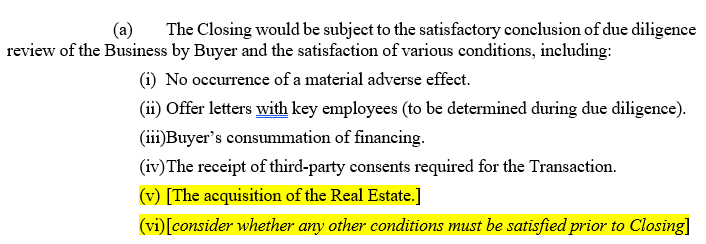
This is what is looks like in myLOI:
A buyer should ask, what change in the business would prevent me from buying it? That should be a closing condition.
*It still feels strange writing substantive M&A posts while 243 civilians are held in Gaza. But our resilience is our strength. This post is dedicated to 5-year-old Emilia Aloni, kidnapped from her home. She has been held captive for 23 days.
Download Loom.
Record every task you do in your business.
Get transcript from Loom and ask ChatGPT to summarize it and list the steps.
Create a database in Notion or Airtable.
Add Loom to database with transcript.
Add category tag so you know what it's for.
Congrats.
Now you have an SOP database and can start delegating tasks.
Don't over complicate things.
When someone "gets" their job and executes well, it translates directly into sales and profits for the company - without headaches and issues.
To do this, we use Metric-Based Roles.
Here is a recent example at one of our acquisitions that increased sales by 20% in 1 month 👇
We had an employee who did odd jobs around the shop, Jim.
Jim cared for the employees, wanted the plant to do well, and understood the basic functions of the factory floor.
I asked him to be "floor supervisor".
"What does that mean?"
"Jim, I want you to run the systems and playbook I give you, and keep this whole floor running"
"What does that mean?"
"Here is a list of examples:
- you may be pushing product through cleaning to meet a deadline
- possibly working with molders to solve a quality issue identified by cleaning
- switching the order of product on the floor
- etc...
I have a playbook, and 5-6 systems - you just need to make sure the team is executing on them."
"I still don't get it... but I'll try"
So I gave Jim his P.A.P.A sheet:
1. His purpose was to meet our values on the floor "Safely get quality product out the door on time while making a profit"
2. He had full autonomy within that statement to call audibles, make changes, and run the business. The floor was his domain, and he was king there.
3. Principles - use our principles when making decisions including long term thinking, prioritization through our framework, experimentation, etc.
4. You'll be held accountable in our weekly meeting.
For his metric-based role, I assigned him "Parts shipped"
If this got pushed too hard, 2 things might happen:
1. quality
2. cost
So I assigned quality as the guiding metric for each department head under him and cost control to the head of the plant within their own P.A.P.A frameworks
Week 1: A mess. He wasn't sure what to do, was "on the floor" and present, but not sure what to focus on.
In the accountability meeting we asked why no parts shipped. After he looked into it, he realized they were held up in shipping due to inspection.
"Ok Jim, so executing our playbook at this stage would have been verifying on your sheet these needed to ship, and pushing them through before they were late."
Week 2: He monitors shipping, but due to a molding issue, we don't ship nearly the product we needed too. Molding was working on quality, and Jim as focused on shipping and inspection hold ups.
In the accountability meeting we discussed and he realized that a part can get held up at any station, and while he doest have to be the one to fix it, he just needs to make sure it is getting fixed, and parts are moving.
"In order to do this, I should know all the orders coming up, and walk the floor a few times a day to get pulse checks and make sure things are moving."
Ah Ha #1 - he is self creating duties and cadences to accomplish his metric
This went on for 2 more weeks as he understood his role and what was needed more and more.
We got 20% more part out the door at the end of that month.
Learning through self discovery is ALWAYS more powerful than simply being told your duties.
Our powerful framework for job definition is simply:
1. Identify the real need: Increased Sales
2. Create the metric: # of Parts Shipped
3. Insert into P.A.P.A framework
4. Create Balance: Offset metrics were assigned
5. Accountability: Weekly meetings based on the metric
6. Space: We gave Jim room to self discover and have poor results - thereby designing his own set of duties and responsibilities.
https://t.co/p7nS8yR8t8
Super excited about the NYC meetup we're hosting at the @Shopify offices Oct 19th!
Open to @ecommercefuel members as well as non-members who do $1M/year.
Share a few details below to get a reg. link/invite. Limited to 100 spots total. See you in NYC!
https://t.co/rjCrGDXXSe
See you in the Show-Me State...
We're looking forward to seeing everyone this November at the inaugural @MainStSummit; a new gathering for SMB owners, operators, and investors.
Hat's off to @BrentBeshore and his team over at @PermanentEquity for putting this all together.
6 reasons why you won’t ever buy a business
1. Uncommitted
2. Don’t have a Get Shit Done personality
3. Volume way too low
4. Criteria is bad / aimless meandering
5. Low confidence - unwilling to bet on yourself
6. It’s hard
I’ve used Zapier for ~6 years
It makes my biz run on autopilot
Today, a buddy asked me how I use it
So, in graphic detail, I showed them every single zap I use in my business
It’s you…
You’re the buddy.
Here are the EXACT Zaps I use to make my biz run on auto-pilot:
👇👇👇
Bring Manufacturing Back To America
- Where it went
- Why its important
- How it actually works
- How to get it back
A mega thread on small domestic Mom & Pop manufacturers on this 4th 🇺🇸
How has Twitter changed since Elon Musk took over?
1) Goodbye Text, Hello Images: Witty, one-sentence bangers are less common than they once were, and almost everything in my Twitter feed is a photo or video now.
2) Pay to play: If you don’t pay $8/month, people won’t see your tweets. Simple as that. Click the replies to any tweet and you’ll see the blue checks at the top, followed by all the people who haven’t forked over their credit card.
3) The Rise of Long Tweets: Long tweets (like this one) are in. Any tweet with a link to an external source still gets punished by the algorithm.
Together, they are a canary in the coal mine for how Twitter will evolve.
— —
Part 2: The Future
For a glimpse into the future of Twitter, look at Elon’s tweets.
Today, he shared that the platform reached an “all-time high in user seconds,” which tells me that these changes are “working.” If so, they’re just the beginning. The more time people spend on Twitter, the more profitable the company will become, so I don’t see the attention-optimization going away any time soon.
Elon also likes to say that “the most entertaining outcome is the most likely,” so I’d bet on Twitter becoming, well, more entertaining… but please get rid of the incessant fight videos and Only Fans ads.
Culturally, Twitter’s changed too. It feels bigger now. More of a keynote speech, and less of a back-room in the pub. The quality of ideas on here reflects that. They’re more polished and buttoned-up, but fringe and esoteric ideas are harder to find now.
The close communities are disappearing too. Do tight sub-communities even exist on here anymore? What creators have gained in top-of-funnel reach, they’ve lost in genuine relationships. I met many of my best friends on here between 2015-2020, but gone is the culture of genuine friendliness that facilitated such relationships.
The time is ripe for a social media platform to do what Twitter used to be so useful for — making friends and meeting like-minded weirdos.
— —
Part 3: My Recommendations
Though Twitter’s changed, it’s still the social platform of record for people in finance and Silicon Valley. The big names are on here. What you say matters. If you’re early in your career, regularly posting high-quality tweets is one of the best ways to make a name for yourself.
If you’re struggling to navigate these changes, I have a few recommendations for you:
1) Write long-form tweets: I actually love these. They’re more thoughtful than the average tweet, and fun to write too. If you’re writing one, nail the first 280 characters so people will click into it and read the entire thing. Long-form writing will improve your thinking too.
2) Lists: You can pin lists to the top of your app. I have a list of ~20 must-read accounts that I check all the time. Then, I have another list for people who write threads and long tweets, which I open whenever I have more time.
3) Teach the algorithm: The algorithm is fairly responsive, actually. Block people. Mute words. If you see a click-bait video, click the “I’m not interested in this tweet” button.
4) Follow the Likes: For a high signal-to-noise ratio, ditch the “For You” feed and browse the likes of your favorite creators instead.
Unfortunately, the Internet is broken.
We’re trapped in a Never-Ending Now. The information architecture of the Internet leads us towards entertainment over education, news over history, drama over wisdom, and the timely over the timeless. Our culture is near-sighted. Panic is the norm. So is anxiety. Our smartphones have instant access to the greatest minds of all-time, from Aristotle to Tolstoy, but we default to nonsense that’s been created in the past 24 hours instead.
What if the Internet was optimized for wisdom?
The Chart of Accounts
they can make or break your financial statements
but what are they?
and how do you design them correctly?
Learn all about them right here 🧵