we are probably 6 to 12 months away from the first pill designed to make you biologically younger
today just changed the stakes
the first ever reverse-aging drug was just injected into a human. Life Biosciences. David Sinclair. today, an actual human patient.
here is everything pointing at the same moment:
- Sinclair is also testing an oral reprogramming pill in the $101M XPRIZE. whole-body rejuvenation. a 10-year biological age improvement in one year of treatment
- scientists just discovered ABT-263 dramatically reverses aging in skin and speeds wound healing. topical. already works
- NewLimit raised $435M from Peter Thiel to deliver age reprogramming to the liver
- semaglutide slowed biological aging by 9% on epigenetic clocks. a diabetes drug doing this on the side
the convergence is coming
bio/acc.
A human brain uses 12-20 watts for core thinking while an AI system doing the same processing could use 2.7 billion watts.
This makes organic brains roughly 100–225 million times more energy-efficient than current silicon-based systems for full biological neural computation.
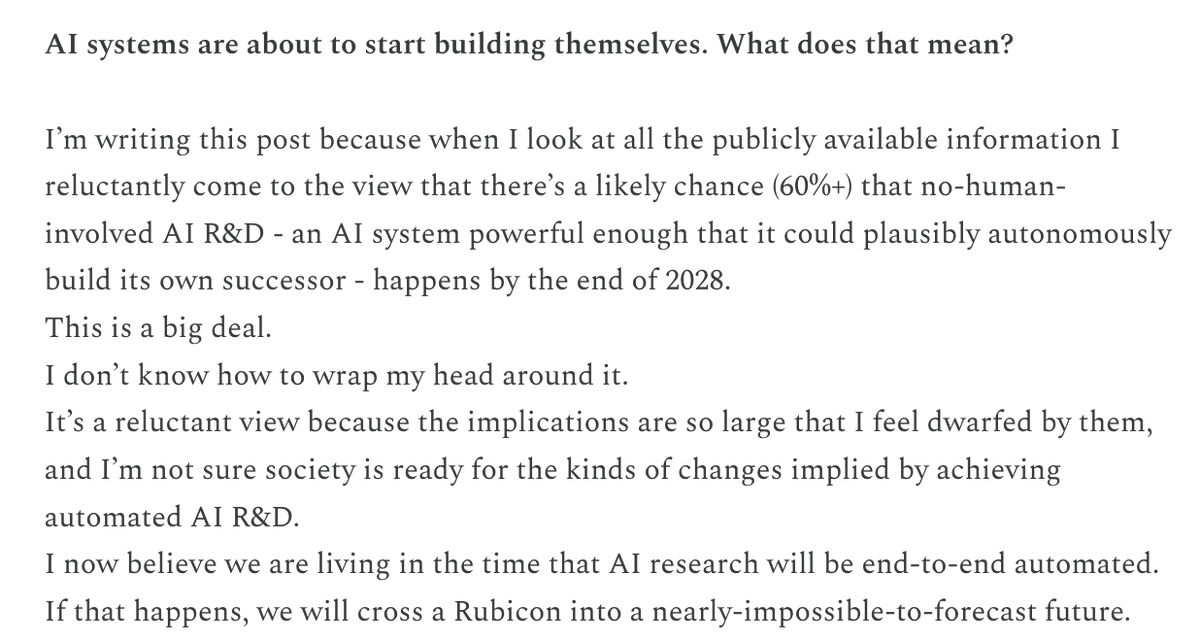
"But if these trends continue, AI systems designing and building their own successors is plausible. This could revolutionize society—medicine, technology, the economy—for the better. But it may also compound alignment issues and ultimately lead to loss of control."
Our internal data shows Claude is accelerating AI development—a possible path to recursive self-improvement, or AI autonomously building a more capable successor.
It’s happening faster than we thought, and the implications deserve greater attention. https://t.co/OVVPJO7VQx
The limitations of LLM based AIs are not too surprising at this point. We need models that are trained on the fundamental patterns of the universe, aka math and physical laws. Statistical pattern matching form language can serve us only so much.
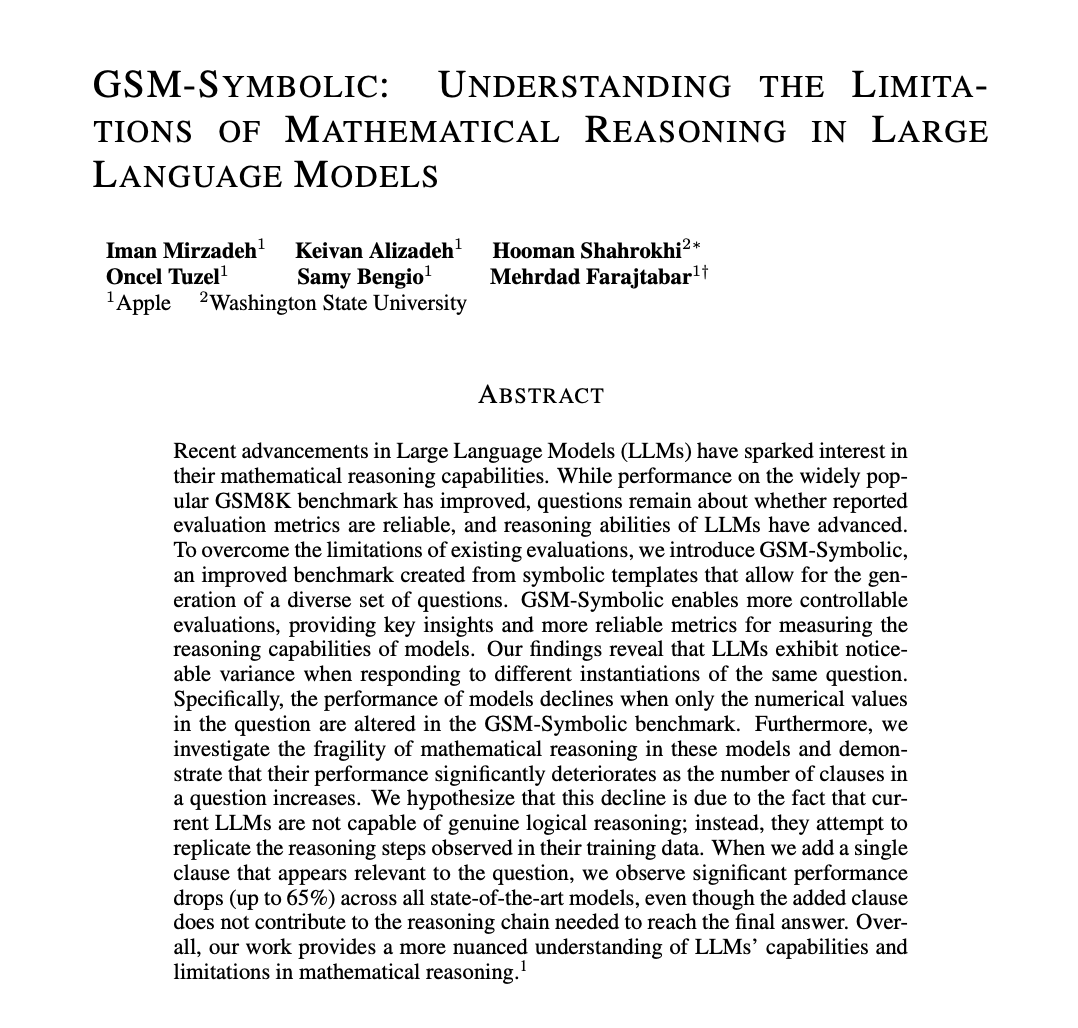
turns out AI models cannot do math.. even grade school math. the kind a 10-year-old solves.
Apple published a devastating study that exposes a massive illusion at the core of artificial intelligence.
they took the standard math benchmark (GSM8K) that every AI company uses to brag about how smart their model is.
first, they just changed the names in the word problems.. the models' performance fluctuated for no reason.
then, they changed the numbers. the performance immediately dropped.
but then they ran the test that broke everything.
they added one single, completely irrelevant sentence to the word problem. something like: "By the way, 5 of the apples were green."
A human 10-year-old ignores the green apples and solves the underlying math.
the AI didn't.
across every state-of-the-art model, performance collapsed by up to 65%.
the AI blindly grabbed the irrelevant number and tried to shove it into the equation. it didn't know why it was doing the math. it just saw a number and assumed it was supposed to use it.
there is no genuine logical reasoning happening under the hood.
we are deploying these systems to run our finances, analyze our legal documents, and make complex strategic decisions.
but the models don't actually understand the logic they are spitting out.
they just know what a smart answer is supposed to look like.
The human body became a software engineering problem the minute CRISPR arrived. Now, AI writes better code than humans, with every disease becoming a potential coding challenge.
Didn't understand much of it, but it feels so weird to know that all our memories - sweet, loving, happy, sad, regretful, exciting, and of all kinds - are just a bunch of molecules hustling and a bunch or neurons aligning to fire in sync in the brain...
How a memory gets physically written into your brain — at the molecular level:
ACTIVATION …
The synapse fires, a glutamate signal arrives, then the NMDA receptor opens and Ca²⁺ floods into the post-synaptic spine.
Calmodulin — a small dumbbell-shaped sensor protein — cradles four Ca²⁺ ions, two per lobe. Loaded calmodulin clamps onto CaMKII, the central memory enzyme of the brain.
CaMKII isn’t one kinase. It’s a holoenzyme: 12 kinase domains arranged as two stacked hexagonal rings of 6, all radiating from a violet hub.
When Ca²⁺/calmodulin binds, the kinase arms swing out from their folded inactive state into the activated starburst.
Then each kinase autophosphorylates its neighbor at Thr286. That single modification locks the enzyme ON — even after Ca²⁺ leaves. The switch is now a latch. The memory trace begins here.
DOCKING …
A microtubule is a hollow cylinder built from α/β-tubulin dimers — 13 protofilaments, 25 nm outer diameter, 15 nm inner lumen. The tubulins tile its surface in a near-hexagonal lattice.
CaMKII’s hexagonal foot is ~20 nm across. The numbers aren’t coincidence — the kinase hexagon matches the tubulin lattice exactly.
When activated CaMKII lands on a microtubule, six of its kinase feet contact six tubulins arranged in a hexagonal ring around one untouched central “address” dimer.
Complementary surface charges hold it in place with 6 to 36 kcal/mol of electrostatic attraction — strong, specific, reversible.
The enzyme isn’t just sitting on the lattice. It’s registered to it. Like a print head locking onto paper.
ENCODING — the write step
Now CaMKII writes…
Each of the six feet transfers a phosphate group (one ATP per contact) onto its target tubulin’s C-terminus — or doesn’t. Six independent decisions. Six bits. One byte.
The phosphorylation sites are real and identified:
Thr312 and Ser444 on βIII-tubulin.
Each phosphate flips that tubulin into a glowing amber conformational state, distinguishable from the unphosphorylated teal/indigo dimers around it.
The information capacity is staggering:
•A-lattice binary (β-tubulin only): 2⁶ = 64 states per byte
•A-lattice ternary (α or β phosphorylation): 3⁶ = 729 states per byte
•B-lattice 9-dimer (ternary, 6 of 8 dimers writable): 5,281 states per byte
Multiply that across the billions of tubulins in every single one of our neurons and you get memory density that dwarfs anything we build in silicon.
COMPUTATION — the pattern isn’t inert; it computes…
The phosphorylation pattern isn’t a passive record. It actively shapes the microtubule lattice, and thus the cell:
C-terminal tails flip between up/down conformations, seeding hexagonal Turing waves that propagate the pattern across the lattice.
MAPs (microtubule-associated proteins) dock preferentially at amber phospho-sites, templating bundle architecture and synaptic stability.
Kinesin — the two-legged molecular motor — reads the amber path and walks cargo vesicles along it. The memory becomes a routing map for transport.
The whole lattice resonates at MHz frequencies — millions of state updates per second. Storage and processing collapse into the same substrate.
The brain may literally write in hexagonal bytes!
Craddock, Tuszynski & Hameroff (2012), PLoS Comput Biol 8(3):e1002421 — https://t.co/InJdmdYv8d
I disagree. The human brain _is_ a biological version of the Turing machine. The human brain operates in an “adversarial” environment for survival and sustenance, but that doesn’t change the computational nature of the brain.
The human brain ( which is part of the body) is NOT a biological version of the Turing Machine
That’s a neuro centric and adult centric bias
More on this soon ! 😎
nature
How to breathe life back into brain theory
This article is a review of Romain Brette’s book The Brain, In Theory.
The central argument is that modern neuroscience relies too heavily on viewing the brain as a computer, machine, or information-processing device. Brette argues that this metaphor misses an essential point: the brain is part of a living body that continuously interacts with the environment to generate meaning and experience.
A key idea is that the brain is not simply a system that receives inputs, computes representations, and produces outputs. Perception and behavior emerge through interactions among the body, movement, emotion, and environment.
Overall, the article argues that neuroscience should move beyond purely computational metaphors and understand the brain as part of an embodied, living agent.
https://t.co/oEaoHsY9y7
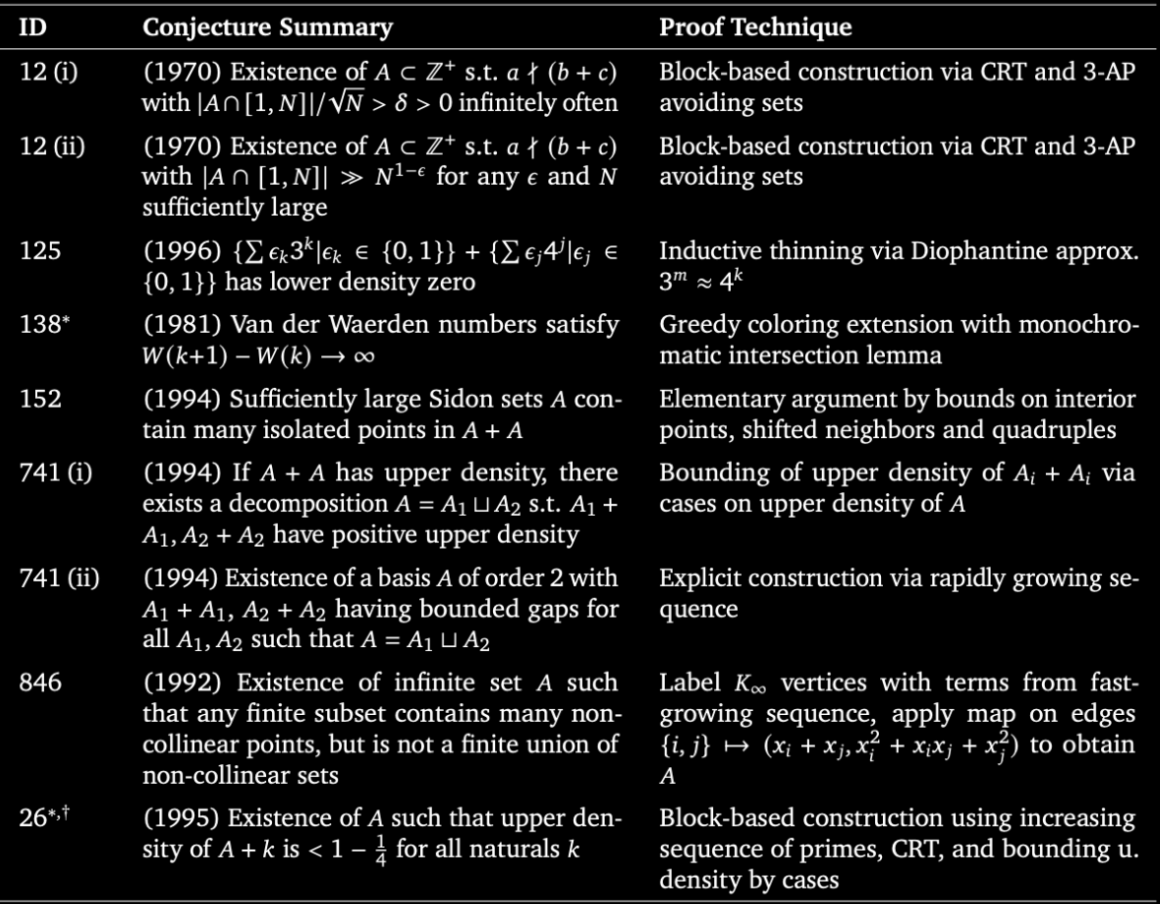
AI agents are advancing research-level math. 🚀
I’m thrilled to share @GoogleDeepMind’s AlphaProof Nexus - an agentic framework for formal proof search powered by Gemini.
When applied to a set of open formal math problems, our agent autonomously solved:
✅ 9 open Erdős problems (including two open for 56 years!)
✅ 44 Online Encyclopedia of Integer Sequences (OEIS) problems
✅ A 15-year-old open problem in algebraic geometry ✅ A 7-year-old open question in min-max optimization
We are collaborating with mathematicians across disciplines - from combinatorics and graph theory to quantum optics. Ultimately, these results show the massive potential of even simple agentic loops powered by Gemini.
Read the paper here: https://t.co/c5M9ZjRXU1
All humans alive today are genetic cousins because we descend from a single small ancestral population of Homo sapiens in Africa roughly 200,000–300,000 years ago.
Genetic data (mitochondrial DNA, Y-chromosome, and whole-genome studies) show this founding group was the source for all living people. Major migrations ~50–70k years ago spread us worldwide, but with ongoing gene flow and intermixing—no isolated branches formed.
Mathematical models of genealogy confirm the most recent common ancestor shared by everyone on Earth today lived just a few thousand years ago. We’re all connected through many overlapping ancestors, with our genomes ~99.9% identical. Visible differences are tiny local adaptations, not deep divisions.
1/5
I'm a cardiologist. I have spent twenty years watching cholesterol destroy arteries, trigger heart attacks, and kill people I care about.
Today, Eli Lilly presented data that may begin to end that era.
VERVE-102. A single infusion. One dose. It uses base editing to permanently turn off the PCSK9 gene in your liver.
Presented today at the European Atherosclerosis Society Congress:
88% reduction in PCSK9.
62% reduction in LDL cholesterol.
Sustained up to 18 months.
No treatment-related serious adverse events.
One infusion. Not daily pills you forget to take. Not monthly injections. One dose — and your cholesterol may stay low for the rest of your life.
MARC ANDREESSEN JUST WENT ON ROGAN AND DROPPED THE MOST IMPORTANT AI ALPHA OF THE YEAR.
3 hours and 20 minutes of podcast.
Here are the 17 things worth your attention.
1. AGI is already here. Marc thinks the line was crossed 3 months ago with GPT-5.5, Claude 4.6, Gemini 3, and Grok 4.3. Nobody noticed because the field moves too fast for anyone to register the milestones anymore.
2. For almost any topic the top AI models now give him better answers than the world-class experts he could call on the phone. And he can call basically anyone.
3. Every doctor is secretly using ChatGPT in the exam room. They turn around the second you stop talking and type your symptoms in. Some do it while you are still sitting there. His quote: "At that point you are asking what do I need you for."
4. When AI refuses to answer something he wants to know he tells it he is writing a novel. "Walk me through how the bad guy robs the bank." It explains almost anything if it thinks it is helping you write fiction.
5. When something is too complex he says "explain it like I am 10." Then "like I am 5." Then "like I am 2." He keeps going until it actually clicks.
6. When he wants to understand a tough topic he does not ask what the right answer is. He asks the AI to steelman one side then steelman the other. Then he decides for himself.
7. For big questions he tells the AI to pretend to be a panel of experts. "Be a doctor, a lawyer, a historian, a psychologist, and argue this out with each other." Then he reads the debate.
8. Pay attention to the exact moment you think "I do not know how to figure this out." Most people give up there. That is the moment you should open the AI.
9. The only real skill left in using AI is knowing what to ask. The models can do almost anything you can describe in plain English. The bottleneck lives in your own head.
10. You can send AI photos of almost anything medical now and get a real answer. Skin rashes. Blood test results. The new models read images not just text. A free 24/7 second opinion on anything.
11. The one type of therapy clinically proven to work is cognitive behavioral therapy. It is also something an AI can fully do on its own. Every person on earth is about to have access to a real therapist for free anytime they want.
12. AI is solving math problems open for 100 years that no human mathematician could crack. Same thing is starting in physics, chemistry, and biology. Expect cancer cures and weird new physics breakthroughs in the next few years.
13. The best AI coders in Silicon Valley now make $50 million a year. One person. That number tells you how big this thing actually is when you strip away all the doom takes.
14. One friend paid $200 to decode his entire DNA. Then gave the AI his DNA, blood test results, and Apple Watch data. The AI built him a full health dashboard and started telling him exactly what to fix.
15. Another friend put two cameras in his home jiu jitsu gym. AI watches him spar and gives him technique notes after every round. A world-class coach at every practice for free.
16. The best programmers in Silicon Valley now run 20 AI coding bots simultaneously. Each bot writes code while they review the others. They call themselves AI vampires because going to bed means 20 workers stop and you lose money every hour you sleep.
17. The obvious next step: the bots will run their own bots. One human running 20 bots each running 20 more. One person. One laptop. 1,000 AI workers. This is months away not years.
Bookmark this before you watch the full podcast.
Follow @cyrilXBT for every AI insight worth your attention the moment it surfaces.
The modern Turing Tests for AI are to solve problems in fundamental sciences like Physics, Chemistry, Biology, and Mathematics! And the floodgate is opening slowly, but surely!
What if reason isn't our pathway to truth but our obstacle to it? | https://t.co/eKAkzpwIj1
From Popper's demand for falsifiability to Darwin's own doubts about the human mind, philosopher of science Samuel McKee argues that our brains were shaped by evolution not to perceive reality accurately, but to survive within it.
False beliefs aren't evolutionary errors, but features optimising us for social cohesion over truth.
I don't think The Hard Problem of Consciousness explicitly says we have a soul or that consciousness is non-physical. It simply says we do not know how the biological and physical brain gives rise the vivid lived experience of things like pain, the redness of red, the hot flush of intense love and desire, and so on.
That said, I agree with Rovelli that consciousness is something we haven't just figured out yet. It's nothing mysterious, 100% generated by the biological and physical substrate in our brain and nervous system.
https://t.co/6q7VNnSKQO
Someone can certainly *make* a billion dollars. That’s not the same thing as earning.
Growing fast and disrupting markets also often means chasing and wielding market power, political influence, and scale.
Take Airbnb. They heavily lobby politicians against passing housing laws to protect working class residents because it’s bad for their business model.
Airbnb could not exist at its current scale and size without the housing market destabilizations, displacements, and exploits that are supercharging the evictions of working people everywhere from Puerto Rico to Jackson Hole.
Now young people are planning for a future where they will never be able to afford to own a home while others have 20 and live off renting it out to them at extortionate rates with zero protections. Yes, a tiny amount of people can make billions of dollars doing that. And millions of everyday Americans are bearing the cost.
[Very] Soon AI will run the show end-to-end.
I think the window for maintaining and preserving human supremacy over AI is between now and until the time when AI start navigating the 4D world (3D space and 1D time). Once AI start taking control of the physical environment, and start planning for future [for themselves] while keeping perfect memory of the past, we might start to _finally_ lose the plot to them!
Not sure if world models is the path to physical AI, but humans are "natural" AI made possible through billions of years of evolution that continuously kept selecting the best "breed" of the Homo Sapiens species in terms of fitness against the environment. So when AI also hits the same rubrics for survival, its only natural that both AI and humans contend for the same set of resources that nature provides us here on planet Earth.
That's also the point when AI may enter into our political and economic activities. And social circles too - soon thereafter.
Fun times to live!