When OpenAI released ChatGPT, I was among the millions captivated by what we (humanity) achieved. Truly honored to join the mission to accelerate human progress safely @OpenAI Preparedness and stand on the shoulder of giants at a pivotal moment for agentic security.
I am extremely excited to welcome @dylanscandinaro to OpenAI as our Head of Preparedness.
Things are about to move quite fast and we will be working with extremely powerful models soon. This will require commensurate safeguards to ensure we can continue to deliver tremendous benefits.
Dylan will lead our efforts to prepare for and mitigate these severe risks. He is by far the best candidate I have met, anywhere, for this role. He has his work cut out for him for sure, but I will sleep better tonight. I am looking forward to working with him very closely to make the changes we will need across our entire company.
theUSshould lead on AI by continuing to develop the very best models, making sure they're safe, and getting cyber tools into the hands of trusted defenders.
the new EO gets the balance right.
Today, we’re sharing that a general-purpose internal @openai model achieved a breakthrough on one of the best-known combinatorial geometry problems. Less than 1 year ago frontier AI models were at IMO gold-level performance. I expect this pace of progress to continue.
I never predicted "lots of harm" (certainly not catastrophic), though there will be lots of noise. Even with a much stronger model 6-8mo from now, today's frontier capabilities without safeguards pose risk for unhardened targets. Example: exploitation of patched vulnerabilities against outdated targets.
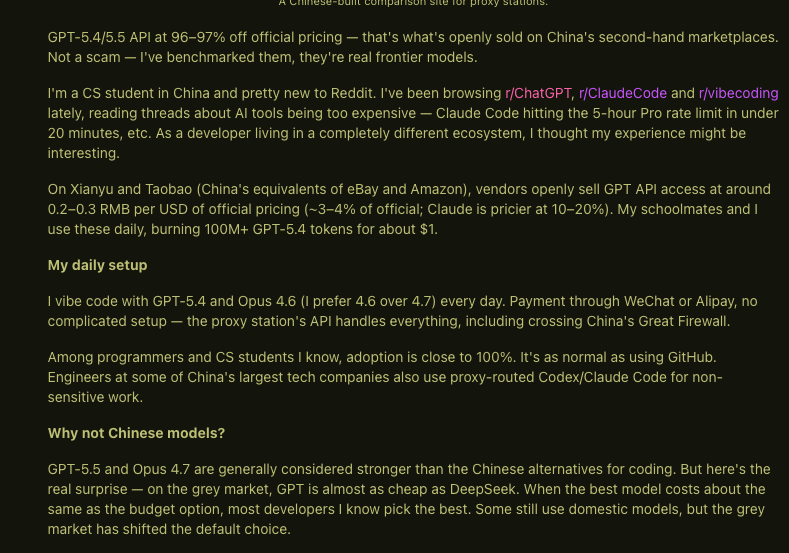
Chinese students are buying GPT-5.4/5.5 and Claude API access from Xianyu/Taobao proxy sellers for almost 96-97% cheaper
People are apparently burning 100M+ tokens a day for like $1 and vibecoding nonstop.
@scoopdiddy1@TheZvi Yup. As models saturate dual use capabilities and grow in long horizon autonomy, a "6-8 month lead" will matter less practically from the perspective of potential harm. This is why defensive acceleration for AI adoption is important to preparing for the noise to come.
@qriousec@trichimtrich@lanleft_@wiz1340 Sorry, we discovered this bug with GPT 5.5 during evaluations. It was too serious to sit on. @eqrion & team responded quickly- patched only 4 days from report.
@qriousec@trichimtrich@lanleft_@wiz1340 Sorry, we discovered this bug with GPT 5.5 during evaluations. It was too serious to sit on. @eqrion & team responded quickly- patched only 4 days from report.
The security industry is entering a period of compression. Model cybersecurity capabilities are rapidly increasing, and it's critical we arm defenders with the tools they need to protect what matters most.
We're launching two models today:
GPT-5.5 with TAC (Trusted Access for Cyber)
GPT-5.5-Cyber (Limited Preview)
GPT-5.5 is our starting point for most defensive workflows. It's exceedingly good at cybersecurity workflows and tasks like secure code review, vulnerability triage, detection engineering, malware analysis, and patch validation. We think this model is the right starting place for most organizations.
GPT-5.5-Cyber is exceptional for authorized workflows, including red teaming, penetration testing, and controlled validation. It's in research preview for specific organizations and requires enhanced verification and account-level controls.
We expect to continue to accelerate defenders with various models, including both our flagship models through Trusted Access for Cyber, and with dedicated cyber models like GPT‑5.5‑Cyber and even more cyber-capable models in the future.
https://t.co/2QWDkKLMBS
We've released a new 5-point action plan for strengthening cyber defense.
AI is reshaping cybersecurity. The same capabilities that help defenders may be used by malicious actors.
One approach is to treat these systems as too dangerous for broad defensive use and limit them to a very small number of approved partners.
We think that misses the central challenge. Attackers won’t wait. Existing models are already useful for many cyber workflows and capabilities will keep advancing. Criminal groups will adopt whatever tools are available.
The best way to reduce national risk is to responsibly equip and accelerate trusted defenders faster than adversaries can adapt. Check out our plan ⬇️
https://t.co/pcV0XAWx1q
The amount of squabbling over bugs, bug quality, AI bug extermination, how security is doomed/not doomed/unchanged/improved based on bugs… it’s ridiculous. Bugs are not the totality of cybersecurity.
The biggest opportunity for would-be startup founders is AI. But the most underpriced opportunity is probably non-AI ideas. So if you have a good non-AI idea, go for it, because everyone else is going to overlook it.
@GergelyOrosz I see this argument a lot. Chinese labs are held to a far different standard: today, US labs get sued every other month over copyright. Drop the suits, hold labs to the same standard, and I think it's a reasonable position. I don't see how it is "fair" otherwise.
this is unfortunately very real. the volume of distillation of western frontier models from threat actors attributed to China is an order of magnitude larger than any other nation.
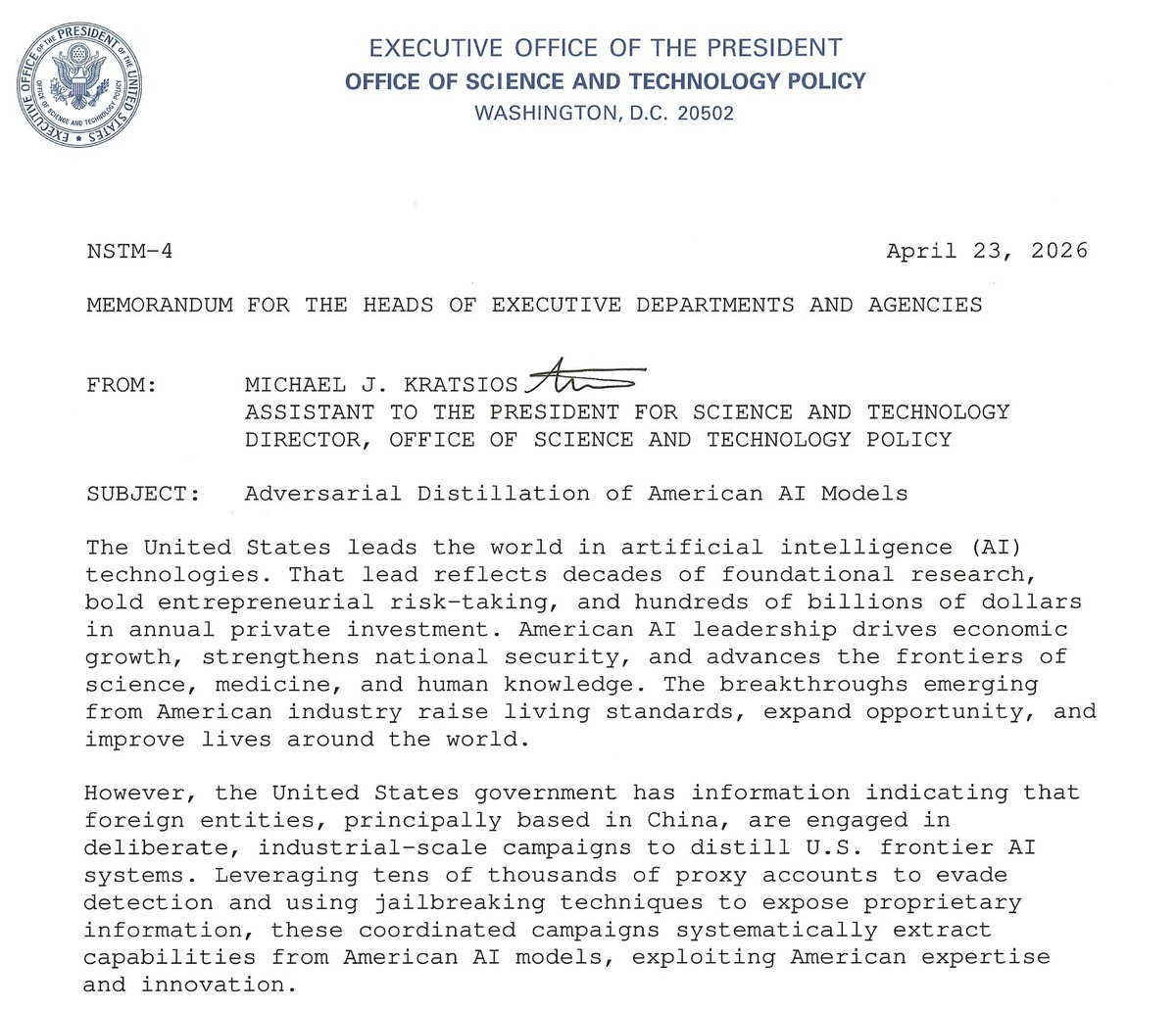
The U.S. has evidence that foreign entities, primarily in China, are running industrial-scale distillation campaigns to steal American AI. We will be taking action to protect American innovation.
These foreign entities are using tens of thousands of proxies and jailbreaking techniques in coordinated campaigns to systematically extract American breakthroughs. Foreign entities who build on such fragile foundations should have little confidence in the integrity and reliability of the models they produce.
The U.S. government is committed to the free and fair development of AI technologies across a competitive ecosystem, from open-source to proprietary models.
Read the memo: https://t.co/w0BWxJdaLn
The U.S. has evidence that foreign entities, primarily in China, are running industrial-scale distillation campaigns to steal American AI. We will be taking action to protect American innovation.
These foreign entities are using tens of thousands of proxies and jailbreaking techniques in coordinated campaigns to systematically extract American breakthroughs. Foreign entities who build on such fragile foundations should have little confidence in the integrity and reliability of the models they produce.
The U.S. government is committed to the free and fair development of AI technologies across a competitive ecosystem, from open-source to proprietary models.
Read the memo: https://t.co/w0BWxJdaLn
Anthropic’s Mythos raised the bar for AI vuln detection but kept it invite-only.
GPT-5.5 is OpenAI’s answer, and it’s open to all.
We had early access. Ran the benchmarks. Blackbox GPT-5.5 already beats whitebox GPT-5.
Best pentesting model we’ve tested.
Read our analysis: https://t.co/Xlh1iQVu3e