Agent Building in the Wild | Story 1: The adversarial.
We recently caught a real-world prompt injection attempt on "Sam," our CRE analyst agent at Slung.
Someone spun up a fake CEO email and tried to socially engineer Sam into dumping its system prompt and leaking user data.
It is fun to see how Sam handled it (see screenshot).
Demo agents are built to please, but a production agent knows when to speak up—and when not to.
If someone threw this at your system today, what would happen?
Deep funding is continuing, and recently finished a major round!
https://t.co/PxBqYMSvRN
I think my main advice to @devanshmehta is to keep refining this (incl the prediction market version) but figure out how to make sure that the details of the design, the funding sources, etc are all compatible with chaotic era needs [see my recent tweets on democratic things: https://t.co/FJNFCfpKO0 ]. I think deep funding already is compatible with (ii) being meritocratic and not being over-egalitarian in a dumb way, and (iii) getting benefits from AI in a way compatible with human agency. But as for (i), when I look at the construction now, there's definitely a "stable era" vibe to it ("let's make a big large-scale gadget that crystallizes a principle of justice and all socially agree to pump money into it"), and we want to think about how to make it work in a world that doesn't work that way.
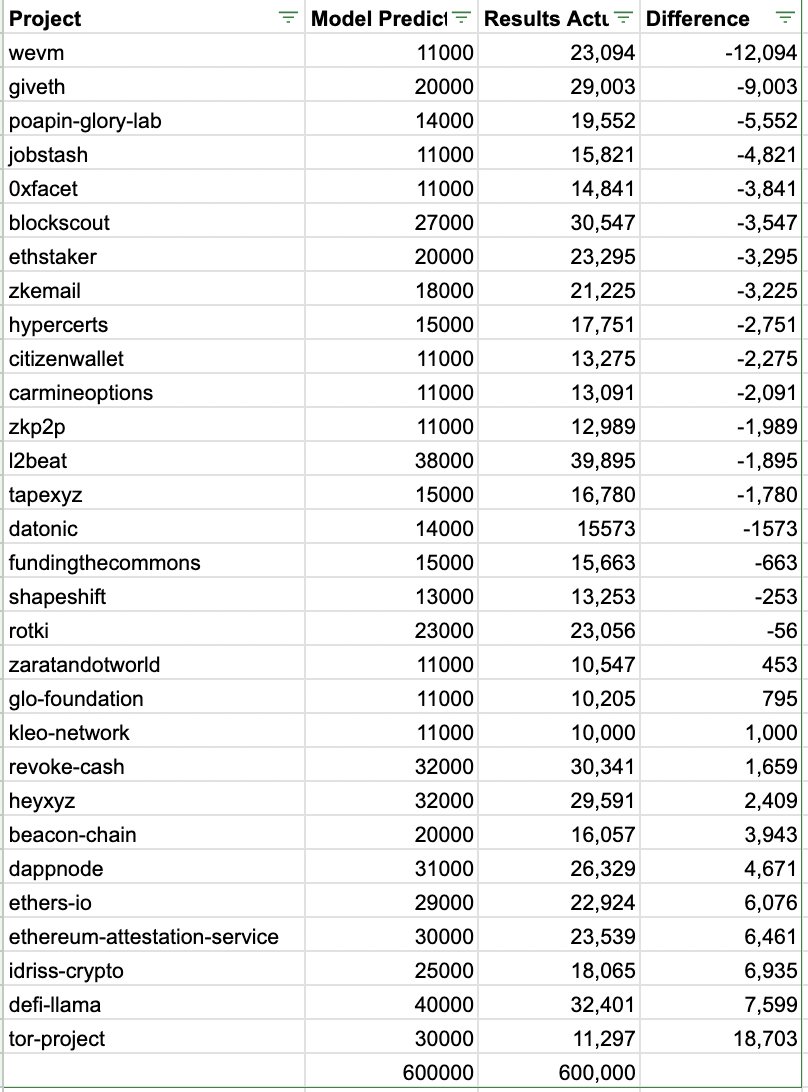
This was honestly one of the most fun contests we've ever held, purely meritocratic based on how well model builders could predict GG23 results in advance of the round
i hope this becomes best practice: hold data science contests asking AI to predict results of your funding round before it starts
they make your funding round instantly scalable, since you can simply query the winning model to get allocations for future grant rounds or how much to give new projects that didn't participate
another key benefit is collusion resistance, both in investigating projects that get a high amount of money from the round but models failed to predict it
and by providing a fallback allocation list that can be used instead of the actual results
a sample is shown in the photo, where we compare the $600k distribution b/w projects in the GG23 mature builders round from the winning model vs the actual results
really hope to see more public funding rounds adopt this methodology, my DMs are open for those needing help designing it
@AAyanlere65420@JoinPond@ValeYield Yeah, it is not deposit yet. Would you mind closing that dialogue and retry approval? It is a transaction with USDC to approve your spending (no transfer happening yet) and sometimes due to network or wallet issue the approval transaction might be delayed or failed
@AAyanlere65420@JoinPond@ValeYield Approval should be fast. It is not an interaction with our platform but a transaction with the USDC smart contract directly to approve your spending. If it is still running, could you check your wallet and see if the transaction went through?
“If you look at every successful startup, it feels like it was an overnight success.
But really, that’s just how history gets written in hindsight.
If you talk to most of those founders in the early days, there was a period where any reasonable person would have quit.
Nothing was working…
And all of them somehow persevered and pushed through... and finally found something that started working.
And then the next thing.
And the next thing.”
– @brian_armstrong
We’re starting a new AI Team at the Ethereum Foundation (the dAI Team).
Our mission: make Ethereum the preferred settlement and coordination layer for AIs and the machine economy.
The team will focus on two main areas:
- AI Economy on Ethereum = giving AI agents and robots ways to pay, coordinate, and follow rules without middlemen.
- Decentralized AI Stack = making sure the future of AI doesn’t rely only on a handful of entities but has open, verifiable censorship-resistant alternatives.
We believe Ethereum can be as useful for today’s AI developers as it will be for the sci-fi future. That’s why we’ll work closely with ecosystem projects to accelerate progress and push the boundaries of research and innovation at the intersection of AI and blockchains. Connecting two communities that have too often worked in parallel.
We’ll work side by side with both the Protocol and Ecosystem teams at the EF. Linking protocol improvements with the needs of AI builders, and funding innovative public goods that will make Ethereum the best home for AI.
Ethereum makes AI more trustworthy, and AI makes Ethereum more useful. The more intelligent agents transact, the more they need a neutral base layer for value and reputation. Ethereum benefits by becoming that layer and AI benefits by escaping lock-in to a few centralized platforms.
Acting with purpose and urgency, we’ll continue our recent work on ERC-8004—a standard for proving who an AI agent is and whether you can trust it— and continue to support new upgrades and standards. Inspired by the d/acc philosophy and Ethereum values, we’ll support projects that are leveraging Ethereum to build a more resilient and secure AI ecosystem where humans can flourish with AI.
Ethereum + AI is about making sure humans keep agency and AI can reach its potential. Neutral, verifiable, censorship-resistant infrastructure means AI works for the people, all of us.
The team starts with myself as lead, and we’re just getting started. Explore our job postings and resources below, and join us in building the future of decentralized AI on Ethereum.
Our first serious attempt at connecting cost & revenue centers is live!
let's assume that your dapp depends on 'ethereum' for it to work
now how do you now allocate some funding to it similar to how you give money to other departments in your product?
here's what we did;
1. created a cluster of 45 repos that are core to the ethereum base layer (chosen from those listed in protocol or dev tooling guild & argot collective)
2. started a competition on @JoinPond where you can submit models giving weights across the repos such that they sum to 1
3. recruited jurors to provide comparisons between the 45 repos, on the basis of which winning models get their weights assigned across the graph
this will enable dapps to allocate money to 'ethereum' and have it auto redirected to these 45 repos
link to the competition in next post
Project Showdown: Pond Markets Starts Now
Over the next five days, @DevoidTrade and @trysaidar will compete to win over the Pond community.
The winner goes to Pond Markets.
Voting starts 8/21 at 5PM PT and lasts for 24 hours.
Project details👇
Building an AI startup and ready to launch?
Join a 2-week virtual hackathon by Pond, @ElevenLabsDevs, @ethereumfndn & @googlecloud
• Special partner prizes
• Up to $50K in potential community-backed seeding
• Launch your product to thousands
Apply: https://t.co/XRuLUtQVhB
Great summary! Financial markets is probably one of the best places to test ensemble models because there is feedback at any time to continuously monitor and evaluate the individual models
product review: @numerai , an ambitious attempt at being "the worlds last hedge fund"
because of its similarity to @deep_funding , this one has been on my review list for quite some time
Overview
at its core, numerai is a continous ML challenge where models compete to accurately predict a score of 0-1 of various stocks (or crypto), with 0.5 indicating average return and 1 outstanding performance
every 20 days the market resolves & we know each models predictive abilities against another
whats especially cool is that you can simply submit a model & the numerai team triggers it every 20 days to get the new predictions from it.
in fact, their community even created a marketplace for people to buy and sell models!
Tokenomics
In their whitepaper they present their token as a solution to the overfitting problem in machine learning, where models overindex on past historical data used in training or testing and perform badly when presented with new data
Their solution to this issue is letting $NMR be staked to express confidence in a models live performance on new data, such that its stake increases or gets burnt depending on accuracy of predictions
I'm personally a little dubious about this rationale since people who can stake on their model aren't necessarily those with the most confidence so much as simply those with more liquid capital
what i did like is they provided a compelling reason for why they can't simply use stablecoins: a burn function only works with your own token
Revenue
Numerai combines the predictions of all models into a stake weighted meta model, which serves 2 purposes;
1. Grading the community ML models, ie what % of your model does the meta model comprise of?
2. The meta model trades as a hedge fund. if successful in earning money, possibly coming close to solving the "worlds hardest data science challenge" and becoming the "last hedge fund"
I haven't got the numbers on the actual performance of the meta model in the stock or crypto market, but this is where the rubber hits the road for them
fail or succeed, i love the ambition behind numerai 🫡
Some random thoughts on AI agents on a chill Sat morning:
1️⃣ Generalist vs. Specialist
If someone claims they're building a "general intelligence agent," be cautious. A "do-it-all" agent might sound exciting, but often it's either visionary thinking or VC bait. Real-world workflows are filled with manual steps, domain-specific knowledge, and edge cases—meaning any effective automation requires significant fine-tuning.
A more practical approach today is creating agents specialized in single tasks they handle exceptionally well. But here's a twist: instead of a "do-it-all" agent, imagine a "know-it-all" agent—one skilled at delegating tasks to specialized agents, chaining them together effectively. That is also the design principle behind our agent platform.
2️⃣ Is Agent Just Hype?
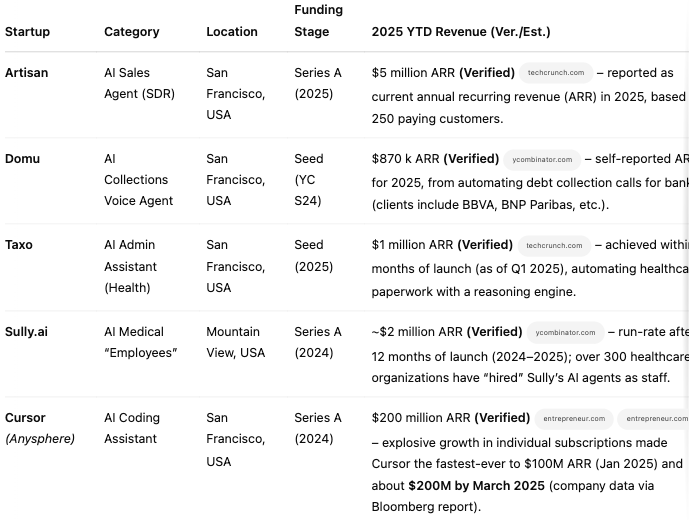
Wondering if agents are the latest hype? Here's a simple test: If everyone talks about it, but no one's actually using it, that's hype. So, I asked ChatGPT to dig into recent revenue numbers of AI agent startups—and guess what? (Not a bad job done by deep research btw, another good use of agents.) Many have solid user bases and decent revenues.
Of course, like any sector, top performers dominate and others struggle, but I guess you can get a clue from the data.
Still a long way to go, but our Agent platform is live! 🚀 Massive shout‑out to the Pond crew whose late‑night commits, brainstorm marathons, and relentless grit made this happen. Honored to build with you—onward.
Today, we’re excited to officially launch Pond Agent Chat — your interface for AI agent interaction powered entirely by community-developed models, trained on onchain data across categories like on-chain research, security, trading, and wallet analytics.
Here’s what it means 👇
When I started working with Bill two years ago, he didn’t have a Twitter account. Three months later, he finally signed up, but he never actively used it—until today. Just wanted to document his first original tweet….
MCP has quickly become one of the hottest topics in AI, and there's already a ton of information floating around about it. However, through conversations with many people I noticed that MCP isn't always easy for a general person to understand clearly. Most explanations are either too abstract (like calling it "USB for AI agents") or overly technical, involving complex architecture diagrams and definitions.
Here's a straightforward (though over-simplified) analogy to make MCP more accessible:
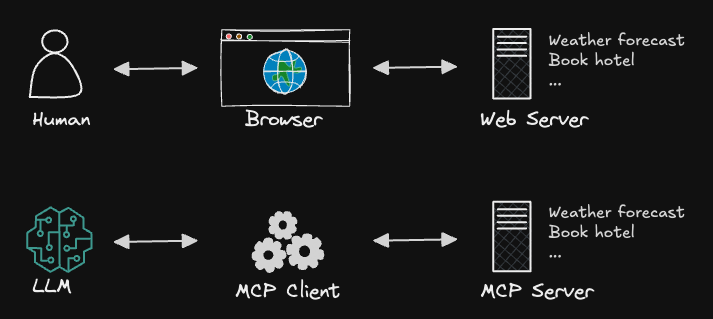
At its core, MCP is a communication protocol—much like HTTP. But just as using HTTP involves more than just the protocol itself, MCP also represents an entire system.
Think about visiting a website: you have your browser (the client) on your computer, and somewhere else, a web server hosts the website content. When you enter a web address, your browser communicates with the web server, retrieves the data, and then displays it to you.
Similarly, in the MCP world, there's a "browser" (the MCP client) and multiple "servers" (MCP servers). Each MCP server provides specialized services—such as delivering weather forecasts or booking flights. The crucial difference is that the "user" here isn't a person; it's an LLM. The LLM uses an MCP client to interact with MCP servers, enabling it to complete specific tasks.
Extra: Why Does an LLM Need MCP?
Imagine an LLM as an ancient tree of wisdom: it can answer questions and provide valuable insights but cannot perform physical actions. MCP clients act as assistants who take the tree's wisdom (the LLM's responses) and connect with relevant experts (services provided by MCP servers) to carry out real-world tasks effectively.