Excluded groups and neighborhoods get less schooling for generations. Can human capital gaps outlive resource equalization? If so, why?
My JMP looks for answers on the two sides of a line drawn in 1542, with historical censuses, a survey & experiment, and a framework 🧵
#JOBMARKET (24/26)
Meet @billywoom, an EJME and JOE Network candidate presented by the Paris School of Economics on the international Job Market.
Read his JM paper and download his CV: https://t.co/SjmyT8Xl6s
Que es el populismo? Por que se puso de moda?
La culpa la tienen las redes sociales y la interné?
Todo esto y mucho más en el #EstoNoEsEconomía de la semana.
https://t.co/O9YhPEm0If
Menna Bishop's JMP studies bonded workers in India's brick kilns, who pledge labor for wage advances. She shows advances smooth consumption, but workers underestimate the interest cost, even when it is calculated for them. https://t.co/WMZH0ih3oq
Job market paper
Deposits accumulated by social-program beneficiaries can be a meaningful funding source for the commercial banks that distribute them.
This paper asks how private banks respond when the government shuts down this channel and delivers the transfers entirely through its own public bank.
📄(Full paper:) https://t.co/m4pkYKzCVi
This is joint work with @alexrivadeneira.
Disclaimer: The views expressed are the authors' own and do not represent Banco de México.
🚨🚨🚨
We’re hiring 3-4 positions at @EconCIDE.
Preferred fields: Macro, international, trade, micro theory, or IO.
…but applications from any field will receive our full consideration, esp. from women (we want you 👉🏽🫶🏽).
https://t.co/hgdSCe5mYl
1/ I am in the 2026 job market! #EconTwitter
Is social fragmentation really a problem for economic development?
In Africa, this debate has often centered on ethnic divisions. My JMP offers a twist from a field experiment in DR Congo. 🧵
https://t.co/RXsIzUhIFb
🏆 Paola Mallia (PSE PhD 2026, PPD 2021) receives the Weiss Fund Distinguished PhD Student Research Paper Award at @NEUDC_2026 for her Job Market Paper on agricultural technology adoption in Uganda. → https://t.co/V7phYYC2Za
#WeissFund#NEUDC2026
#OrgulloCIDE | María Montoya Aguirre, egresada de la Licenciatura en Economía del CIDE (@EconCIDE), ganó la décima edición del Premio de Economía Joaquín Xirau Icaza 2026.
📄 Lee la nota: https://t.co/8dztZGZPUh
Congratulations to Paola Mallia on winning a Weiss Fund Distinguished PhD Student Research Paper Award at @NEUDC_2026.
The Weiss Fund awards recognize outstanding PhD student research in development economics. Read her paper at the link in first reply. 🔗 🌐
🚨🚨🚨#EconJobs
We are hiring two or more Assistant Professor positions: Macro, International, Trade, Micro Theory or IO, preferred, but any field is welcome to apply.
Please, women in the #EconJobMarkey apply!
https://t.co/8PL3TwtHAD
How do leaders mobilize collective action in divided communities?
In my JMP, we study how religious leaders and local chiefs leverage social and internal motivations to mobilize cooperation across ethnic divides.
Thanks to David and the World Bank for featuring our work!
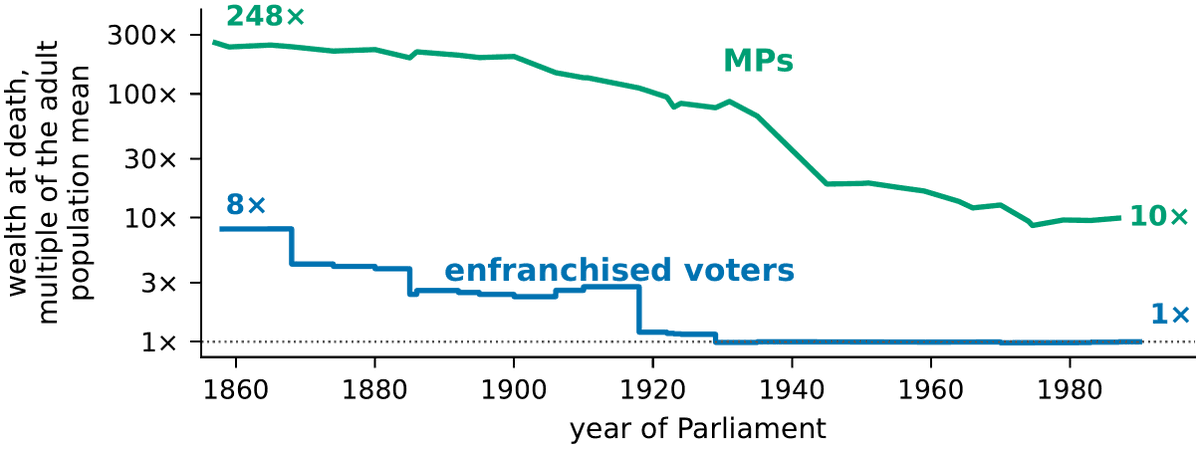
1/ Does it matter if politicians are far richer than their voters? Does enfranchising poor people lead to policies that benefit them? We link UK MPs and their voters to wealth records, 1858-1990, to find out. My JMP w/ @ellen_munroe: “How Enfranchisement Led to Representation” 🧵
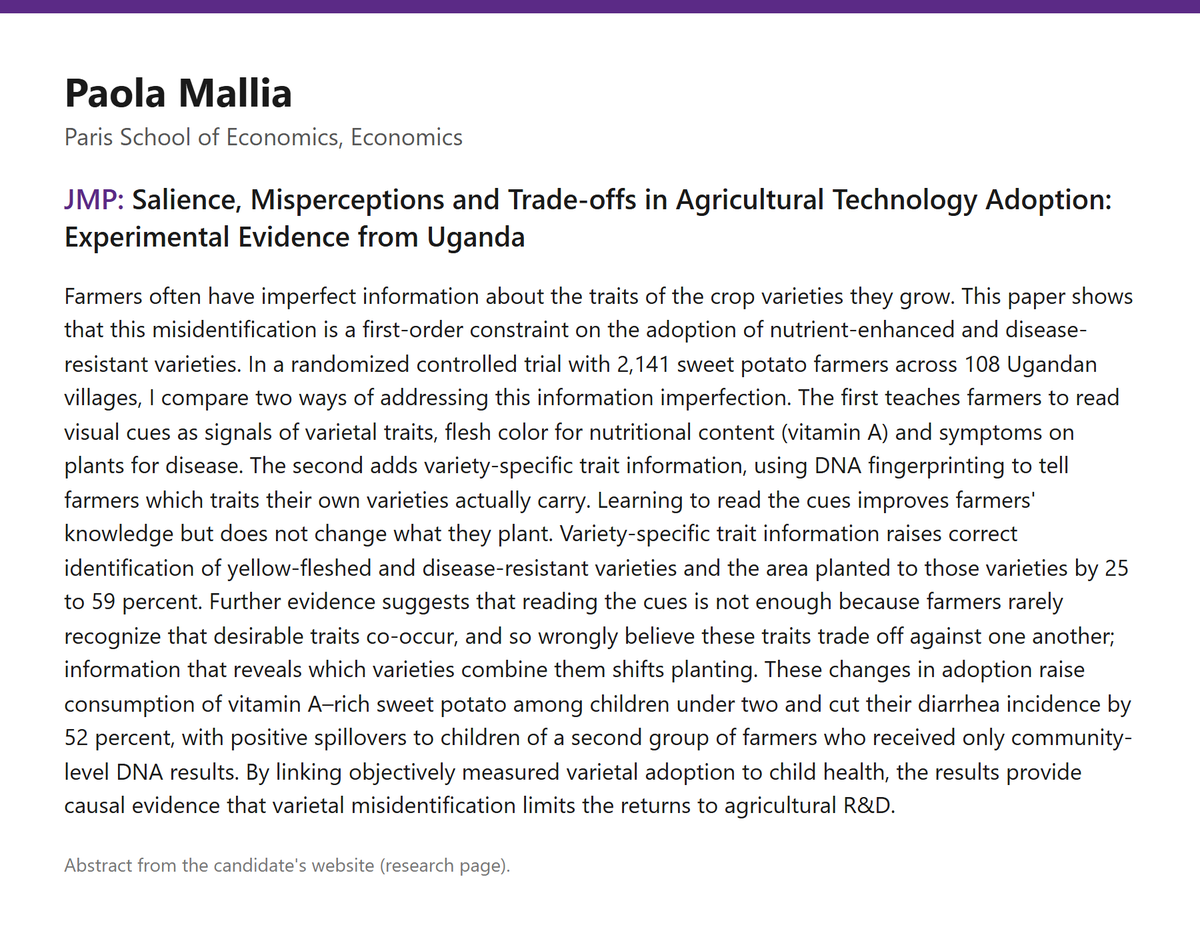
Paola Mallia
JMP: Salience, Misperceptions and Trade-offs in Agricultural Technology Adoption: Experimental Evidence from Uganda
Website: https://t.co/oOQY74nuPV
Con gusto les comunicamos que, en sesión celebrada el 10 de noviembre de 2026, el Comité Dictaminador del "Premio Daniel Cosío Villegas en Ciencias Sociales 2026" resolvió otorgar esta distinción a @HansbergRossi, economista mexicano cuya obra integra el comercio internacional, el crecimiento económico, la economía urbana, la organización de las empresas y, más recientemente, el cambio climático dentro de modelos cuantitativos con una dimensión geográfica explícita. Es Glen A. Lloyd Distinguished Service Professor en la Universidad de Chicago, donde se incorporó en 2021, Lead Editor del Journal of Political Economy y codirector de la International Economics and Economic Geography Iniciative del Becker Friedman Institute. Previamente fue profesor en la Universidad de Stanford (2002-2005) y en la Universidad de Princeton (2005-2021), donde ocupó la cátedra Theodore A. Wells ’29 Professor of Economics.
Ha sido una figura central en el desarrollo de la economía espacial cuantitativa, que estudia cómo la geografía, los costos de transporte, la migración, el comercio y las diferencias locales de productividad determinan la localización de las personas y de la actividad económica. Con Gene Grossman publicó trabajos influyentes sobre offshoring y comercio de tareas; con Luis Garicano analizó cómo la organización jerárquica de las empresas y la distribución del conocimiento inciden en la productividad, el tamaño de las organizaciones y la desigualdad. Con Klaus Desmet y Dávid Nagy publicó The Geography of Development (Journal of Political Economy, 2018), distinguido con el Robert E. Lucas Jr. Prize en 2019, y ha extendido esta agenda al estudio de los efectos espaciales del cambio climático, analizando cómo el calentamiento global puede modificar la localización de la población y de la actividad económica, las ventajas comparativas regionales y los patrones migratorios.
Sus modelos han sido especialmente útiles para estudiar la economía mexicana, desde los cambios en el empleo asociados a la integración productiva con Estados Unidos después del Tratado de Libre Comercio de América del Norte (TLCAN) hasta las relaciones entre el tamaño de los establecimientos, la informalidad, el cumplimiento de las obligaciones de seguridad social, la asignación del talento y la productividad.
Historical exclusion cuts deep, but its implications are elusive. @billywoom's work take that challenge very seriously.
Human capital is not just a matter of opportunity, but also of how historically excluded groups develop the capacity to resist and adapt.
#EconJobMarket