I attended the international summit against oligarchy, organized by Gabriel Zucman. Some reactions.
It is clear that the new oligarchs pose a danger to democracy. I believe this is how the fight against them should be framed: as a fight for democracy. Not as vengeance, or punishment.
The main issue is not their wealth, but their political power. A 2% "Zucman tax" (or even a 50% "Piketty tax," for that matter) will not diminish their power.
While taxation is an essential tool, it is by no means sufficient on its own.
Reforming campaign finance, shifting the governance of newspapers to favor journalists, and exercising much tighter control over social media algorithms are all essential steps.
@gabriel_zucman@GailiusP is on the market this year, with this paper as his JMP. Our research agenda surrounds implications of extreme wealth for political power and public goods
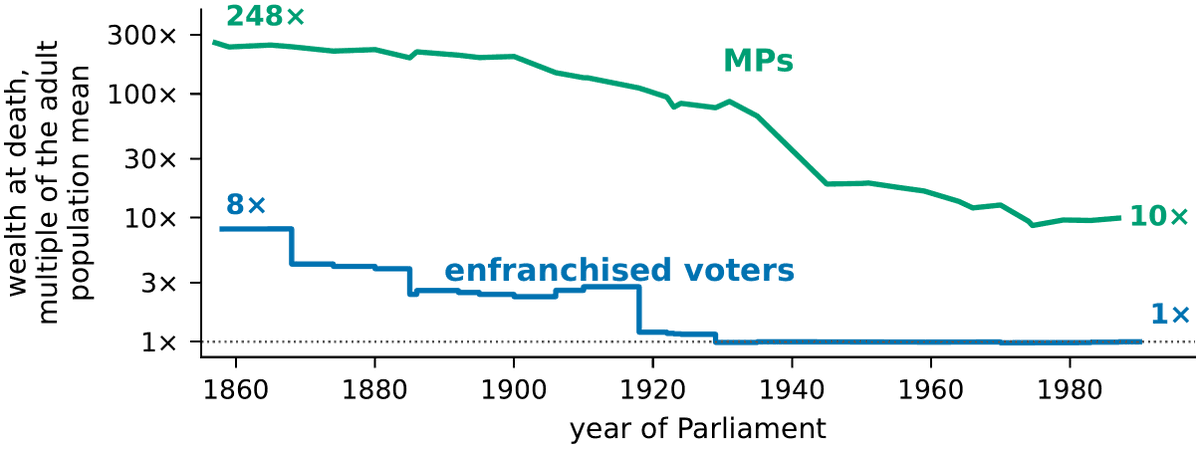
What a time to be studying extreme wealth and political power! @gabriel_zucman In our paper we use 140+ years of individual wealth data answer: What is the relationship between wealth and power? How can a plutocracy be dismantled? see link below
Today, we are launching Paris Manifesto against the international oligarchy.
Together with more than 100 researchers from around the world - economists, political scientists, legal scholars, sociologists, philosophers, historians and others -, we are sounding the alarm: the explosion of extreme wealth is a threat to our democracies. 🧵
https://t.co/gtUqlK2dxx
@GailiusP is on the market with our joint paper! We've had an absolute blast writing about the long-run relationship between wealth and political power in the UK. Check it out https://t.co/EfEGgWF5is
1/ Does it matter if politicians are far richer than their voters? Does enfranchising poor people lead to policies that benefit them? We link UK MPs and their voters to wealth records, 1858-1990, to find out. My JMP w/ @ellen_munroe: “How Enfranchisement Led to Representation” 🧵
In Budget 2026, we’re backing the Canadian artists who tell our stories.
That means if you’re a Canadian artist, you won’t pay tax on up to $45,000 of income derived from your creative work.
Coffee shops boost innovation. 10% more Starbucks in an area --> 3-4% more inventions.
People gather over a cuppa. They share ideas, discuss how to untangle a knotty problem, help see an issue from another perspective. These conversations lead to breakthroughs and inventions.
A very fun paper finds that when Starbucks rolled out to a new county, it fueled a coffee-shop culture, urging more and more people to “grab a coffee” together. The authors compare the counties where Starbucks had rolled out to those where it had not yet arrived. And they find that the number of patents in caffeinated counties is meaningfully higher.
This paper underscores how essential the face-to-face encounter is. Starbucks isn’t that old. People Could have picked up the phone and chatted at any time. People Could have dropped an email. Probably they did. But those connections didn’t yield the same insights and creativity.
Turns out that a Cup of Joe really does help the knowledge flow. We talk about how much in-person connection boosts creativity in In Person. It’s out in just few days, so now is a great time to pre-order.
To see the full research use the link in the comments.
#Innovation #InPerson #FutureOfWork #CoffeeCulture #NewBook
I am not happy about the Economist’s article, which feels like a hit piece. There is also a background to it, which is more troubling (as I will share at some point). I asked them to allow me to respond. I am waiting for their answer. If not in the magazine, I will share my response here.
I’m reminded how special British Columbia is when I go to buy non-alcoholic beer and BC liquor store doesn’t accept my valid Canadian passport as sufficient identification :)))
@ericnrobertson @GailiusP We can Dm you the link but the organizers prefer the zoom link isn't shared on social media for security reasons. I'll send to you via email.