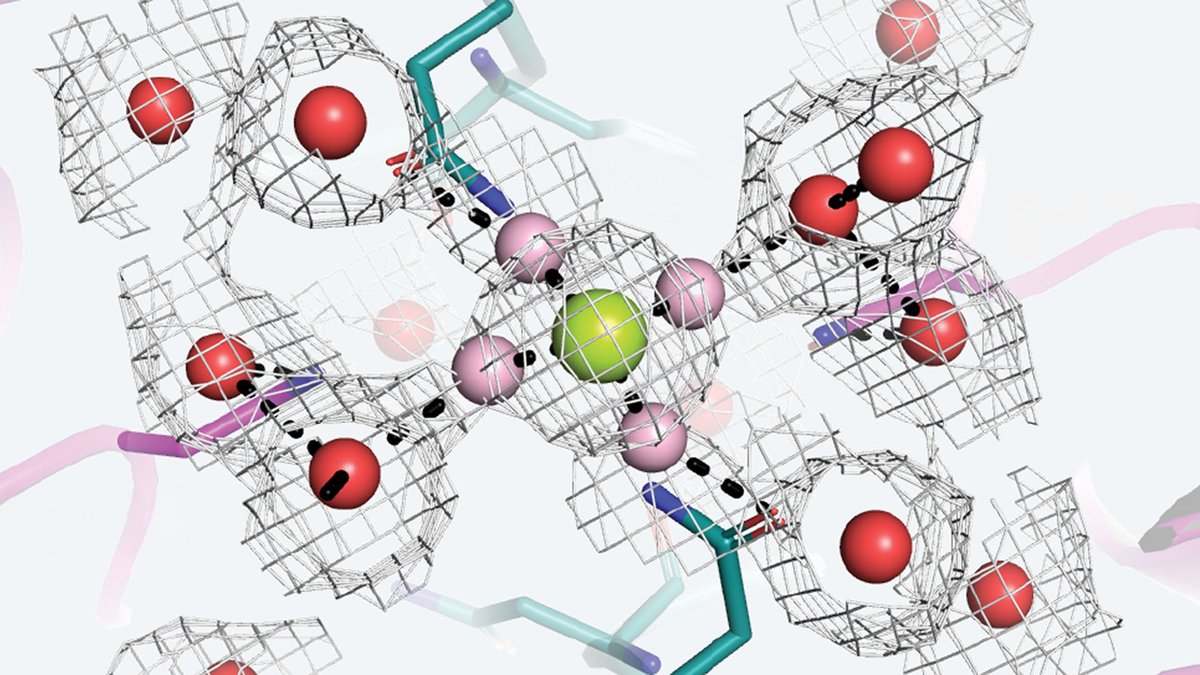
Ever wonder how your brain knows to hold onto something? What even is learning? At the molecular level, one key player is a kind of brain receptor called an NMDAR. CSHL Professor Hiro Furukawa (@Lab_FURUKAWA) has dedicated his career to breaking down the structures of these important brain receptors.
Now, Furukawa, postdoc Ruben Steigerwald, and colleagues have shown for the first time how NMDARs tell apart calcium and magnesium. Would you believe it involves dehydration?
The team's research offers new insight into the key molecular features of learning and memory. Additionally, it could have big implications for brain health and disease.
Special thanks to CureGRIN for helping to support this important work. Professor Furukawa is proud to be a part of the group’s Scientific Advisory Board.
Read more about this study at the link in bio https://t.co/3dRW56bBeB
#InspiringCuriosity #RareDisease #GRIDisorders #BrainHealth #ScienceMakesLifeBetter @NatureNeuro
Breaking the Timescale Barrier: Generative Discovery of Conformational Free-Energy Landscapes and Transition Pathways
1. A groundbreaking study introduces Gen-COMPAS, a novel framework that uses generative modeling and committor-guided path sampling to explore rare molecular events. This method reconstructs transition pathways and free-energy landscapes without predefined variables, significantly reducing computational costs compared to traditional molecular dynamics simulations.
2. Gen-COMPAS leverages a diffusion model to generate physically realistic intermediate conformations and uses committor-based filtering to identify transition states. This iterative approach allows for rapid convergence of transition-path ensembles within nanoseconds, a dramatic improvement over conventional methods that require orders of magnitude more sampling.
3. The framework is demonstrated on systems ranging from a miniprotein to a ribose-binding protein and a mitochondrial carrier. It efficiently retrieves committor maps, transition states, and free-energy landscapes, providing deep mechanistic insights and practical applications in drug discovery and protein design.
4. A key innovation of Gen-COMPAS is its ability to model protein-ligand complexes and other heterogeneous biomolecular assemblies without adaptation. This capability, combined with its GPU optimization, makes it scalable to large biomolecular systems and applicable to a wide range of biological processes.
5. The study shows that Gen-COMPAS can reduce sampling times by hundreds of times, making it an exceptionally efficient tool for investigating rare events in complex systems. It also provides a unified approach to studying both thermodynamics and kinetics, offering a comprehensive view of molecular transitions.
6. The framework's efficiency and accuracy are demonstrated through applications to fast-folding proteins like Trp-cage, binding-upon-folding processes in ribose-binding proteins, and the conformational transitions of the mitochondrial ADP/ATP carrier. These examples highlight Gen-COMPAS's potential to transform our understanding of molecular dynamics.
📜Paper: https://t.co/tRtfWjmjot
#MolecularDynamics #GenerativeModeling #ComputationalBiology #RareEvents #FreeEnergyLandscapes #TransitionPathways