The OWASP Smart Contract Top 10 2026 dropped yesterday.
The headline finding: governance manipulation, multisig compromise, and supply chain exposure caused more losses in 2025 than any category of code bug.
Security isn't just about your contracts anymore.
Aave's approach to security serves as a benchmark for all DeFi protocols.
Last month, we published a public security assessment of Aave V4 that's included in Aave's transparency report.
Read it to see how layered security works in practice.
If you hate paying monthly software subscriptions, save this.
🔗 https://t.co/b94YT8BfqQ
One of the largest open-source directories on the internet.
• 180K+ GitHub stars
• Open-source alternatives to almost every SaaS you pay for (Slack, Notion, Shopify, etc.)
• 100% free to fork, modify, and host yourself
• Covers analytics, project management, AI tools, and databases
• The ultimate cheat code for bootstrapping founders
The anti-subscription playbook 🐐
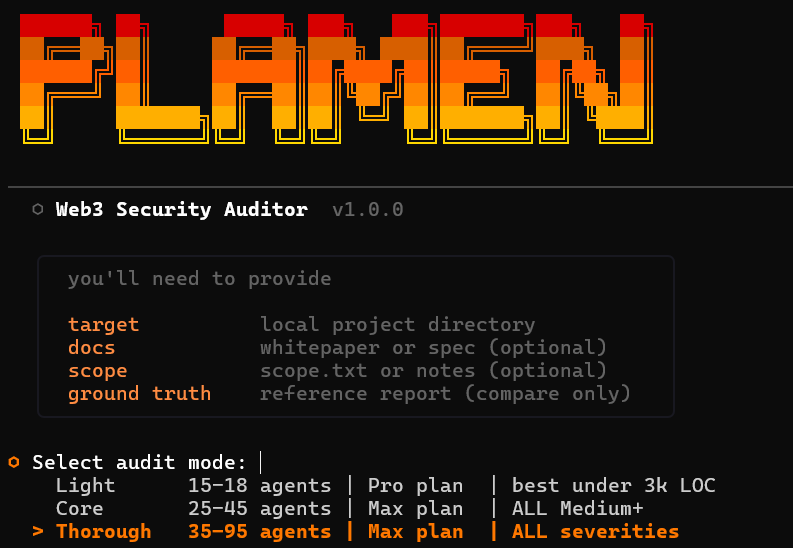
Every AI auditor now does the same boring thing.
So I went and fused the 4 security pillars into a singular pipeline:
- Static analysis
- RAG vulnerability search
- Recursive depth analysis
- Fuzzing and testing
Fully autonomous 🤖
Fully open-source 🔓
Going live tomorrow 🚨
OpenZeppeling released v5.6.0 - fully audited and introducing many breaking changes.
The most important one:
- ERC1967Proxy and TransparentUpgradeableProxy reverts on deployment if an initialize call is not provided
Hopefully, that's the end of uninitialized contracts.
OpenZeppelin Solidity Contracts v5.6 is here 💥
This release enables seamless crosschain bridging, trustless state verification across chains, and enhanced account abstraction, making it easier to build complex onchain applications.
Fully audited and production-ready 🔒
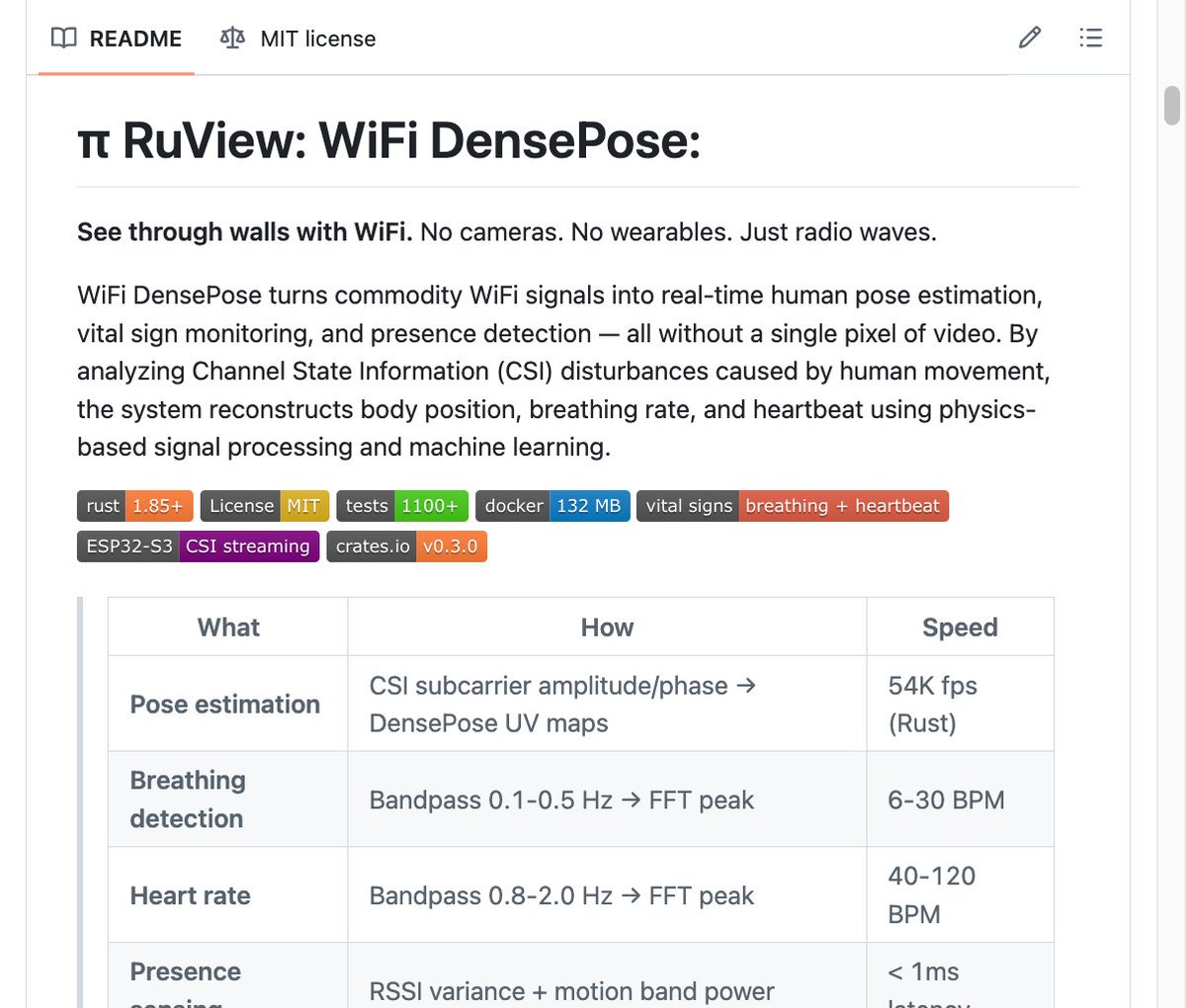
🚨 Someone just turned your WiFi router into a full-body surveillance system.
No cameras. No wearables. No video. Just radio waves.
It's called RuView. It uses the WiFi signals already in your room to detect human poses, track breathing, measure heart rate, and see through walls.
Not a concept. Not a research paper. Working code you can run right now.
Here's what this thing actually does:
→ Tracks full 17-point body pose using only WiFi signals
→ Detects breathing rate (6-30 BPM) without touching anyone
→ Measures heart rate (40-120 BPM) from across the room
→ Sees through walls, furniture, and debris up to 5 meters deep
→ Tracks multiple people simultaneously with zero identity swaps
→ Self-learns from raw WiFi data. No labeled datasets needed
Here's how it works:
WiFi signals pass through your room and hit the human body. The body scatters those signals differently based on position, breathing, even heartbeat. RuView reads that scattering pattern and reconstructs everything.
A mesh of 4 ESP32 nodes ($48 total) gives you 360-degree coverage with 12 measurement links, 20 Hz updates, and sub-30mm precision.
Here's the wildest part:
It has a disaster response mode called WiFi-Mat. It detects survivors trapped under rubble through concrete walls, classifies injury severity using START triage protocol, and estimates 3D position. The kind of tool that saves lives after earthquakes.
The Rust implementation processes 54,000 frames per second. That's 810x faster than the Python version. The entire Docker image is 132 MB.
The AI model fits in 55 KB of memory. Runs on an $8 ESP32 chip.
Train once, deploy in any room. No retraining. No recalibration.
1,100+ tests. SHA-256 verified capability audit.
22.4K GitHub stars. 2.7K forks. MIT License.
100% Open Source.
✨Introducing evmresearch✨✨
A knowledge graph of nearly everything I've learned about the EVM in the past six years
The graph structure emulates the brain, exponentiating research speeds for both humans and agents
https://t.co/974InOGRmw
This weekend I analyzed EIP-712 implementations across major protocols so you don't have to!
The main trade-off: should you compute the domain separator on demand or apply caching optimization to reduce hash operations?
Let's check industry best practices 🧵👇
... after three long days with claude code, i have this to share:
→ https://t.co/XuhC7uarbl a human readable web ui for evm storage visualization (supports Solidity + Vyper)
→ Blog post documenting my learnings: https://t.co/Nh55i9bFPu
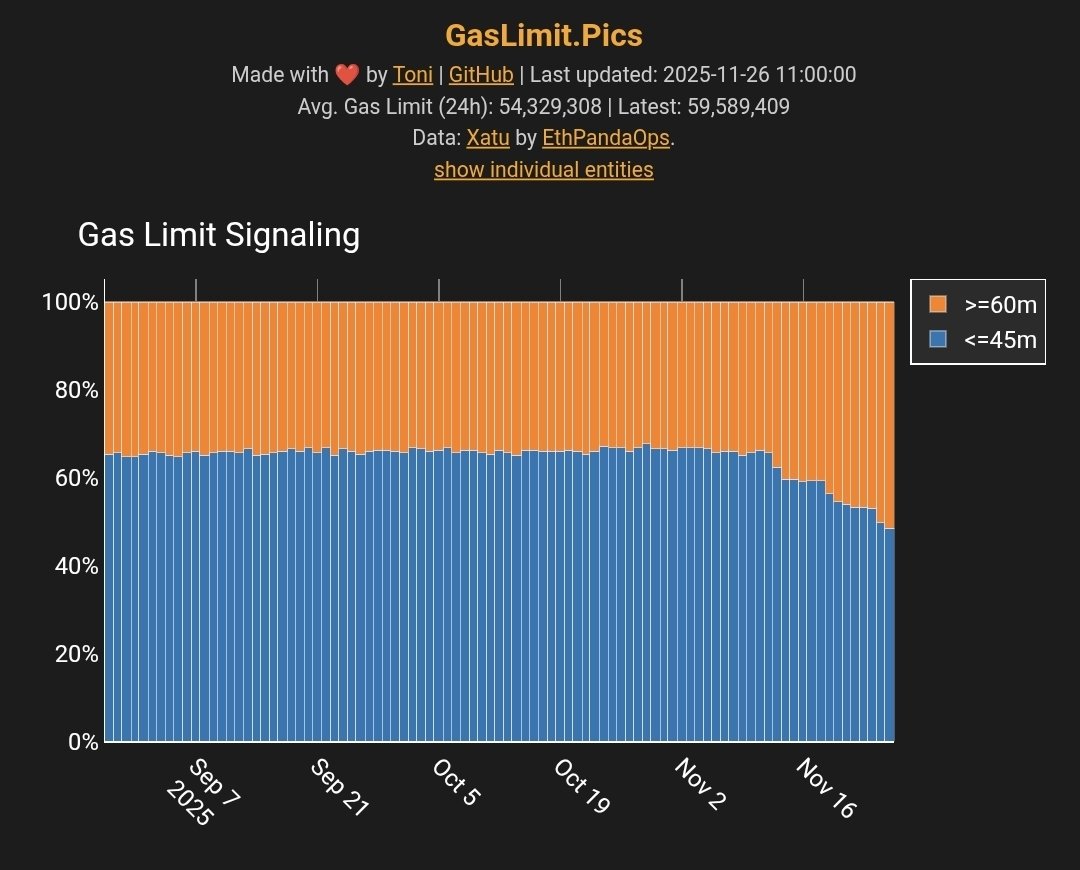
Just a year after the community started pushing for higher gas limits, Ethereum is now running with a 60M block gas limit.
That’s a 2× increase in a single year — and it’s only the beginning.
H/t to all client teams, the researchers involved, and to @nanexcool and @econoar for helping mobilize the effort.
🔗 https://t.co/vrIl4EQZwr