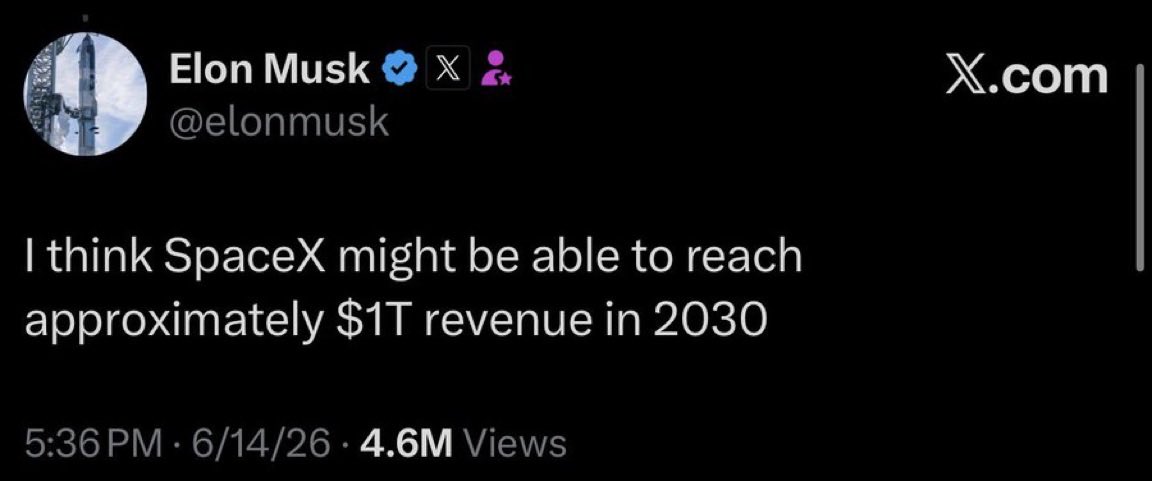
Here's some situational awareness to start your day: the world goes into a depression if SP500 crashes. It is propped up by 401k flows and degens levered to the tits but it still needs the AI ecosystem to thrive, propped up so far via cash injections from private credit raiding the IOUs of insurance companies they co-own through offshore structures. Continued cash flows depend on Anthropic and OpenAI IPO'ing. China just invalidated their business model via frontier open source models. David Sacks, "the AI czar" of the administration, has been too outspoken about preventing regulatory capture to change direction soon, which was the only thing that can save OpenAI and Anthropic other than straight up government contracts which are not economically sound in this increasingly competitive market and would be recognized as the bailouts they are, making them wildly unpopular - perhaps still attempted after the midterms to save the system. Anthropic can still IPO soon on pipe dreams and fomo(like SpaceX) and it would provide a temporary band-aid if they do but it also exposes the growth charade in their first earnings report, the stock crashes like a stone and OpenAI can't realistically IPO above $1T, which ends the cycle as OpenAI collapses in on itself. We also have the obvious business & credit cycle fragility as total # of working Americans keeps plunging, commercial & residential real estate and private credit are nosediving, Chinese households and banks are de-leveraging and European de-industrialization is gaining steam. Nothing stops this train.
@TheRealDanSaedi "demand for frontier tokens is near limitless still" sure. is this demand that's supposed to justify trillions in the room with us right now?
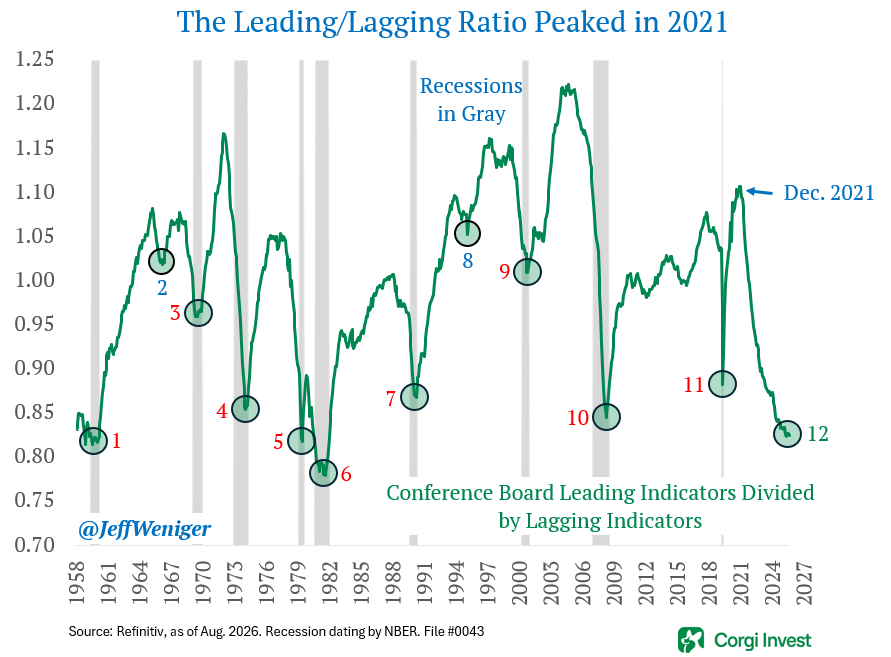
From 1959-2026, there were 12 declines of note in forward-looking leading economic indicators divided by backward-looking lagging indicators. Of the first 11, we witnessed recession in all periods save two (#2 and #8). This has fallen so far since 2021 that, at least optically, you start to wonder if there's something the consensus is missing on 2027 economic output.
I'm increasingly partial to the argument that increases in the fed funds rate will do little to lower inflation, and may be counterproductive.
- AI investment is unlikely to slow because interest rates are slightly higher
- Energy is highly inelastic and rate changes can't alleviate the current supply shock
- Higher rates hurt supply-side solutions in housing, energy, autos, and other capital intensive industries
- Higher borrowing costs raise business operating expenses, some of which is passed along to consumers
- A large percentage of debt is fixed-rate, dampening the feedback loop but hurting new homeowners, small businesses, and investment
- An economy increasingly dominated by services is less sensitive to rate changes
- This century has repeatedly demonstrated how blunt interest rate policy can be, both in stimulating inflation when it's low and suppressing it when it's high
Musings of the Day, 10/8/26
This is the two-month change in the UST Yield Curve.
Imho, it’s way overextrapolated Warsh’s reaction function, and I think this economy breaks long before Fed Funds gets to 4.75%.
This entire AI Buildout, now that it’s financed by massive amounts of DEBT, reminds me of the dark fiber buildout of 1999-2001.
ALL parts of the Leveraged Credit Trifecta (HY, BSL, PC) are suffering indigestion, the DEBT GOVERNOR is in charge now, like it or not, and will throttle GROWTH.
Read my Wile E. Coyote piece to find out what happens then.
https://t.co/J3AA02qDO2
Well the chief US economist, inarguably better equipped to know the US economy, agrees with me. https://t.co/WvxxDeGIFG
That comment on my gains.. You are just a petty little child hiding behind a middle aged bald man's profile picture aren't you.
My thesis is that supply shocks are not inflationary in an environment of tame real incomes - and I am right. If I am wrong and it is the 1970s, we will have double digit inflation by the presidential elections and higher rates than today. I wager both CPI and rates will be lower than 2% by then UNLESS Trump supplies another supply shock or the Iran war doesn't end by end of spring. remind me of this doesn't work anymore but I'm sure you'll dig it up if you're right.
Debate on cause of rise of the long term bond yields:
Two models, both produced by economists affiliated with the Fed:
1) ACM (it’s all real yields/growth/ppl expect Fed to hike)
2) KM (it is term premium)
Warsh picked the former interpretation. As did the rest of the FOMC, implied in the SEP
More than a year ago, debate on whether tariffs would generate persistent vs transitory inflation:
Two models also from Fed affiliated economists:
1) tariffs generate persistent inflation (new research)
2) tariffs deflationary in the long term, and initially a one off price change (from a long standing structural model that proved to be correct in 2018)
The FOMC adopted the first interpretation, until facts showed otherwise today.
Tell me that economics is not a dismal science.
At least the Fed should debate about this, disagree. That is not what the SEP show.
Group think is rearing its ugly head inside the Fed again.
@CEOofSPY@jam_croissant@RemindMe_OfThis I agree. People who disregard valid arguments rather attack the author should not be on this platform. As if central banks don't make wrong decisions obvious in hindsight. Research Trichet. Learn history. Unequivocally wrong my ass - Bloomberg's chief economist agrees w me.
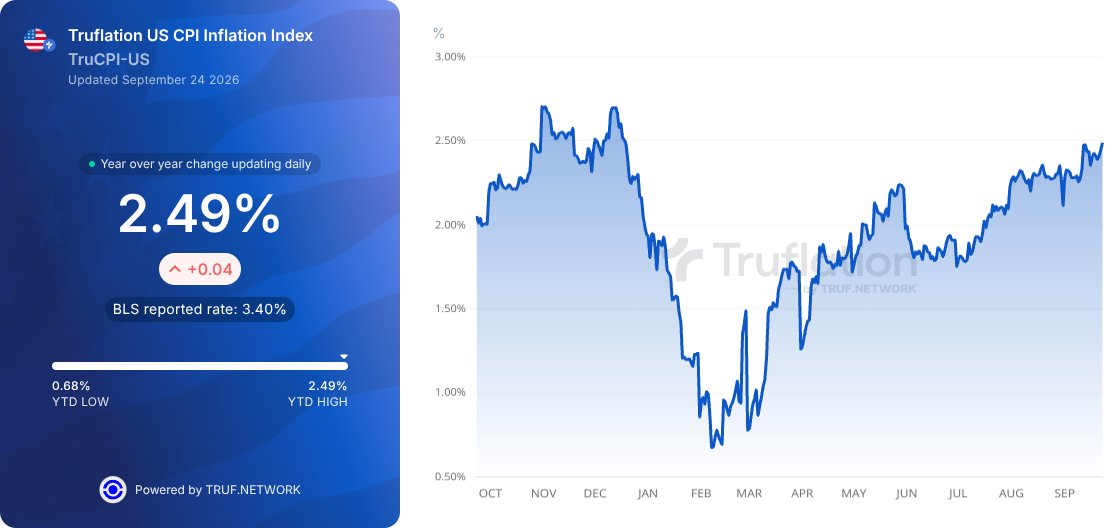
@CEOofSPY@jam_croissant@RemindMe_OfThis Hahah this is great. The thing is.. I was right. Truflation was sub 1% right before the Iran war because supply shocks are not inflationary. This oil shock will prove to be the same. I don't doubt it for a second actually..
Maybe the miracle weapon works. A deus ex machina. But currently everyone in power is desperate for it to work and that shows, despite breathless claims otherwise, that the U.S. and the West weren't doing very well in recent years until the unearned miracle arrived.