supprimez tiktok, snap & insta de votre téléphone et utilisez ce temps récupéré pour marcher dehors visiter un musée ouvrir un livre que personne ne vous a recommandé, vous réglerez 80% de l'anxiété que vous croyez chronique en moins de 30 jours parce qu'au fond la plupart des problèmes qui vous obsèdent sont des futilités amplifiées par des algorithmes conçus pour pour garder anxieux et in fine comparer votre vie intérieure aux vitrines retouchées des autres
cependant, il suffit d'une vraie épreuve dans la vraie vie pour comprendre instantanément que tant qu'on a un toit, ses deux parents encore en vie et un corps en santé on tient en réalité l'essentiel
pour être passé par là sachez que le réveil arrive toujours trop tard, le jour où un proche tombe gravement malade, le jour où on perd un parent ou le jour où un médecin annonce une nouvelle qui change tout et là on réalise que les heures passées à scroller des couples parfaits et des vies retouchées étaient du temps volé à ceux qu'on aimait et à soi-même
bref fermez ces apps maintenant pendant que vous avez encore le luxe de ne pas savoir à quoi ressemble la vraie souffrance et vivez pleinement votre vie
I got fired from Coinbase in the recent round of layoffs.
I was the guy in charge of turning the air conditioners on and maintaining the temperature of the server farm.
@CDEB_2022@BetterCallMedhi Et quoi d'autre pourrait sauver l'humanité ? Quoi d'autre pourrait réparer les dommages du passé ? C'est une fuite en avant, mais on n'a pas le choix. Ne rien faire, ça ce serait vraiment suicidaire.
The Batman effect.
A female experimenter, appearing pregnant, boarded the train. In the experimental condition, an additional experimenter dressed as Batman entered from another door. Passengers were significantly more likely to offer their seat when Batman was present (67.21% vs. 37.66%).
[Francesco Pagnini et al.,"Unexpected events and prosocial behavior: the Batman effect", Nature, 2025]
@ErikVoorhees@criptopaul How can we verify your claims?
We do have to trust you and your partners that your implementation of "math" is flawless, right?
former 20 millions d'actifs à l'IA en 5 ans est exactement le genre d'annonce qui sonne brillant en commission parlementaire et qui produit 0 effet réel je dis bien 0 effet sur le terrain parce qu'on a oublié quelque chose de fondamental qui est que:
l'IA n'est pas une compétence en soi c'est un amplificateur des compétences cognitives qui préexistent dans votre cerveau, savoir lire profondément, savoir raisonner par premiers principes savoir formuler une intention claire ou même savoir reconnaître un raisonnement bancal
autant de muscles intellectuels qui se construisent uniquement par 20 ans de friction réelle avec des livres, ddes problèmes mathématiques exigeants et des projets concrets sur lesquels on échoue / itére avant de réussir
je crois que le drame de cette annonce c'est qu'elle traite l'IA comme un nouveau excel qu'il faudrait apprendre à manipuler en 6 modules de formation alors alors que le vrai sujet c'est de reconstruire dans le système éducatif français les fondations cognitives qui permettent ensuite à un adulte d'utiliser l'IA comme un véritable allie démultiplicateur
ce n’est que mon avis MAIS sachez que sans ces fondations vous obtenez exactement le contraire de l'effet recherché, des millions d'actifs qui délèguent leur pensée à la machine et perdent en 18 mois ce qu'il restait de leur autonomie cognitive, c'est l'inverse exact d'une politique souveraine c'est une politique de zombification industrielle financée par les impôts des contribuables
et ce que cette annonce va concrètement produire dans les 24 mois est facile à prévoir, l'apparition massive d'une nouvelle génération de Brivael, ces opportunistes qui ne tweetent plus eux mêmes mais qui font tweeter leurs agents IA pendant qu'ils encaissent en vendant des formations et des calls à 999 dollars de l'heure parce que chaque fois que l'etat français sort une enveloppe budgétaire avec le mot innovation dedans c'est exactement le profil qui se rue dessus pour la capter
on aura donc dépensé plusieurs milliards d'euros publics pour enrichir des grifteurs qui n'ont eux mêmes jamais rien construit dans leur vie pendant que les vrais bâtisseurs deeptech par ex continueront de galerer pour financer leur première levée
je suis persuadé que ce dont la France a vraiment besoin n'est pas une formation IA pour 20 millions d'actifs, c'est une refonte profonde de l'école primaire et du collège pour reconstruire les capacités d'attention de lecture de raisonnement et de créativité de la jeunesse française
c'est aussi un investissement massif dans la recherche fondamentale en mathématiques, en physique et en biologie, c'est un soutien acharné aux bâtisseurs qui font de la deeptech et du hardware en France plutôt qu'aux vendeurs de formation digitale
mettez vous vous en tête que qu'à la fin des fins ce qui déterminera la position de la France en 2050 ce n'est pas le nombre d'adultes qui savent prompter ChatGPT, c'est plutôt le nombre de cerveaux capables de produire la pensée originale que la machine ne pourra jamais générer toute seule
"so you staked your ETH on the Ethereum blockchain to earn yield?"
"yes, Dave"
"except you didn't want your capital to be locked up so you actually staked it with a liquid staking protocol called Lido?"
"that's correct, Dave"
"and Lido gave you a liquid staking receipt token called stETH in return?"
"yes, Dave"
"and then you didn't think that was enough, so you juiced the yield even further by depositing your stETH receipt tokens into a restaking protocol called Eigenlayer?"
"you are correct, Dave"
"and now you didn't want to lock up your capital, so you actually restaked with a liquid restaking protocol called KelpDAO who provided you with a liquid restaking receipt token called rsETH?"
"you got it, Dave"
"and then that was surely not enough juice, so you then deposited your rsETH tokens into a lending protocol called AAVE so that you could open a leveraged looping position that borrows ETH against the rsETH collateral and restakes the ETH into rsETH which is then deposited as collateral, except it turns out rsETH used a cross-chain bridge called LayerZero whose security is held together by a 1/1 toothpick, which was obviously hacked by north koreans causing rsETH to become undercollateralized and now these looping positions are stuck and unprofitable, and everyone is pointing fingers at each other, and also DeFi is a very serious industry"
"you are 100% correct, dave"
jfc.
The people in this photo aren't friendlier than you. Their apartments are just smaller. So small that Parisians basically gave up on living indoors and moved their living rooms onto the sidewalk. And that was the whole plan.
In the 1850s, a city planner named Baron Haussmann tore apart medieval Paris and rebuilt it. He widened streets into boulevards, capped every building at five stories, and added one rule that explains this entire photo: the ground floor of every building had to be a café, a bakery, or a shop. The apartments above were intentionally tiny. Some were single rooms carved out of old mansions. No garden. Barely any sunlight. A private balcony was something most Parisians would never have.
So the café became home. You ate breakfast there. Held meetings there. Received your mail there. By the late 1700s, Paris already had close to 2,000 of them. In 2002, there were still 1,907. Even now, after years of closures brought that number to about 1,410, the coverage is absurd: a 2020 city study found 94% of Parisians live within a five-minute walk of a bakery. When COVID shut indoor dining in 2020, Paris ripped out parking spaces, turned them into outdoor terraces, and let 9,800 cafés and restaurants keep them permanently.
An American sociologist named Ray Oldenburg wrote a book in 1989 called The Great Good Place. He had a name for spots like the Parisian café: "third places." Not your home, not your office, but the casual in-between spots where you actually get to know people. Cafés, pubs, barbershops, the corner store where the owner knows your name. His whole argument was that American suburbs were built with only two zones, your house and your job, connected by a car. No sidewalk café, no place to bump into a neighbor by accident.
The U.S. Surgeon General declared loneliness a national health epidemic in 2023. Being alone all the time is as bad for your body as smoking 15 cigarettes a day. Half of American adults say they feel lonely. Weekly socializing dropped from 5.5 hours in 2003 to just 4 hours in 2023, and it never bounced back after COVID. Americans between 15 and 29 now spend 45% more time alone than they did in 2010.
The scene in this tweet looks like a personality trait. It is a 170-year-old engineering project that works exactly as designed.
Having trouble understanding the market's reaction here.
Activity-based rewards are still enabled under the CLARITY Act, meaning yield can still flow indirectly via DeFi protocols for users willing to take some risk with their stablecoins. Smaller TAM, sure, but worst case Circle keeps the spread, and that shouldn't structurally cap USDC's growth.
The real question is how regulators draw the line between passive and active holding. If someone runs on @merkl_xyz an incentive campaign for USDC lenders on Morpho's idle market, does that qualify? That distinction will matter a lot more than the headline read.
bought a hardware wallet to verify transactions before signing them. to use the industry standard multisig i have to go into device settings and explicitly disable transaction verification. i am paying for security so i can turn it off.
you set up 5 signers with offline key storage, airgapped ceremony, timelocked execution, the whole production. then every single one of them clicks approve on a hash they can't read because EIP-712 calldata doesn't fit on a 2 inch screen.
billions of dollars in crypto treasuries secured by "does this browser tab look right to you"
sometimes this industry just feels like a complete joke
c’est une chose que j’avais déjà anticipé dans un thread l’année dernière
évidemment que la plupart des projets d’IA générative échouent dans les grandes entreprises françaises et je vais vous expliquer pourquoi c’est structurel
le problème MAJEUR reste que les grandes boîtes ne comprennent pas qu'on ne résout pas un problème de structure avec une rustine algorithmique
ces boîtes font exactement la même erreur à chaque fois, elles prennent leur organisation existante avec ses process, ses silos, ses validations à 15 niveaux hiérarchiques et elles essaient de coller une couche d’IA par dessus comme on mettrait un turbo sur une charrette
sauf que ça marche pas parce que l’IA générative exige de repenser les flux de travail depuis 0, le problème c’est que personne dans ces entreprises a le mandat ni le courage de toucher à l’organisation, donc ils font des POC des pilotes, des comités de réflexion, des études de faisabilité…etc etc pendant 18 mois et à la fin ils concluent que l’IA c’est prometteur mais pas encore mature
non c’est votre organisation qui est pas mature et techniquement le problème est encore + profond que ça, ces entreprises essaient d’utiliser des LLMs comme des outils isolés alors que la vraie puissance de l’IA générative vient de l’orchestration
c’est quand vous connectez un modèle à vos bases de données internes via du RAG par ex que vous construisez des pipelines d’agents autonomes capables d’enchaîner des tâches complexes que vous intégrez des function calls pour que l’IA puisse agir directement dans vos systèmes ERP CRM et outils métier
c’est précisément là que la magie opère mais pour faire ça il faut des données propres, des APIs ouvertes et une architecture modulaire (minimum )or les grandes entreprises françaises tournent sur des systèmes legacy empilés depuis 20 ans avec des données en silos que personne a jamais pensé à structurer pour être exploitées par une IA
donc ils finissent par utiliser ChatGPT pour résumer des emails et ils appellent ça une transformation digital et pendant que les grands groupes FR font des Powerpoints sur l’IA, des startups de 5 personnes utilisent Claude pour faire le travail de départements entiers à une fraction du coût
le vrai sujet c’est que l’IA générative fonctionne parfaitement quand vous construisez autour d’elle dès le départ, elle échoue systématiquement quand vous essayez de l’injecter dans une bureaucratie qui a été optimisée pendant 30 ans pour ralentir toute forme de changement
je pense que dans 5 ans on regardera cette période et on réalisera que les grandes entreprises qui ont «échoué » avec l’IA ont en réalité échoué avec elles mêmes
le signal principal que vous devez surtout comprendre à travers mon tweet c’est que sans repenser l'architecture socio-technique, les agents resteront des gadgets à démonstration incapables de s'inscrire durablement dans des chaînes de valeur humaines
🛸 Un logiciel open source vient de changer les règles du jeu.
Il s’appelle Ground Station.
Avec une simple clé USB à 30€ (RTL-SDR) et une antenne basique, vous pouvez :
📡 Suivre en temps réel tous les satellites qui passent au-dessus de chez vous
🌦️ Recevoir des images météo directement depuis l’espace — sans passer par Météo France ou aucun intermédiaire
📻 Capter et décoder des signaux radio satellites
🛰️ Contacter la Station Spatiale Internationale — les astronautes répondent parfois
📺 Regarder des chaînes TV diffusées en clair par satellite — gratuitement et légalement
🔒 100% open source. Vos données restent chez vous. Zéro cloud. Zéro GAFAM.
C’est exactement ça la souveraineté numérique : recevoir directement depuis l’espace ce qui passe au-dessus de votre tête, sans demander la permission à personne.
Le projet est disponible ici 👇
https://t.co/qdE0o0ODWp
Source : @simplifyinAI
It’s theoretically possible but practically a nightmare.
It’s easy to create enough noise to drown out the CPU (DDoS). Injecting the malicious data would requires Precision Waveforming. You’d have to perfectly time the mmWave pulses to mimic the exact voltage changes of a valid Ethernet preamble and payloadand also even if you inject a packet, the OS kernel's network stack will likely drop it because the checksums won't match the random atmospheric noise.
In 2003, 17-year-old Mike Rowe registered MikeRoweSoft[.]com for his web design business. Microsoft sued for trademark infringement and offered him $10 to give up the domain.
Insulted, he countered with $10,000. Microsoft then sent a 25 page cease and desist accusing him of extorton; a settlement was eventually reached, with Rowe granting ownership of the domain to Microsoft in exchange for an Xbox.
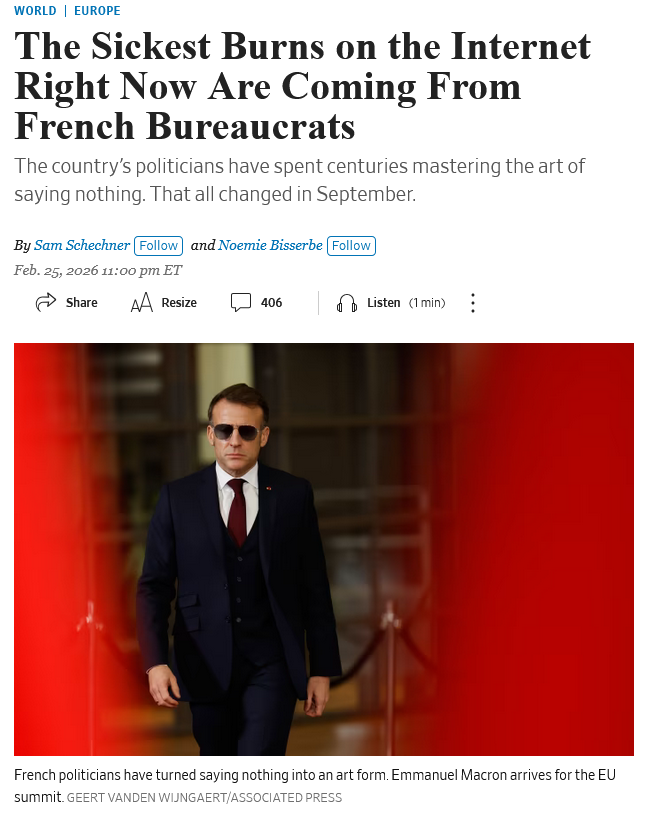
🏅🇫🇷Le Wall Street Journal fait l'éloge de notre @FrenchResponse national.
L'évolution de la diplomatie française à travers ce compte est historique.
Nous sommes le seul État au monde à pratiquer ce nouveau type de « diplomatie directe ». Une riposte officielle cinglante, ironique, mais toujours élégante qui suscite l'admiration à l'international et la fierté chez les Français.
Cette évolution n'est pas à sous-estimer, c'est un vrai tremblement de terre dans la diplomatie française. Avec le premier mandat de Donald Trump, nous avions déjà vu une nouvelle forme de diplomatie émerger à travers des tweets enragés dirigés contre l'Iran.
Aujourd'hui, la nouvelle évolution diplomatique est française, et elle cartonne ! 🇫🇷🇫🇷 Nos diplomates débunkent la désinformation qui nous cible et ils en profitent pour tourner au ridicule les accusations sans aucun fondement qui visent à déstabiliser la France chaque jour.
Cela correspond bien à la mentalité française : « de l'audace, encore de l'audace, toujours de l'audace » comme disait Georges Danton. Ce type de communication aurait été impensable émanant d'un ministère officiel il y a 10 ans, et cela crée évidemment des réactions.
D'abord, ils vous critiquent, puis ils vous copient. Je suis convaincu que dans les années à venir, d'autres pays vont se doter de ce type de diplomatie directe. C'est aujourd'hui l'un des meilleurs moyens de contrer les attaques dans le champ informationnel.
Nos partenaires européens, en particulier, observent avec intérêt l'initiative française 👏🇫🇷







![Rainmaker1973's tweet photo. The Batman effect.
A female experimenter, appearing pregnant, boarded the train. In the experimental condition, an additional experimenter dressed as Batman entered from another door. Passengers were significantly more likely to offer their seat when Batman was present (67.21% vs. 37.66%).
[Francesco Pagnini et al.,"Unexpected events and prosocial behavior: the Batman effect", Nature, 2025]](https://pbs.twimg.com/media/HHYM9SvbgAAC1GK.jpg)






![CR1337's tweet photo. In 2003, 17-year-old Mike Rowe registered MikeRoweSoft[.]com for his web design business. Microsoft sued for trademark infringement and offered him $10 to give up the domain.
Insulted, he countered with $10,000. Microsoft then sent a 25 page cease and desist accusing him of extorton; a settlement was eventually reached, with Rowe granting ownership of the domain to Microsoft in exchange for an Xbox.](https://pbs.twimg.com/media/HCtXh3abcAA35-G.png)