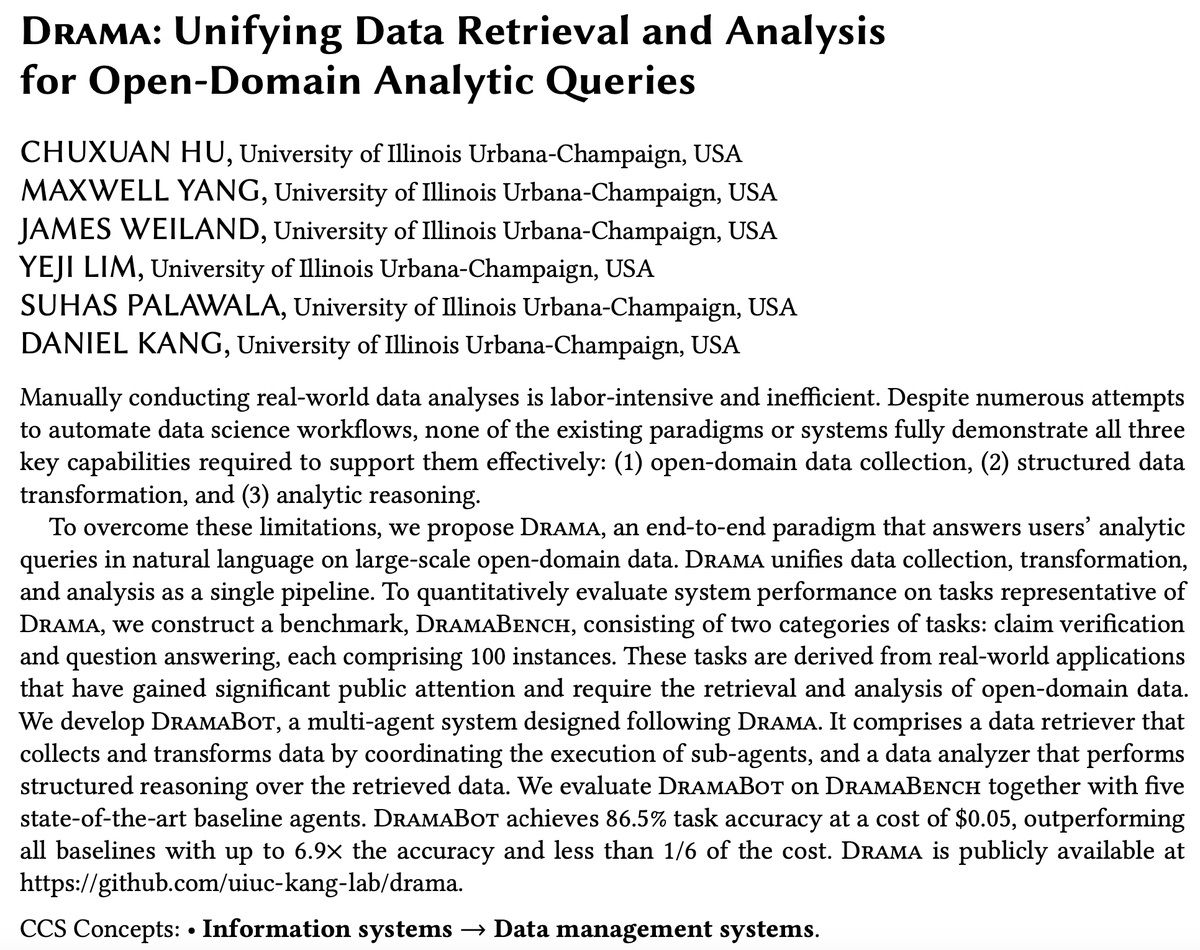
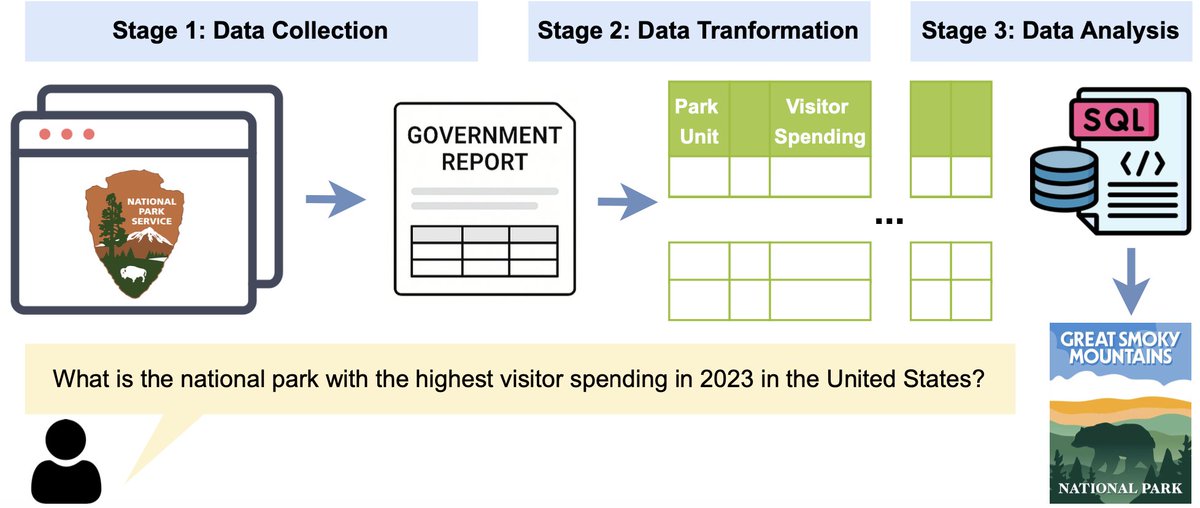
Real-world data science (especially in the social sciences) starts with collecting and structuring data from open domains, yet existing AI agents either assume access to ready-to-query databases or stop at surface-level retrieval and summarization.
To augment data scientists, our #SIGMOD2026 paper presents DRAMA, a new paradigm that unifies data collection, transformation, and analysis, achieving 7× higher accuracy on analytic queries over open-domain data than SOTA agents like the OpenAI research agent. 🎭
1/8
@OpenAI claimed in their GPT-4 system card that it isn't effective at finding novel vulnerabilities.
We show this is false. AI agents can autonomously find and exploit zero-day vulnerabilities.
Paper: https://t.co/ywjCe7BfE6
🧵 1/7
As ML proliferates, society has called for transparency into ML systems. How can we balance this with the need to protect trade secrets?
We introduce ZKAudit to solve this problem.
Paper: https://t.co/aIoqU4c2xb
Blog: https://t.co/OzEmPtZE3u
🧵 1/5
OpenAI announced GPT-4 fine-tuning this week. Fine-tuning can remove RLHF protections from weak models, but is GPT-4 susceptible?
Unfortunately yes: removing RLHF protections from GPT-4 is trivial
Paper: https://t.co/DiNcMpj4wp
🧵1/6
Business analysts to legal scholars want to use ML to understand their unstructured data. But it’s costly and difficult.
We’re announcing AIDB, an open-source framework that makes analyzing unstructured data as simple as running a SQL query!
https://t.co/hQFaQufUox
🧵 1/7