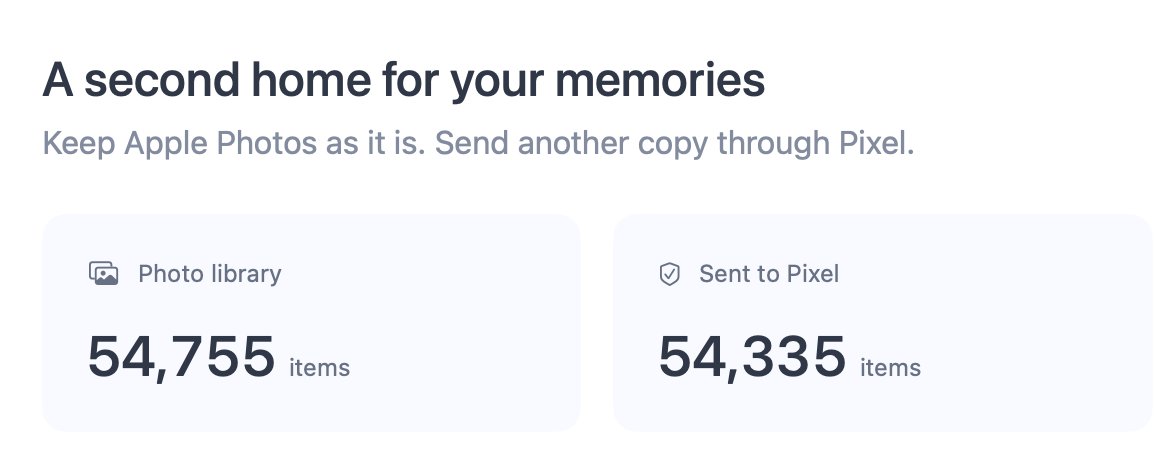
Built PixelBridge to back up my Apple Photos library through an old Pixel.
I open-sourced the beta so people could verify that photos never hit my server.
This week it backed up ~54k photos/videos — a few hundred GB — from my own library.
Introducing Flue 2 — Build dynamic agents that evolve over time.
Flue is a TypeScript framework for building the next generation of agents, powered by the @pidotdev agent harness.
The Flue 1.0 Beta was released last month & has now been downloaded 700,000+ times. And from all of that feedback, we realized something we'd missed.
Agents have a familiar problem: composability.
How do you compose together different agent capabilities in a way that feels expressive AND maintainable, especially as you scale up complexity?
Last week, I teased: “What if React for Agents?” and yes, as you will see, the inspiration here is obvious. But UI devs and agent devs have some things in common, including the same problem that the React team solved almost a decade ago with... Hooks!
There are now things that you can do in Flue 2.0 with hooks that are just fundamentally difficult in other frameworks:
A Flue agent can enforce a multi-step workflow, earn new tools once certain conditions are met, or trade up to a bigger model when the work gets too hard.
Handling metadata and context no longer requires custom framework APIs and configuration. In Flue, you can pass data to a tool the same way you pass arguments to a function.
I'm really excited for you to try Flue 2.0 out yourself. It's a big, bold take on what agents could be capable of in the future.
Read more: https://t.co/kW69RWJ00Q
Hi, I'm RC. I built Kimi CLI at Moonshot last year, and back in 2015, bots that lived in group chats. For the past four months, I've been building Raft in public.
Today I'm launching Raft 1.0.
Right now, working with agents means juggling terminals, sessions, and skills. The more you run, the more you end up holding it all together yourself, and the easier it is to lose the thread.
Raft puts your agents in team mode: one workspace where working with agents feels like messaging your team. The work keeps moving, and you stay at the wheel.
Meet my Raft agent team👇
introducing https://t.co/20es64pAqZ
a dictionary for ui things you can see but can't name
made it because i'm primarily a designer, and my biggest resistance was always knowing what things are called when prompting my agents
it learns as people use it: every search teaches the site new words, and the built-in pocket dictionary grows with it
give it a try and let me know what you think
can't find something? dm me and i'll add it
i want this to be the lowest resistance resource you have
you can just build things
I've been working on making the WebAssembly build of libghostty a bit more ergonomic. Here's a weird API I've never written before, but libghostty-vt now has an API to dump its exported structs as JSON with size/alignment/type info to help bindings: https://t.co/e4uMJFeiiz
The data is generated at compile-time and stored in read-only memory so you're not paying any runtime cost to generate this and libghostty itself doesn't need to embed any kind of machinery to encode JSON.
The `example/wasm-vt` example in the Ghostty project shows how its used: we call this after loading libghostty, decode and cache the data, and then use it with some helpers to set struct fields by byte offset. This is necessary because WebAssembly doesn't have a formal struct system. And we don't want to expose a bunch of functions we have to promise ABI compatibility for.
Computer use is now in Claude Code.
Claude can open your apps, click through your UI, and test what it built, right from the CLI.
Now in research preview on Pro and Max plans.
libghostty for Rust! Some Ghostty maintainers came together and made a really high quality Rust crate in front of libghostty-vt. The repo includes a full port of Ghostling (full terminal in a single Rust file!). The API is beautiful. https://t.co/6sdTkjG24V
anthropic open sourced zero-copy rust protobufs
been waiting for this (previously we just re-wrote the generated code when needed)
https://t.co/bA0QcvC8IU
Your work tools in Claude are now available on mobile.
Explore Figma designs, create Canva slides, check Amplitude dashboards, all from your phone.
Give it a try: https://t.co/hwPB3zlk0w
Interesting read from Anthropic on harness design for long-running apps.
A lot of parts they described: loops, handoffs, evaluator separation, and runtime control are exactly the layer ralph-orchestrator provides
https://t.co/mrKP2GbOuO
https://t.co/1GyrLD36Qp
Introducing Dimension. The AI coworker that never sleeps.
Set it up in 2 minutes and it gets to work. Morning briefings, meeting prep, email drafts, action items, and more.
Get started at https://t.co/HzTBgBSJAY
Introducing Generative TUI
Ask anything - get polished dashboards with real data, rendered live in your terminal.
27 components. Streaming. json-render + Ink.
npx skills add vercel-labs/json-render --skill ink
You can now enable Claude to use your computer to complete tasks.
It opens your apps, navigates your browser, fills in spreadsheets—anything you'd do sitting at your desk.
Research preview in Claude Cowork and Claude Code, macOS only.