Thrilled to see this paper published @JFluidMech!
Check it out at https://t.co/jDCXkixbmP.
In it, we describe how elastic flow instabilities manifest in ordered granular media — and how inter-grain contacts shape the characteristics of the unstable flow. 🌪️⌛️
Summary below ⬇️
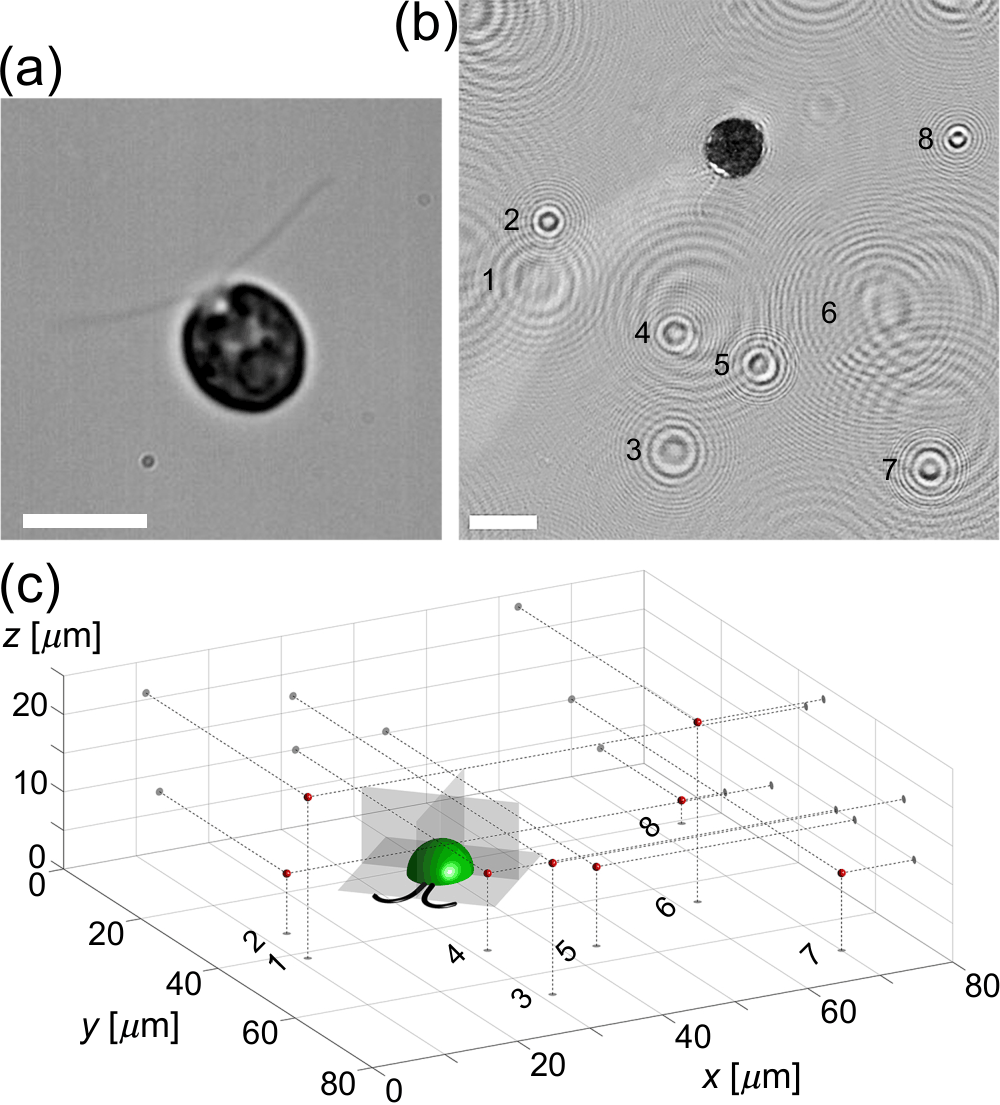
Direct, time-resolved measurements of the 3D flow field generated by a single microalga swimming through a fluid demonstrate how 2D features, like in-plane vortices and the stagnation point, emerge due to the 3D flow. See how: https://t.co/TBouf9EISE
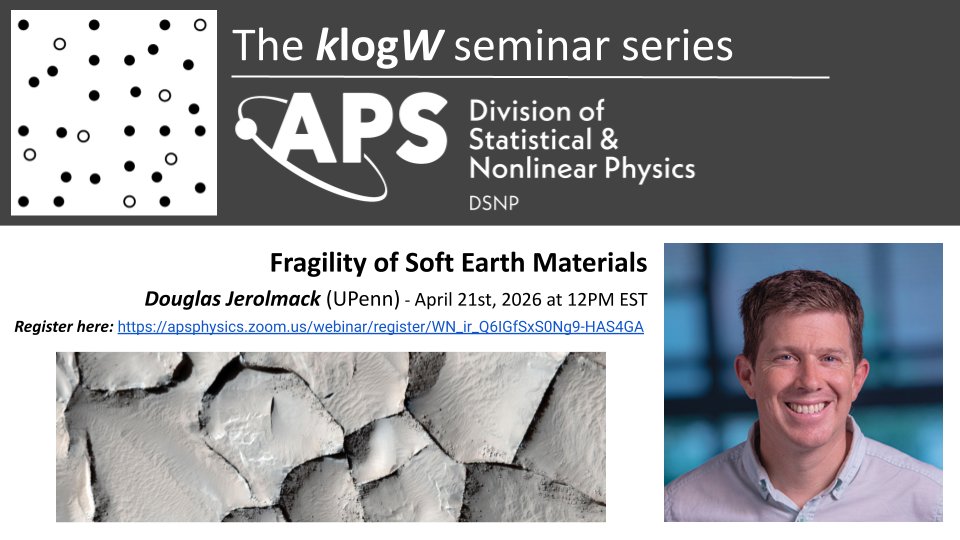
📢 We’re kicking off the first klogW seminar of the year!
Join us on April 21st at 12PM EST for a talk by Douglas Jerolmack (UPenn) — 2026 APS-DSNP Fellow — presenting "Fragility of Soft Earth Materials" 🌎🌍🌏
Registration link: https://t.co/0UqJsvnQA5
🚀 Get involved with DSNP! It’s a great opportunity, especially for grad students and postdocs, to grow your network and share new ideas.
📲 Scan the QR code in the slide or follow the link to sign up!
https://t.co/6lGoCjaG1y
#APS#DSNP#PhysicsCommunity
We’re delighted to share a new editorial in @PhysRevE on the DSNP Dissertation Award in Statistical & Nonlinear Physics, marking the inaugural year of PRE sponsorship. Congratulations to this year’s winner, 𝐉𝐨𝐧𝐚𝐬 𝐕𝐞𝐞𝐧𝐬𝐭𝐫𝐚, 𝐟𝐫𝐨𝐦 @UvA_Amsterdam ,! 🎉
I'm happy to share with you my latest published paper in collaboration with @LastraFrancisca , @bioactivematter and Italo!
This beautiful work came almost naturally to confirm our thoughts on the formation of vortical flows by confined active carpets!
https://t.co/GuagfnUNkC
🎊 Congrats 𝐉𝐨𝐧𝐚𝐬 𝐕𝐞𝐞𝐧𝐬𝐭𝐫𝐚, Univ. of Amsterdam, recipient of the 𝐃𝐒𝐍𝐏 𝐃𝐢𝐬𝐬𝐞𝐫𝐭𝐚𝐭𝐢𝐨𝐧 𝐀𝐰𝐚𝐫𝐝 for "𝘈𝘯𝘪𝘮𝘢𝘵𝘪𝘯𝘨 𝘮𝘦𝘵𝘢𝘮𝘢𝘵𝘦𝘳𝘪𝘢𝘭𝘴 𝘸𝘪𝘵𝘩 𝘯𝘰𝘯-𝘳𝘦𝘤𝘪𝘱𝘳𝘰𝘤𝘪𝘵𝘺" Join and listen to them at the DSNP awards session #APSSummit26
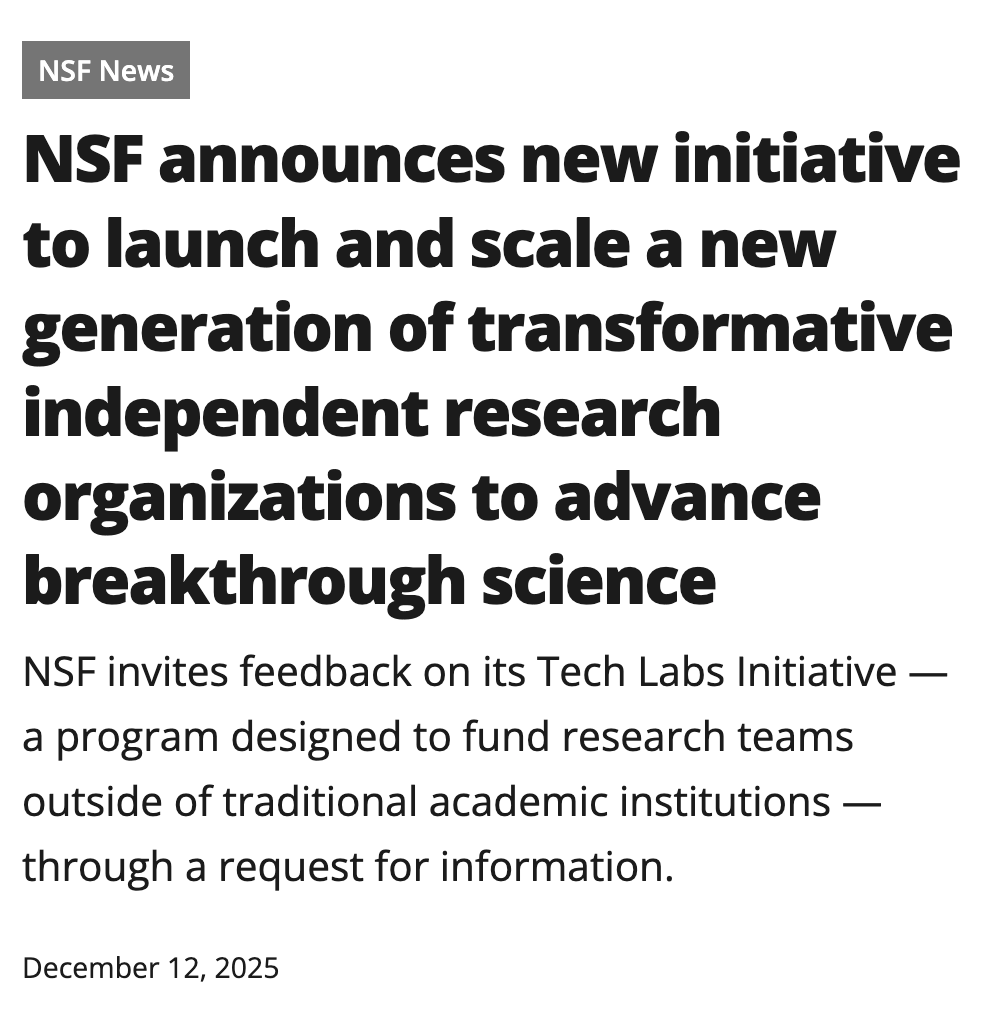
NSF is launching one of the most ambitious experiments in federal science funding in 75 years.
The program is called Tech Labs, and the goal is to invest ~$1 billion to seed new institutions of science and technology for the 21st century.
Instead of funding projects, the NSF will fund teams. I’m in the @WSJ today with a piece on why this matters (gift link): https://t.co/xteQ3NgWVC
Here’s the basic case:
1) Most federal science funding takes the form of small, incremental, project-based grants to individual scientists at universities.
2) The typical NSF grant is ~$250k/year to a professor with a couple of grad students and modest equipment over a few years. This is a perfectly reasonable way to fund some science, but it's not the only way.
3) A healthy portfolio needs more than one instrument. Project-based grants are like bonds: low-risk, steady, safe. But no one trying to maximize long-run returns would put 70% of their portfolio in bonds.
4) Yet that's basically what our civilian science funding portfolio looks like. Around 3/4ths of NSF and NIH grant funding is project-based.
5) Tech Labs is NSF's attempt to diversify that portfolio. The Tech Labs program is aiming for:
- $10-50 million/year awards per team
- 5+ year commitments
- Measuring impact through advancement up the Tech Readiness Level scale rather than papers published
- Up to ~$1 billion for the program
- Supporting research orgs outside traditional university structures
6) Scientific production looks very different than it did when the NSF launched 75 years ago. The lone genius at the chalkboard can only do so much. Frontier science + tech today is increasingly team-based, interdisciplinary, and infrastructure-intensive.
7) The team behind AlphaFold just won the Nobel Prize in Chemistry. It came from DeepMind, an AI lab with sustained institutional funding and full-time research teams. It would be near-impossible to fund this kind of work on a 3-year academic grant.
8) Same pattern at the @arcinstitute (8-year appointments, cross-cutting technical support teams) and @HHMIJanelia (massive infrastructure investments to map the complete fly brain). Ambitious science increasingly needs core institutional support, not a series of project grants stapled together.
9) Similarly, Focused Research Organizations (@Convergent_FROs) have showcased a new model supporting teams with concrete missions and predefined milestones to unlock new funding.
10) There’s a whole ecosystem of philanthropically-supported centers doing amazing research, like the Institute for Protein Design, the Allen Institute, the Flatiron Institute, the Whitehead Institute, the Wyss Institute, the Broad — the list goes on.
11) But philanthropy can’t reshape American science alone. The federal government spends close to $200 billion each year on research and development, an order of magnitude more than even the largest foundations.
12) If we want to change how science gets done at scale, federal funding has to evolve. And the NSF and NIH don’t have dedicated funding mechanisms to support or seed these sorts of organizations.
13) Earlier this year, I started working on a related framework called “X-Labs” that built on all this exciting institutional experimentation that’s been happening within the private and philanthropic sectors. It’s time for the federal government to step into the arena: https://t.co/0iVLobqQeA
14) Traditional university grants are still important for training the next generation of scientists and for certain kinds of curiosity-driven work. But after 75 years of putting nearly everything into one model, we should try something different.
15) And key program details are still being developed! You can reply to the Request for Information with suggestions or feedback on how to design this program here: https://t.co/R6MNo0ZfN1
16) Science is supposed to be about experimentation. Science funding should be too.
Hey, so we have a new draft with @LastraFrancisca ,@bioactivematter and Italo! We found some interesting scale-invariant 3D flow structures induced by active carpets in confined sea slick-like environments! Go check it out :D
https://t.co/tZyn9HcwSe
Applications for the DSNP 2025 Dissertation Award are open until September 1st, 2025!
Apply here https://t.co/QcuEUqsCrX
The award consists of $2,000, travel reimbursement, and a registration waiver to attend the next APS Global Summit as an invited speaker. Read more below.
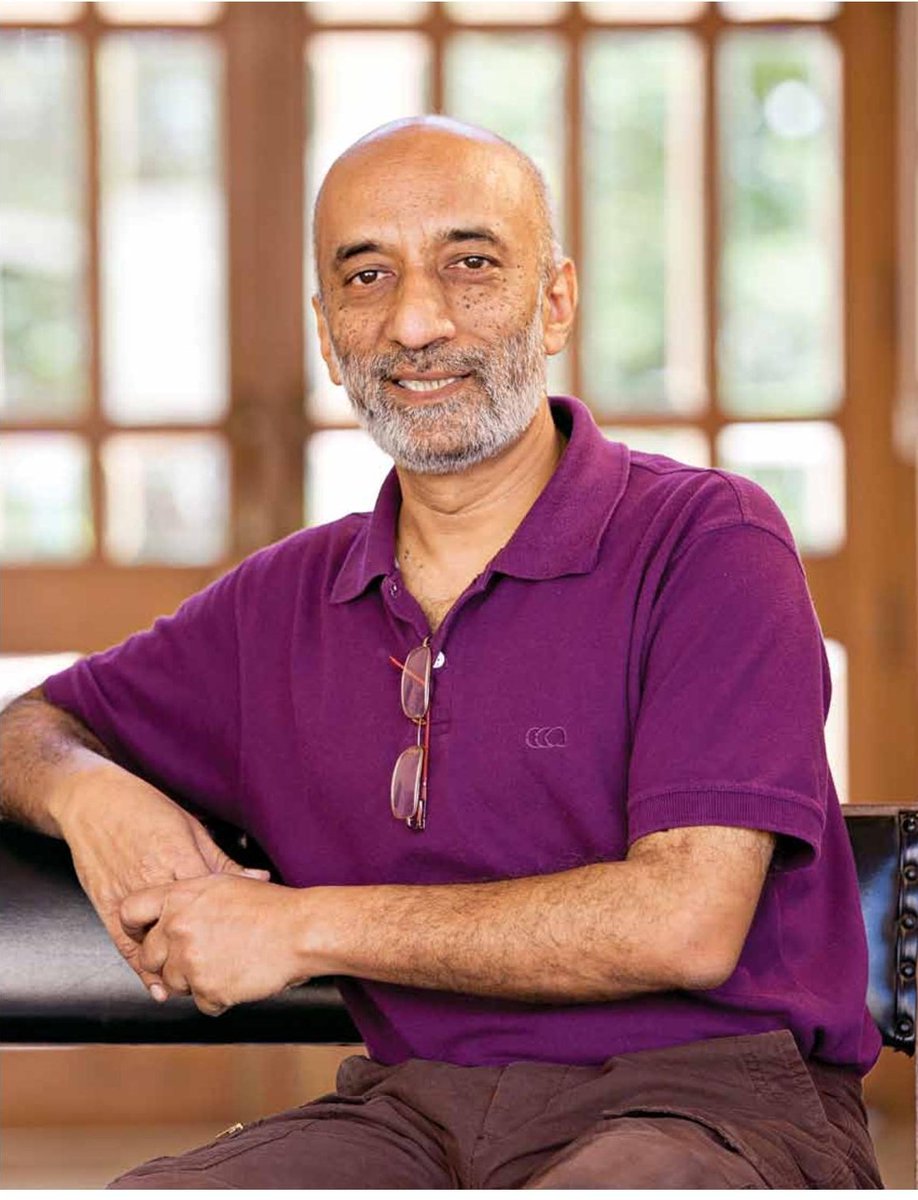
With great pride, we announce that Prof. Sriram Ramaswamy, who is also a J.C. Bose National Fellow @Physics_at_IISc, @iiscbangalore has been elected to the US National Academy of Sciences @theNASciences.
At the APS March Meeting in Anaheim, organized and chairing or co-chairing these sessions with fantastic talks. The talks by students and early career people are impressive and inspiring. #ActiveMatter#BioPhysics#SupportScienceResearch
Paper now out in PNAS! Our colloidal whole-cell simulations + in vivo 3D particle tracking reveal how macromolecular interactions and confinement determine dynamics/localization in E. coli. Congrats @AlpSunol & @dsvalverdem! https://t.co/jk1UzowgwT