Lab of Sujit Datta @Caltech studying transport of soft (“squishy”) and living systems to address challenges in biotech, energy, medicine, & sustainability.
The views and opinions expressed in this account are solely those of the members of the Datta Lab and do not necessarily reflect the position of our funding agencies or Princeton University.
(Following, RT, and Likes ≠ endorsement)
New research from the Caltech lab of Sujit Datta, professor of chemical engineering, bioengineering, and biophysics, helps to explain why Phages can sometimes outnumber bacteria a hundredfold, yet the bacteria endure and even thrive.
Read more: https://t.co/9WvBm3jsDH
Bacteria can escape viral predators by collectively swimming along chemical gradients, which allows the population to outpace the spreading infection, according to a new study. @TheSquishyLab@Caltech@Princeton https://t.co/W5oY4JajN1
Honored to be a fellow of the @APSphysics; this reflects the creativity & effort of all the students & postdocs I've worked with. Thank you to my trainees, collaborators, colleagues, mentors, and the soft matter community for supporting & inspiring me.
https://t.co/iAfvOf6fcZ
Thrilled to see this work published in Science Advances.
Check it out at https://t.co/g1gv6xfYxo!
In it, we describe how bacteria use collective migration to outrun spreading infection by phage predators. Summary below!
Excited to release our latest work, led by former postdocs Victoria Muir & @almcalvo, along with Ned Wingreen: https://t.co/jTqz5i8yG5!
We found that bacteria use chemical cues to outrun viral predators—establishing a new ecological role of chemotaxis! 🦠
Summary ⬇️ [1/8]
Excited to see our collaboration with @KatrinaVelle, @FritzLaylin, & others published in @PNASNews. In it, former postdocs @RamaswamyMeera & @BabakVH studied how a relative of "brain-eating" amoebae move through sediment-like packings. 🦠
Check it out at https://t.co/iZPPT6VDrl!
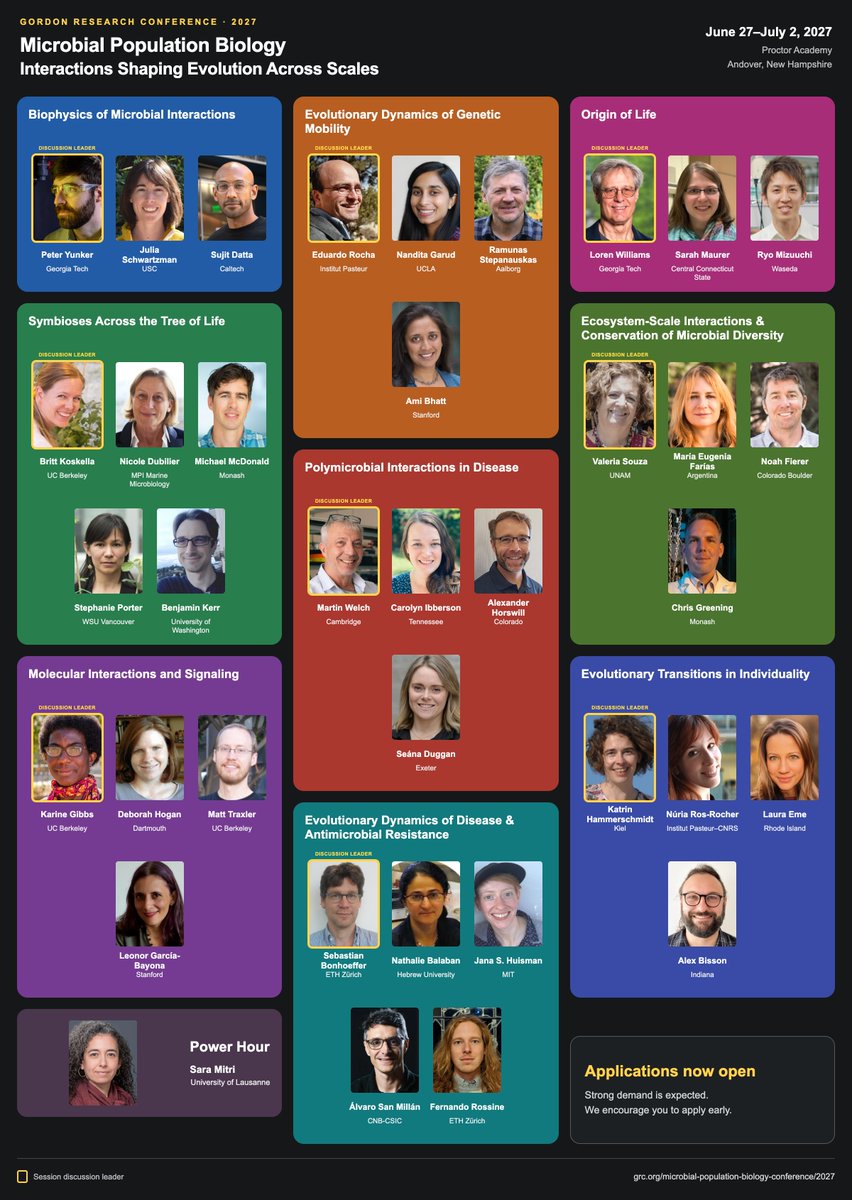
1/17 Submissions are now open for the 2027 Microbial Population Biology GRC! We expect this meeting to be extraordinarily oversubscribed. If you want to come, time is of the essence--apply early!
June 27–July 2 • Andover, NH
https://t.co/PkUzSv8y15
New KITP summer program: Phenotypic Heterogeneity & Collective Behavior in Biofilms — summer 2027 at UCSB.
Weeks of seminars, blackboard sessions, and time to think. Apply: https://t.co/M46GZ7ao0Q
Study of bacteria in liquid crystals to better emulate their natural environments reveals how the physical forces influence their life
📹 Sebastian Gonzalez La Corte & Thomas G. J. Chandler et al @Princeton in @PNASNews
➡️ https://t.co/cHI7LGCgYm
Thrilled to see this work published in @PNASNews .
Check it out at https://t.co/kg8WWYI2ca!
In it, we describe how bacteria growing in nematic liquid crystals form single cell-wide 'chains' that buckle in unusual ways.
Summary below! ⬇️
Excited to release our latest work, led by former PhD student @sesgonzalez along with @TGJChandler, @SaverioIV, & Ned Wingreen: https://t.co/6wUiFdOSkw!
We found that bacteria growing in liquid crystals (LCs) form 'chains' that buckle in weird ways... 🦠🍜
Summary ⬇️ [1/6]
As always, we would love to hear your feedback; we continue to learn as we explore this growing (pun intended) area of research at the intersection of biology and physics. Please RT/share with whoever might be interested! [5/5]
Excited to release a review led by postdocs Pablo Bravo, @DharTanumoy, Eloise Masquelier, & PhD student Danielle Sclafani: https://t.co/GV3qOeszDL!
We argue that studying the feedback between bacteria & soil is an exciting frontier for physics. 🌱🦠
Tweetorial follows... [1/5]
Life in soil demands the attention of biological physicists: it is fundamentally interesting and key to understanding the sustainability of this planet. Our goal here is to draw attention to this area by framing open problems & clarifying directions for research. [4/5]
Thrilled that former postdoc @BabakVH is joining the faculty at UC Berkeley! Babak studied how bacteria self-organize in confinement (https://t.co/sDAKJ512HA) & how yeast use biogenic CO₂ bubbles to escape confinement (https://t.co/3KUVdDTQJ0). Many exciting things to come! 🎉
I am thrilled to announce that I will be joining the Department of Chemical and Biomolecular Engineering, @UCB_Chemistry, @UCBerkeley as an Assistant Professor in January 2027!
I am incredibly excited for this next chapter. 🐻 (1/6)


![TheSquishyLab's tweet photo. Excited to release a review led by postdocs Pablo Bravo, @DharTanumoy, Eloise Masquelier, & PhD student Danielle Sclafani: https://t.co/GV3qOeszDL!
We argue that studying the feedback between bacteria & soil is an exciting frontier for physics. 🌱🦠
Tweetorial follows... [1/5] https://t.co/JWUCj9HqzN](https://pbs.twimg.com/media/HNK_kEqXkAAhmUE.jpg)


