A beehive of unconventional innovators | Idea factory that spun out Metabolik Technologies (now part of @AllonniaBio), @Tersa_Earth, Tydra Labs and others!
The next generation of engineers will deliver the future that we want for our kids. Hoping to see many of these future leaders at the UBC Engineering Open House on November 7. https://t.co/w6PnBg5ATZ @ubcengineering@CHBEUBC
Read this over the weekend (bonus if you read all the papers in the Research List) and you’ll be among the “very few who understand how far-reaching” the shift to World Models is.
https://t.co/DJnKX6ePc2
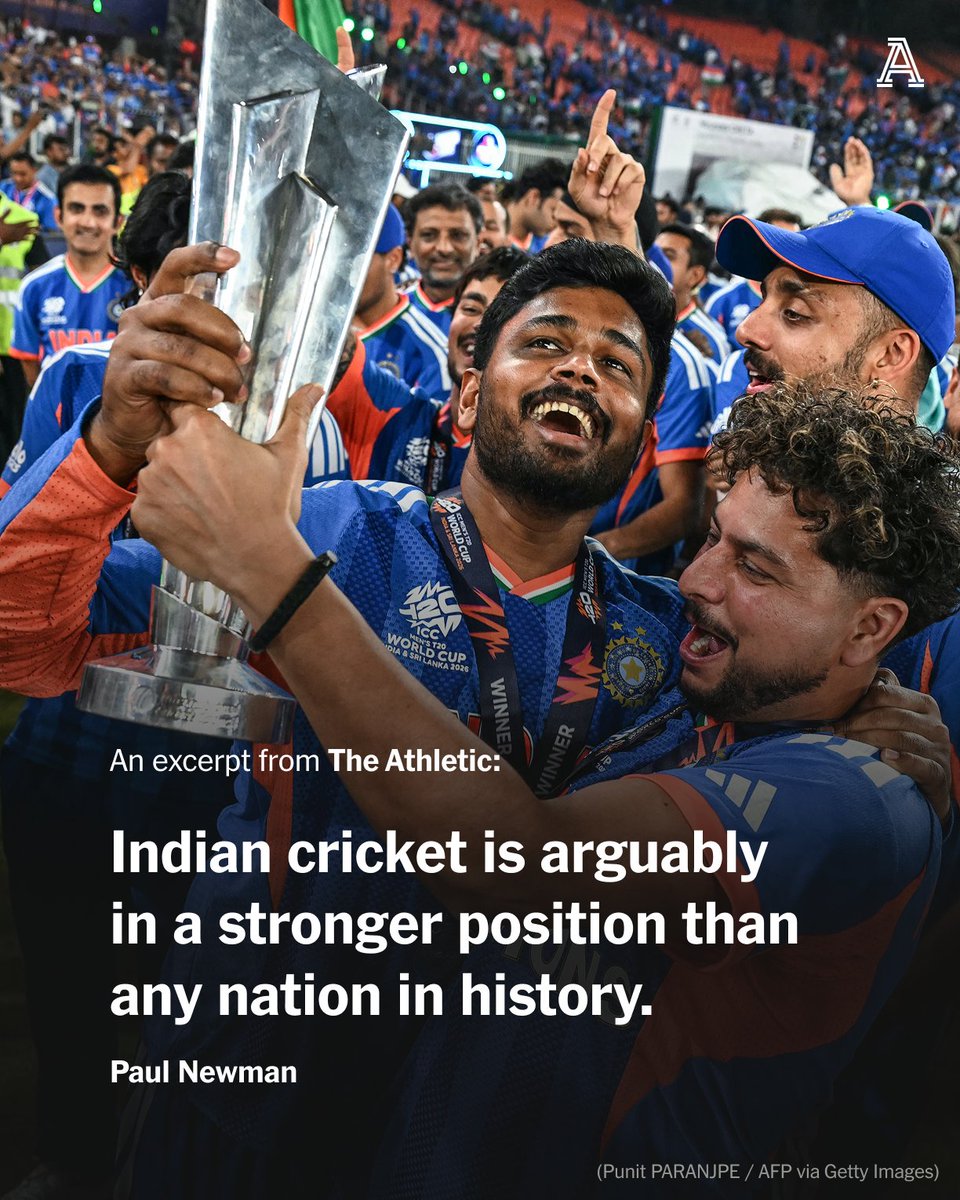
They have not just been the best team at this T20 World Cup.
India may be the best side in the 21-year international history of the short-form they have conquered and now own.
The challenge for every other team, after India defended their T20 world title in emphatic style by thrashing New Zealand in brutal fashion, is to stop them dominating T20, and possibly all cricket, for years to come.
📝 @Paul_Newman66
Free to read here ⬇️
🔗 https://t.co/kC1f8L242C
75 cents of every Canadian defence procurement dollar goes to US-built equipment.
Only 43% of defence contracts currently go to Canadian firms.
Read @EliotPence's memo on transforming our military procurement at https://t.co/6Dvu7DDjMy
Bill Belichick, the 8-time Super Bowl-winning HC, is not a first-ballot Hall of Famer, per @SethWickersham and @DVNJr. Belichick fell short of the 40 out of 50 votes needed for induction to the Pro Football Hall of Fame in his first year of eligibility.
https://t.co/ooJutI0C0Q
In an era of great power rivalry, Canada is choosing to be principled and pragmatic. To name reality, to act together, and to build what we claim to believe in.
Anthropic is donating the Model Context Protocol to the Agentic AI Foundation, a directed fund under the Linux Foundation.
In one year, MCP has become a foundational protocol for agentic AI. Joining AAIF ensures MCP remains open and community-driven. https://t.co/718OwwyFJL
On the night of May 20, 2025, a little girl in a faded pink frock fell asleep on her mother’s lap at Chhatrapati Shivaji Maharaj Terminus. Her parents, simple people from Solapur, had come to Mumbai for her father’s treatment. They were exhausted. Just for a moment, the mother closed her eyes.
When she opened them, her daughter was gone.
Six months.
Six months of walking from police station to police station.
Six months of showing the same crumpled photograph to strangers on trains, in slums, in orphanages.
Six months of the father not sleeping, the mother not eating, both of them growing hollow-eyed, whispering the same name into the dark: “Aarohi… Aarohi…”
In Varanasi, a thousand kilometres away, a tiny girl with no memory of her real name was learning to call herself “Kashi.” She had been found crying near the railway tracks in June, barefoot and terrified. The orphanage gave her food, a bed, and a new name. She smiled easily, because children always do, but sometimes at night she clutched the edge of her blanket and asked for “Aai” — Marathi for mother — and no one understood.
Back in Mumbai, the police refused to close the file. They printed posters with Aarohi’s face, stuck them on every platform from Lokmanya Tilak Terminus to Bhusawal to Varanasi Cantt. They ran newspaper ads, knocked on doors, begged journalists for help. Six months is a long time for hope to stay alive, but some officers carried her photograph in their shirt pockets like it was their own child.
Then, on November 13, a local reporter in Varanasi saw the poster. Something clicked. He had seen a girl who spoke Marathi words in her sleep. He made a phone call.
The next morning, a Mumbai Police inspector sat in front of a laptop in Varanasi and opened a video call. On the screen appeared a little girl in a pink frock — the same colour she was wearing the day she vanished. The mother, standing behind the officer in Mumbai, saw her daughter and collapsed without a sound. The father just kept repeating, “That’s my Aarohi… that’s my baby…”
They flew her back on Children’s Day — November 14.
When the plane landed, the entire Mumbai Crime Branch was waiting. They had bought her balloons and a new frock, sky blue this time. But the moment the little girl stepped out and saw the sea of khaki uniforms, she did something no one expected.
She ran.
Not away — toward them.
Tiny legs pumping, arms outstretched, she threw herself at the nearest officer and laughed — the purest, clearest laugh that had been missing from the world for half a year. The officer, a tough man who had seen everything, felt his eyes burn. He lifted her high, and she wrapped her arms around his neck like he was family.
Her parents were crying too hard to walk. So the policemen carried their daughter to them.
The mother touched her face again and again, as if checking she was real. The father fell to his knees and pressed his forehead to his child’s tiny feet, sobbing words no one could understand except God.
And the little girl? She just kept smiling, looking from her parents to the officers and back again, completely unaware that she had turned an entire police station into a sobbing, laughing, praying family.
Six months of darkness ended in one hug.
Aarohi is home now.
The kidnapper is still out there, but that is tomorrow’s fight.
Today, a mother is singing lullabies again.
Today, a father is smiling in his sleep.
And somewhere in Mumbai, there are policemen who will never forget the weight of a four-year-old girl in their arms — the weight of an entire life returned.
Sometimes the uniform doesn’t just catch thieves.
Sometimes it carries lost children all the way back to their mothers’ hearts.
The University of British Columbia has ranked 2nd in Canada and 33rd overall in the 2025 NTU World University Rankings, which recognizes the scientific performance of the top universities worldwide.
Learn more: https://t.co/AGxPLxHDd3
Rest in peace, Dr. Goodall.
Generations to come, it may be, will scarce believe that such a one as this ever in flesh and blood walked upon this earth.
Today, the UN family mourns the loss of Dr. Jane Goodall.
The scientist, conservationist and UN Messenger of Peace worked tirelessly for our planet and all its inhabitants, leaving an extraordinary legacy for humanity and nature.
The moment we started referring to companies who’ve raised at a billion dollar valuation as “billion dollar companies” we helped to shift the focus of startup founders from their customers to their investors. I prefer to call companies with a billion dollars in revenue “billion dollar companies”. In the first case - all it takes is an investor making a bet with someone else’s money. In the second, a billion dollars+ of value had to be delivered to customers. These are worlds apart.
At 10 AM tomorrow, 2nd September, will inaugurate Semicon India - 2025, an important platform that brings together leading stakeholders from the world of semiconductors. This is a sector in which India’s recent strides have been remarkable. The Conference will focus on key themes like Semiconductor Fabs, Advanced Packaging, Artificial Intelligence, research and investment.
https://t.co/ZIUhWtrABn