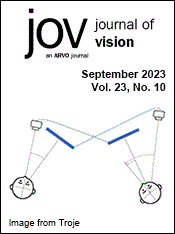
Zoom conveys visual signals about gaze behavior, but they are spurious. In a new paper, I discuss the problem as a general lack of directionality, and show that using display technology that simulates motion parallax is necessary and sufficient to fix it. https://t.co/owfj5zSt11
We are honoured to receive $105M in funding for "Connected Minds: Neural and Machine Systems for a Healthy, Just Society". We look forward to working with Queen’s University on this meaningful research program! | #CFREF#fondApogée@queensu
Binocular disparity for distance, motion parallax for direction and place! The geometry of BD and MP is almost identical, but their functional significance is vastly different. A new paper from @BioMotionLab@vistayorku postdoc Michael Wang just appeared.
https://t.co/xnmJlp7FFu
I (@NTroje ) am currently spending a sabbatical year with the Konstanz Collective Behaviour group. It's an amazing experience. Here is @tomscott's take on a current experiment.
https://t.co/2hxV8Ijsi0
Zoom disrupts eye contact behaviour! We know that. But what exactly is the problem and how can it be fixed properly? Here is my own approach, framed as a TICS Science & Society mini paper. @vistayorku@YUResearch@CentreforVisio1 https://t.co/qmFT60mRVm
New review on an ongoing topic: Life Detection from Biological Motion. We haven’t contributed a lot lately, but many other labs have. Here, @NTroje and Dorita Chang provide an update on what's new and exciting. @vistayork@YUResearch@CentreforVisio1
https://t.co/zFTVn8qQPE
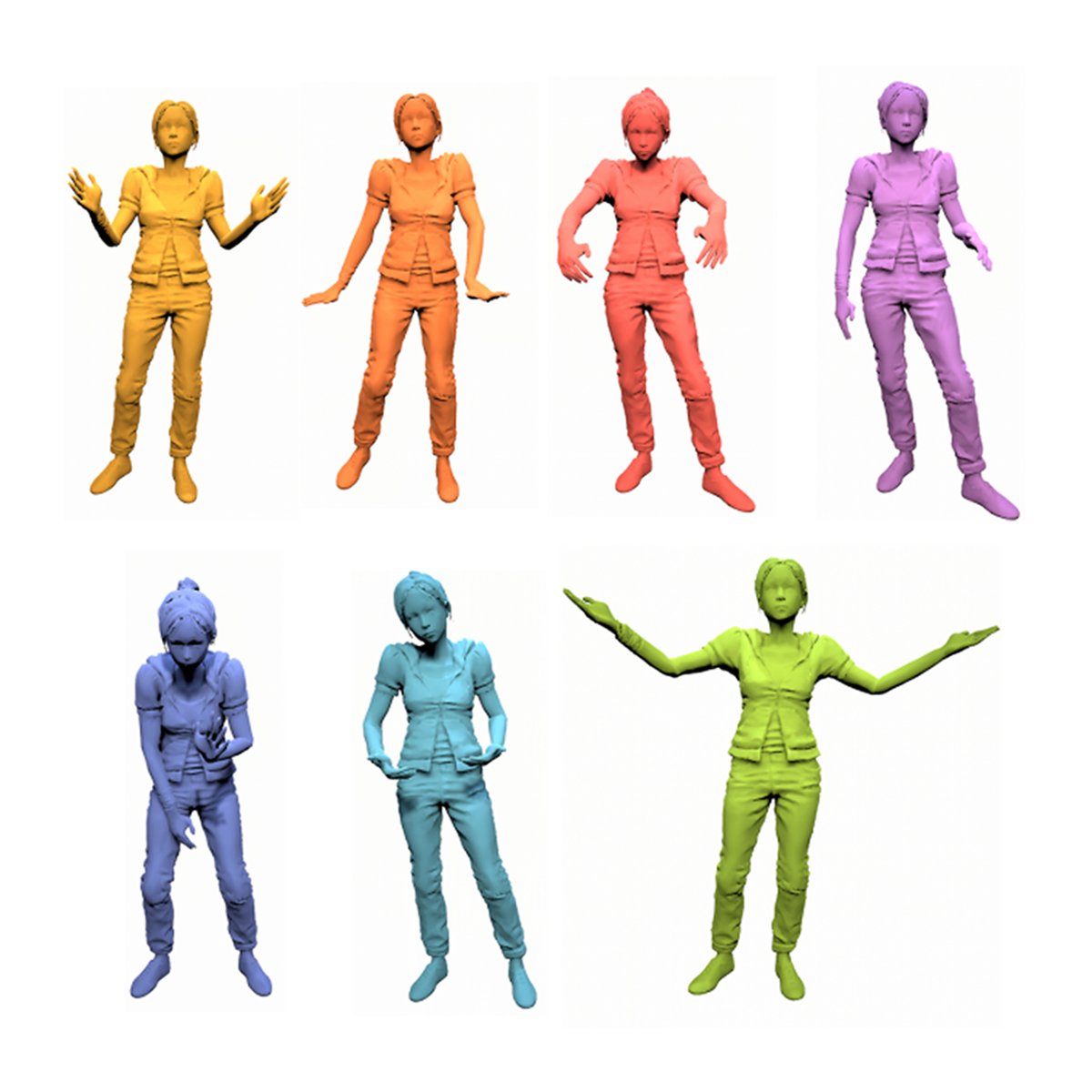
Check out 'ZeroEGGS' which takes recorded speech and creates gestural movement to match, powered by the brains and research of our teams at @UbisoftLaForge!
Want to play around? It's open source and we'd love to see your results!
📺 https://t.co/Xt1DMZG9D0
Does belief in free will influence biological motion perception? Probably not. But why would we expect that in the first place? Wei Peng, graduate student in the lab of Marcel Brass has answers to these questions. https://t.co/CDLyyrMkaU
Lily Martin, PhD student at University of Heidelberg, and her supervisor Thomas Fuchs collaborate with the @biomotionlab to characterize motor abnormalities in schizophrenia that can be used for diagnosis and assessment. https://t.co/dtAe69YRlC
This post features the work of @BioMotionLab graduate student Saeed Ghorbani @SaGhorbani who did an internship with @Ubisoft as a grad student and was then promoted to become an R&D Scientist with @UbisoftToronto. Congratulations, Saeed!
Ashley was also a graduate students in the @BioMotionLab. It is sad, that she leaves physically, but she will remain a much appreciated member of the lab until she defends her thesis later this year. We'll miss you, Ashley.
VISTA core member @NTroje presenting his innovative work on the “Alberti Frame” in his talk, Mug shots: Systematic biases in the perception of facial orientation. Come check out his demo on @VSSMtg Demo Night and say hi to me on the other end of the frame! 👋 🖼 @BioMotionLab
ICYMI "My education will never be complete. Most professions come with some aspect of lifelong learning, but being a researcher means learning itself is the goal and not just a vehicle to reach some other goal." https://t.co/7DKsK1Srd8 #meettheresearcher@YUResearch@vistayorku
ICYMI Renaissance architect and mathematician Leon Battista Alberti believed paintings should recreate exactly the view seen through an empty frame. What does this concept have to do with virtual reality? https://t.co/QOzddlljsd @YorkUnews@BioMotionLab@YorkUScience@vistayorku