#BIOP ignites the #BitcoinL2 ecosystem! #OP_CAT empowers BTC smart contracts!
#BIOP brings #DeFi to L2 with speed and security!
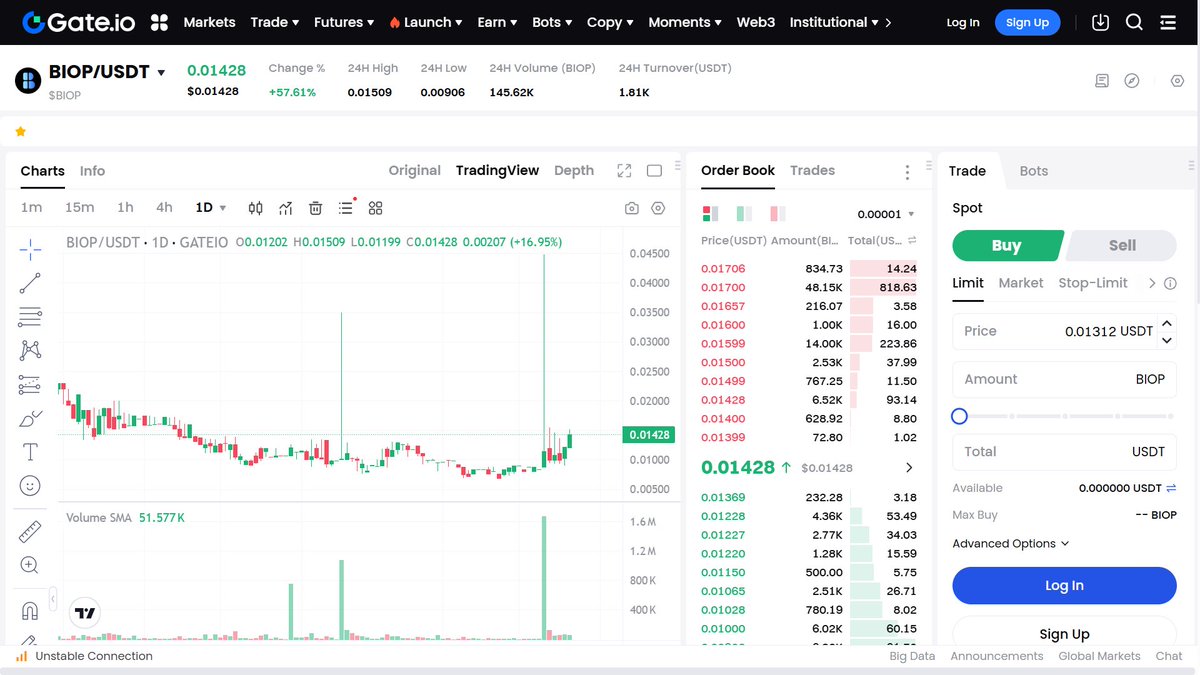
$BIOP has been listed on #Gateio@Gate_io, https://t.co/bkUUBzoOL9
🔗https://t.co/SOV8fZkiks
#BTC#BTCL2
🔥#Biop leads the #BitcoinL2 revolution! #BIOP combines #OP_CAT to unlock new possibilities for smart contracts!
✅Join the first Optimistic Rollup L2!
$BIOP has been listed on #Gateio@Gate_io, https://t.co/bkUUBzoOL9
🔗https://t.co/SOV8fZkiks
#BTC#BTCL2
#OP_CAT is the key to unlocking #Bitcoin potential.
Programmable Bitcoin? OP_CAT makes it happen, and #BIOP is the first #BitcoinL2 to harness it.
$BIOP has been listed on #Gateio@Gate_io, https://t.co/bkUUBzoOL9
🔗https://t.co/SOV8fZkiks
#BTC#BTCL2
🔥#BitcoinL2 is evolving with #OP_CAT, and #BIOP is at the forefront
✅Faster transactions, lower costs, and a thriving ecosystem
$BIOP has been listed on #Gateio@Gate_io, https://t.co/bkUUBzoOL9
🔗https://t.co/SOV8fZkiks
#BTC#BTCL2
🔥#BIOP brings #OP_CAT to #BitcoinL2.
✅Scalability, security, and innovation
$BIOP has been listed on #Gateio@Gate_io, https://t.co/bkUUBzogVB
Whitepaper: https://t.co/SOV8fZjKuU
#BTC#BTCL2
🔥#BIOP is the first mover. #BIOP#BitcoinL2 powered by OP_CAT is here to revolutionize BTC.
✅OP_CAT unlocks the future of Bitcoin!
$BIOP has been listed on #Gateio@Gate_io, https://t.co/bkUUBzoOL9
Whitepaper: https://t.co/SOV8fZkiks
#BTC#BTCL2
#BitcoinL2 powered by OP_CAT will revolutionize BTC.
#BIOP is the pioneer. BitcoinL2 is about to get a major upgrade with OP_CAT, fast, secure and programmable.
$BIOP has been listed on #Gateio@Gate_io, https://t.co/bkUUBzoOL9
Whitepaper: https://t.co/SOV8fZkiks
#BTC#BTCL2
As Domo @domodata mentioned, native protocol assets like #BRC20 can be transferred to #BitcoinL2 to participate in secure, fully decentralized, efficient transactions and #DeFi while maintaining the security of the #Bitcoin Mainnet.
#BIOP is coming, https://t.co/XPMss8qc1F
BITCOIN RAILS EPISODE #17: DOMO’S SIDE OF THE STORY & the HISTORY OF BRC20
A particularly special episode—@domodata sits down with me for his first video interview ever—to recount the unique history of the BRC20 protocol.
The first Bitcoin-native token standard ever created, BRC20 came into existence almost overnight and quickly emerged as a multibillion dollar asset class in 2024.
This episode covers the influences leading up to the birth of $ORDI, the roles of different players involved along the way, and how core maintainers are preparing for their next major update—affectionately dubbed “BRC 2.0” by Bitcoin educator @bobbodily
Additionally, Domo shares his memory of key moments in BRC20 history—including:
—the development of BRC20's canonical indexer and details of Domo's working relationship with @unisat_wallet
—Ordi's listing on OKX and Binance (+ what he believes triggered listing decisions by those exchanges)
—the creation of the Layer 1 Foundation and the responsibilities of its member organizations in maintaining the core protocol
—why Domo has never accepted funding (including advisory fees) from either of his lead maintainer companies @unisat_wallet or @bestinslotxyz
We also go into depth about what sparked the “BRC20 indexer wars” and how stakeholders are ensuring the integrity of its consensus going forward.
This episode includes special mentions of major influences in the evolution of BRC20—including @redphone@robertjfclarke@Bitcoin_Punks_@satsnames@bestinslot@unisat_wallet and others.
This episode can be viewed on YouTube or Spotify using the linktree in Isabel’s bio—YouTube episode is also in the comments.
As always, thanks to the show's sponsor @bestinslotxyz for making this episode possible— in addition to being a core maintainer of BRC20, Best In Slot maintains the leading API for Ordinals and BRC20 data aggregation and indexing.
TIMESTAMPS:
01:04 Domo, Ethereum, and how he found Bitcoin
05:04 Why Ordinals clicked for Domo
07:58 Ordinals going from underground to mainstream
11:13 Who helped Domo ideate around Ordinals? 16:21 How did Domo announce ORDI, the “first” BRC20?
20:02 Why did BRC20 blow up so fast?
22:25 How did UniSat get involved with BRC20?
25:12 Catalysts for the BRC20/ fungibles boom
26:35 When did BRC20 get good pricing data?
29:00 Domo’s stresses during the ORDI blowup
31:34 How involved was Domo with UniSat early on?
35:00 Exchanges instantly deciding to list ORDI
37:38 How did Best In Slot start indexing BRC20s?
41:48 Centralization of indexers
44:18 Coordinating indexers around Ordinals forks
47:25 Relaunching the Layer 1 Foundation
49:25 The relationship between Domo, UniSat, and Best In Slot
51:02 Upgrading BRC20: Swap and Programmability Module
54:55 How the programmability module came to be
57:00 “Standard Maxiness” is hurting the industry
59:00 Plugging BRC20 into everything else
01:00:50 Do programmable metaprotocols solve interoperability?
01:02:50 Metaprotocols and L2s: do they compete?
01:05:00 Does BRC20 have an advantage over the metaprotocols?
01:06:20 How should the community approach Bitcoin’s issues?
01:08:50 Competition rising in the BItcoin space
01:10:00 People are underestimating metaprotocols
01:11:55 Single step transfer for BRC20
#Biop is being developed based on #OP_CAT.
#OP_CAT is the best way to #Bitcoin L2.
More is coming.
$BIOP has been listed on https://t.co/F7HCFrUagR, https://t.co/2j786VFF1B
#Biop Whitepaper: https://t.co/SOV8fZkiks
#BTC#BTCL2#BitcoinLayer2
“THE ARGUMENT IN FAVOR OF OP_CAT IS… IT MIGHT GET DONE SOONER”
@lopp asks blockstream ceo adam back @adam3us: “on a scale of zero to meow, how much do you love OP_CAT?” 🙀
Every red square you see in this box contains a chopped up piece of a Circle STARK verifier (ZK verifier)
OP_CAT allows each square to depend on eachother—it links them together sequentially
This means we can have a OP_ZKP_VERIFY without actually committing to any proof system!
Here is a full demo of an onchain verification of a STARK proof of a Fibonnacci computation, on Catnet (custom Bitcoin signet with OP_CAT enabled).
Based on the amazing work of @weikeng!
I want to take the opportunity here to clear up some confusion around OP_CAT and the extent to which it enables "ETH-like" protocols on Bitcoin.
If you're reading this, and you're wondering "Why Would We Want To Make Bitcoin _Anything At All_ More Like The Garbage Shitshow That is ETH?" and for that reason feel that OP_CAT is unnecessary, l understand that emotion and want to clarify some things.
What does OP_CAT do and why do we actually need it?
So, everyone who knows anything about Bitcoin knows that the longest dispute/challenge we've had with the protocol is how to make it scale. How do we enable more transactions on Bitcoin, more users, to transact on the chain in a non-custodial fashion?
In 2015-2016, we were at a crossroads and basically had to choose between:
1) Increasing the blocksize, making blockchain validation harder to do for the average user at home
2) Attempt to scale using complex "Layer 2" technologies, trying to aggregate as many transactions offchain as possible and settle to the mainnet only when necessary
At the time, the downsides of (1) were clear and understood. Many people in Bitcoin felt that it was unwise to go for this option before we had explored (2), myself included.
So we explored the Lightning Network, the channel-based, only "real L2" system that was possible to build on Bitcoin at the time (leveraging the OP_CLTV and OP_CSV opcodes that had been recently softforked into the protocol, and later, also SegWit—the latter two softforks activated specifically to enable LN).
But Lightning has proven to be lackluster. While it is possible to route around BTC offchain in this manner, in a decentralized way, many, if not most LN-engineers are deeply frustrated with the complexity of the protocol.
While marginal improvements have been made, we're still stuck with a channel-based, liquidity-management-based scaling system that drives most people to use custodial solutions, undermining the core premise of Bitcoin (self-sovereingty, privacy, censorship resistance).
So, unless we want to surrender and actually make the blocks larger, we have to make Layer 2 protocols easier to use.
The main roadblock to make Layer 2 protocols that are channel-free and easy to use is the lack of ability to in code specify how a Bitcoin transaction output (UTXO) can be spent.
This technical detail is what's known as "covenants". There are many proposals for how to enable covenants and a lot of politicking involved in how to choose the right one.
We've been observing the covenants debate deadlock for years. One of the leading proposals, called OP_CTV, has failed to win sufficient community consensus, and has often been bikeshedded by leaders in the industry with arguments such as "Why don't we just re-enable OP_CAT which exists today on sidechains like Liquid and altcoins like Bitcoin Cash?"
If the primary holdup to activate covenants are questions like "Why don't we just activate OP_CAT instead?" then I think it's worthwhile to force the conversation and say, "Yeah, how about it? Why don't we just activate OP_CAT?"
In May last year in Austin, at the most high-density Bitcoin developer conference of the year, @btcplusplus, developer consensus that are in some flavor in support of adding the functionality of OP_CAT was gauged and the overwhelming sentiment was that OP_CAT is actually something that we want in Bitcoin.
Again, the introduction of OP_CAT is a way to introduce covenants into Bitcoin, with the core purpose being to break Bitcoin free from the lack of functionality that prevents it from being able to host good Layer 2 protocols (that don't require channels, trust, or inbound liquidity).
Yes, it is true that these Layer 2 protocols will also be able to run Ethereum-like computation ontop, instead of just being scaling mechanisms, but OP_CAT overall is not an "Ethereumification" of Bitcoin.
Bitcoin Core won't be any costlier to run at your home computer with OP_CAT, Bitcoin Script won't be running complex Turing complete computation, Bitcoin won't be managing more data onchain than the current 4MB block limit allows, it won't have rich statefulness, it will still be using the same old rudimentary UTXO-model at the baselayer.
The only difference being that that rudimentary UTXO-model can now concatenate elements and verify if a hash belongs in a particular Merkle tree, and carry state from one UTXO to another, enabling every UTXO to operate as a tiny "state machine" in and of itself.
This allows more powerful, user-friendly Layer 2 protocols, such that users can actually use them non-custodially and not keep their funds in custodial wallets, as we see with most leading Lightning efforts today, defeating the purpose of using Layer 2 protocols in the first place.
So, would OP_CAT allow more "ETH-like" protocols to run ontop Bitcoin? Yes! It allows for channel-free, permissionless, user-friendly L2s to be built.
Does OP_CAT make the Bitcoin Layer 1 "ETH-like"? Not by a longshot.
Of course you are bearish on OP_CAT
You're a 3rd year laser-eye. You just finished reading “the bitcoin standard” — a book written for Saifedean by a fiverr ghost writer — and watched some Swan podcasts probably. You're gonna be so excited about this for a month until you get to Jason Lowery, and then you're gonna be talking about how the cyber warfare drones are going to be powered by bitcoin proof of work. That's gonna last for another week or two, when you’ll stumble upon Andrew Poelstra saying that OP_CAT is actually great—
> “Well, as a matter of fact, I won't, because MEVi—“
'Because MEVil is bad and we won’t let it happen' You got that from Matt Corallo. On Stephan Livera episode 417 “Why We Must Larp About Fake Centralization Concerns Instead Of Doing Any Actual Work For Once”, right? Yeah, I watched that one too. Were you gonna plagiarize the whole thing for us? Do you have any thoughts of your own on this matter?
Or do you... is that your thing? You log on to X. You read some scaremongering from washed-out influencers that no one cares about anymore post-ETF and then pretend... you pawn it off as your own idea just to impress some feds who claim to be bitcoin e-girls and to embarrass Saylor’s social media intern??
See the sad thing about a guy like you is in 3 months you're gonna start doing some thinking of your own and you're gonna come up with the fact that there are two certainties in life.
One: OP_CAT is going to activate on bitcoin, because everyone who matters wants it.
And two: You wasted 4 years jacking off to multisig bridges and custodial wallets when you could’ve just joined Taproot Wizards instead and become an OP_CAT expert just in time for the greatest and most lucrative bitcoin renaissance in 15 years