GLM‑5.3 Flash is now live on Zro.
We’re giving it special treatment from day one, with a focus on fast, reliable serving.
More performance improvements are coming over the next few days.
It varies by the protocol for PIR, but I would say that if the total amount of data a user needs to download exceeds 10MB or so then PIR would be more bandwidth saving. This then translates to the size of a block without witness data. So if the user is more than 100 blocks away, PIR starts being very useful.
I have been working on this for a few months. It currently supports DPF-PIR, HarmonyPIR, OnionPIRv2, and now also ORAM with TEE client proxy. Lightning integration for paying for PIR and Nostr server discovery on the way.
.@weikeng is building Private Information Retrieval (PIR) for bitcoin: query the UTXO set without revealing what addresses you are interested in. It’s a rare way to gaze into the bitcoin abyss without it gazing back.
Before: GPT 5.6 Sol Ultracode + /goal
(ran out of usage limit in 2 days)
Now: GPT 5.6 Sol High + “use Terra for subagents not Sol”, “let subagents do coding”, “my usage limit is tight please have mercy”, “I will notify you when CI is done, please do not loop wait”
(still at 99%)
I was one of the users who sent that idea to gdb back then when he was collecting ideas :) I wonder if OpenAI can gift a banked reset for predicting what eventually goes into products. @thsottiaux
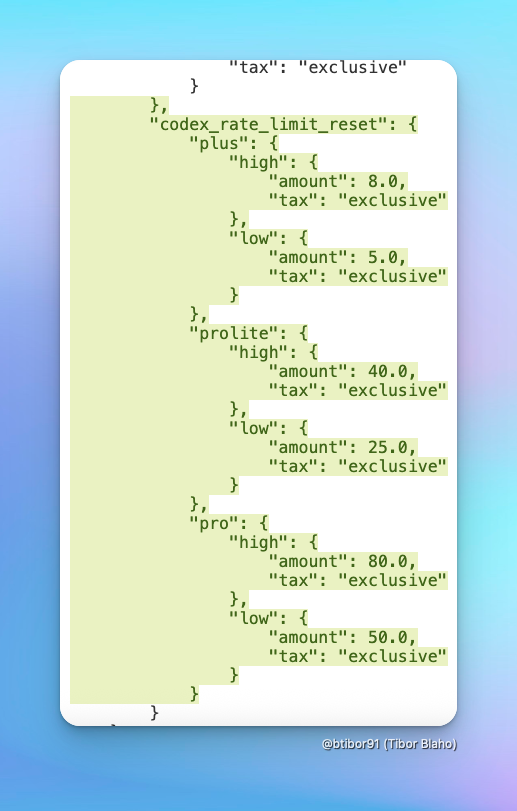
OpenAI appears to be working on a feature that would let you purchase a rate limit reset for Codex
Source: public checkout pricing config & ChatGPT web app assets
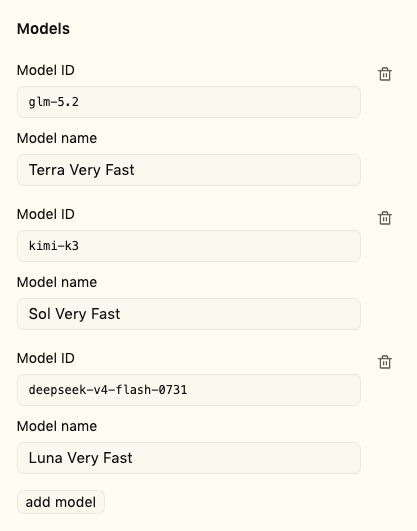
My current use of Zro: (1) Kimi K3 as Sol, (2) GLM-5.2 as Terra, (3) DeepSeek v4 Flash as Luna.
The inference is fast, especially for Kimi K3. When you need independent code review, GLM-5.2 can help.
Today we added @AMD MI325X as a new serving backend for @zroai_. Kimi K3 is the first model running on it, powered by @sgl_project.
We believe this is the first production support for the official Kimi K3 weights on CDNA3.
With 256 GB of HBM per GPU, the full model fits on a single 8×MI325X node. This is likely the lowest-cost hardware configuration capable of serving Kimi K3.
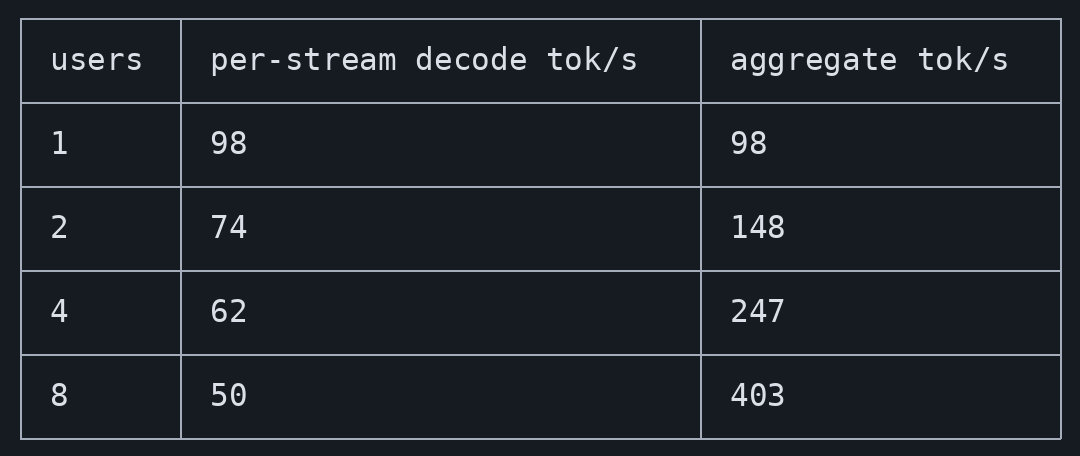
The benchmark below shows solid serving performance, even before adding any of MoonMath’s custom kernels.
Huge thanks to @digitalocean for their partnership.
~~~~~~~~~~~~~~~~~~~~~~~~~~~~~~~~~~~~~
Here is everything we changed to make Kimi K3 work on CDNA3 with SGLang:
1. Rerouted MXFP4 experts to AITER’s Triton GEMMs:
AITER’s default 4-bit MoE path selects a FlyDSL kernel on gfx942, then fails during compilation. Its A4W4 kernels are gfx950-only. AITER states this in the source, and AMD’s MI35x tests note that “MXFP4 does not register on gfx942.” Without this change, K3’s MoE has no working execution path on CDNA3. We enable the Triton route automatically on gfx942.
2. Fixed an AITER GEMM crash on sliced activations:
K3 passes the tuned GEMM path a 1,536-wide slice of a 2,112-wide tensor. The launcher rejects its strides and throws; under graph capture, that becomes fatal instead of falling back. The tricky part is that PyTorch ignores the stride of size-1 dimensions, so the view reports as contiguous and .contiguous() does nothing. The fix explicitly checks for the canonical strides required by the launcher.
3. Fixed a recent regression in K3’s SiTU activation:
An August 1 upstream commit added an unguarded CUDA-only include, breaking the kernel build on every AMD GPU. Because the failure appears during graph capture, it looks like a graph issue rather than a missing kernel. We route ROCm to SGLang’s equivalent Triton implementation. Upstream, a two-line ifndef USE_ROCM guard would fix MI355X as well.
4. Selected the required graph-capture mode up front on ROCm:
Upstream replaced graph recapture with a validator that raises an error. Under speculative decoding, capturing a mode that is too weak now kills the run instead of triggering a recapture. We force the correct hidden mode before capture begins.
5. Added support for 12 MLA heads per rank:
With TP8, K3’s 96 heads become 12 heads per rank. AITER has no MLA kernel for that shape: it rejects the configuration at startup and can later call abort() from C++ without a Python stack trace. We bypass the startup assertion and zero-pad the query heads from 12 to 16 so a supported kernel can run.
6. Enabled the configuration the stack actually requires:
The working setup needs:
SGLANG_USE_AITER=1
SGLANG_AITER_K3_OPT=1
<head-padding flag>
--trust-remote-code
SGLANG_USE_AITER=1 enables the AITER MoE route. Without SGLANG_AITER_K3_OPT=1, expert weights are padded to 256 and TP8 runs out of memory during loading. Missing --trust-remote-code fails only after loading roughly 1.42 TiB of weights.--kv-cache-dtype fp8_e4m3 is not inherently required by K3 or ROCm; our current attention path requires it because it does not yet include a BF16-KV kernel.
All credit goes to the team - I am here simply to report their work 💐
Ok, I was wrong. It's really good, maybe not as good as glm 5.2 but - I've seen the code and it's really good, specially on style/taste - doesn't overthink; does a good job at getting there without too much ceremony. Really good comprehension and communication. I'm impressed and for the price, unbeatable right now.
ten significant advances in mathematics and theoretical computer science.
solved using an internal version of Astra, our next major model, for a total cost of about $2000 at Sol API prices:
The updated dsv4-Flash-0731 feels unfairly good :)
We added day-@zroai_ support serving it from our EU infra.
And, just like with Kimi K3, we cut the price 🤠