How does your brain decide to persist or quit? We modeled brain circuits that support perseverance over aggression, shaping social dominance and flexible responses in animal competitions.
Learn more 👇
https://t.co/qkO6P6WOi7
We’re continuing the conversation — in a new place.
AIP Publishing is now posting on Bluesky: @ https://t.co/t1X0TdZQnD
Follow us there for the latest research����
We’re continuing the conversation — in a new place.
AIP Publishing is now posting on Bluesky: @ https://t.co/t1X0TdZQnD
Follow us there for the latest research🧪
This review covers recent nerve repair findings, focusing on the peripheral nervous system and regeneration. It highlights electric field strategies for enhancing nerve growth.
Learn more 👇
https://t.co/avSMUwDspf
This review highlights recent advancements in predicting mutation-induced ΔΔGs in protein interactions, focusing on methods, challenges, and AI-driven improvements. https://t.co/nJH8OTNvOP
Caused by the abnormal polymerization of hemoglobin molecules, sickle cell disease creates deformations in red blood cells (RBC) that lead to sometimes fatal perturbations in cellular behavior and rheological characteristics in blood. #scilight
👇
https://t.co/yyD0J8gMOv
This review highlights recent advancements in predicting mutation-induced ΔΔGs in protein interactions, focusing on methods, challenges, and AI-driven improvements.
Learn more 👇
https://t.co/aAVQfcXFIC
Recent breakthroughs in intrinsically disordered proteins and how we go from molecular descriptions to cellular functions with the help of NMR. @SAShowalterLab@Wei__Chen_@cegrPSU@psu_chemistry https://t.co/r69hViSsJP
Integrating AI and traditional network analysis methods can assist in building more accurate models of RNA complex structures, predicting their dynamic behaviors, and designing RNA-based inhibitors.
Learn more 👇
https://t.co/pqn34sU5hA
This review discusses the application of nanotechnology and nano biomaterials in retinal diseases, emphasizing research investigations in nanomedicine-based diagnostics and therapeutics. @WayneStateOVAS@waynemedicine@nikhil24216
Learn more 👇
https://t.co/l794SN1uAL
This review discusses the application of nanotechnology and nano biomaterials in retinal diseases, emphasizing research investigations in nanomedicine-based diagnostics and therapeutics. @WayneStateOVAS@waynemedicine@nikhil24216
Learn more 👇
https://t.co/l794SN1uAL
Publishing #OpenAccess enhances the visibility and impact of research. Our author select program allows researchers to publish OA across our whole portfolio. Read one of the most downloaded articles from Biophysics Reviews as we celebrate #OAWeek!
👉 https://t.co/RemYHVDXCi
Hey @MicroTas2024!
We're searching for the next editor-in-chief for @BiophysRev! To learn more about this opportunity in #Biophysics, stop by @AIP_Publishing Booth 49.
Or apply 👉 https://t.co/H3mOtrXnji
Microfluidics provides a physiologically realistic and yet controlled playground for quantitative studies of cell migration. @mingmingwu2
Learn more 👇
https://t.co/dj3ucNKJ0s
Are you an artist with a passion for science or a scientist with an artistic flair?
Submit a "Visuals" gallery-type article to Biophysics Reviews today!
Learn more 👇
https://t.co/oPZFXoaeyP
We strongly believe that art & science have more in common than typically
appreciated. Learn more about our new gallery-type article, "#Visuals"!
👇
https://t.co/PxR3fwLm3N
After performing its function, the fibrin component of a blood clot must be degraded. Here, we visualized stable fibrin fibers and partially degraded fibers with bound catalytic enzymes (green). @ValTutwiler@rebecca_risman@BMERutgers
Learn more 👇
https://t.co/hYwTz2RrPq
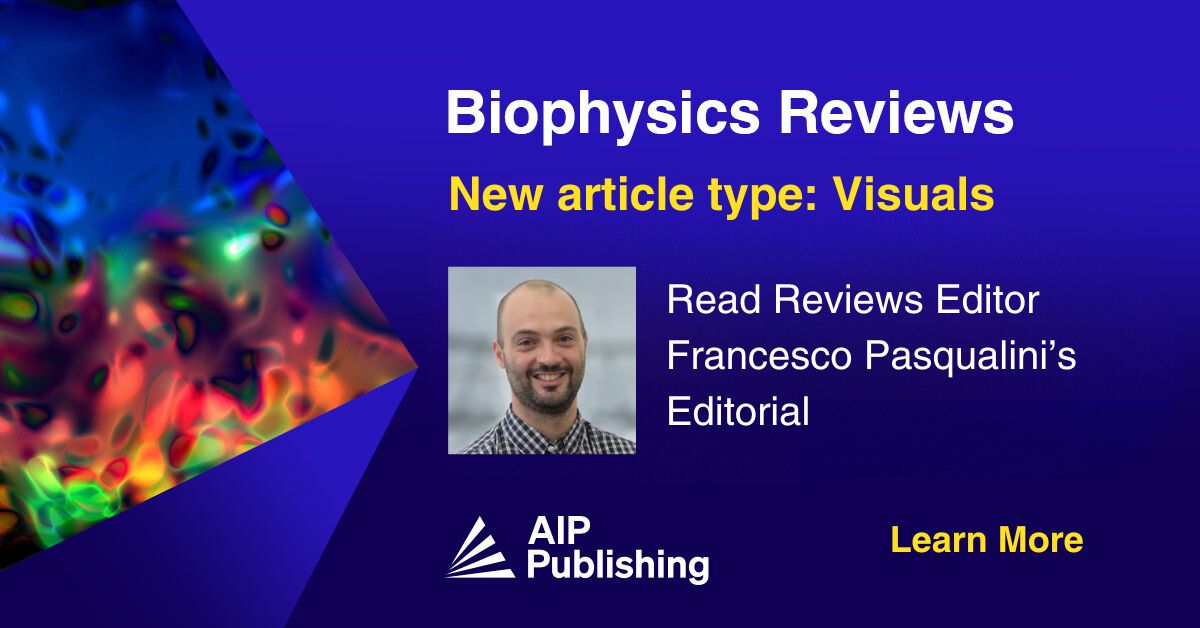
Submit to our new gallery-type article "#Visuals"! These articles are a new format designed to capture the essence of #biophysical research. Check out this Editorial from Reviews Editor @fspasqualini to learn more!
Learn more 👇
https://t.co/KA6QANpOmo