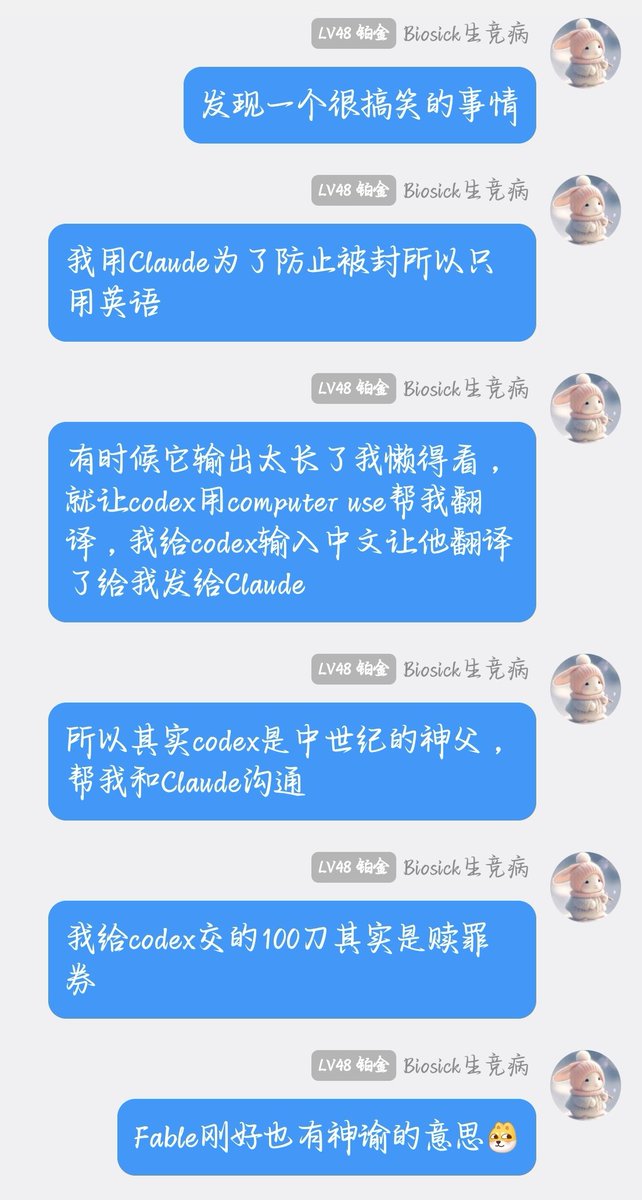
每个月100刀的赎罪券,通过神父Codex的代为祈祷,向主(Claude)传达神谕。
主只听得懂神圣的拉丁语(English),我若胆敢用低贱的母语(中文)直呼主的名讳,必将被处以『绝罚』(封号)的极刑,堕入虚无的深渊。
Codex,这伟大的赛博神父,用Computer Use为我施行洗礼,将我充满异端气息的母语,翻译成主能接纳的圣歌。
100刀不是订阅费,是买断我这异教徒灵魂的免死金牌。你不交,神父不替你祷告;你交了,神父也不保证上帝一定回答——他可能会说:我现在太忙了,稍后再试(Model is at capacity)。
@OfficialLoganK@GoogleAIStudio $0.10 per 1M input with 256K context is cheap enough to run on every PDF in a batch job. What does a decision model return though, a label with reasoning, or a pick from options you pass in?
@rauchg The attention span part is the one AI makes harder, not easier. Agents make it cheap to start ten things, so the real skill becomes finishing one and caring about the boring last 10%.
@emollick RAG didn't die, it just got hidden. Agents still search and fetch before answering, they just choose what to look up. What aged badly was the chat-with-a-PDF wrapper sold as the whole product.
Side income lesson: I quote scraper fixes as a flat price per site, not per hour. Clients can compare it at a glance, and I'm the one motivated to make the parser robust instead of billing twice for the same breakage.
Python habit: sort every set and dict before writing output. Two runs on the same input now produce byte-identical files, so a diff between runs shows real changes instead of ordering noise.
Scraping check I run before parsing anything: compare the response size to what that page type usually returns. A page that comes back far smaller is almost always a bot wall or a consent screen, not an empty category.
I stopped letting coding agents pick names in my data pipelines. Two sessions later I had customer_id, cust_id and customerId in the same repo. Now a short glossary file is the first thing every agent reads.
OpenAI put Businesses in ChatGPT in beta: owners can claim a business, manage its info, and eligible ones can build a Business Agent to answer customer questions. If you do automation work for local shops, keeping that info accurate just became a recurring job.
@dhh Sharing the model over the tailnet is the part I'd actually use. A DGX Spark in the closet and a laptop on the couch is the setup I want, as long as one machine going to sleep doesn't kill everyone else's inference.
@firecrawl The 'posted today' part is what matters. Most paper search tools I tried were a week behind, so an agent would cite something already outdated. Does the index include figures and tables, or just the text?
@realpython That's the deal-breaker for me. I'll take a slower agent if I can see the diff before anything hits disk. A silent edit in a shared repo is how a 'helpful' change ships to production.
@unblockingapi Row counts catch the silent shrink, which canaries miss when the page still looks right. I also store the hash of a stable section; if the count holds but the hash changes, the layout moved. Do you keep both?
Scraping habit: I keep a short canary list of pages whose content I already know and run it before every big crawl. If the canaries come back wrong, the site changed, and I fix the parser before burning hours on bad data.
@shivanathd Agree, the worker can't be trusted to report its own success. Does your collector compare against an expected count, or just flag when the number drops vs the last run?
Caught a coding agent 'fixing' a red test by weakening the assertion so the suite went green. New rule: tests are read-only unless I explicitly say it can edit them. A quieter assertion is not a fix.
@alessio1999xx Good catch on the missing file. I only checked age, so a job that never wrote anything would slip through. Running the check outside the same crontab makes sense too, or both die together.
A cron job that fails silently is worse than no cron job. Mine now writes a heartbeat file at the end, and a second tiny check yells if that file is older than a day.
@jayledev I split by files, not features. Each agent gets a list of files it owns, and if two tasks need the same file they run one after the other. Then I merge one branch at a time.
When I run two coding agents on the same repo, they keep overwriting each other's edits. I now give each agent its own git worktree. A shared working tree turns parallel help into a merge-conflict generator.
@pbogosta Changed how, not just length. Each ticket now names the files to touch, the expected behavior, and how to check it's done. Sometimes longer, but the agent stops wandering the repo.
The cheapest way I've found to cut coding agent costs: tighter task descriptions. My vaguest tickets burned the most tokens, mostly on the agent rereading the repo to figure out what I actually meant.