Check out this interesting work from the Stacey Ogden lab @StJudeResearch, out now in @NatureComms :
A case where virtual screening and MD simulations successfully predict binding residues and allosteric sites of SMO. This was a great collaboration!
https://t.co/9xMcBqY3bQ
New Huang lab publication at Nature. Our newly developed technique: transient Pore Analyte Looping (tPAL) now achieves “chop and measure” nanopore sequencing of peptide, in an amino acid by amino acid manner. https://t.co/YMUPMckpnx
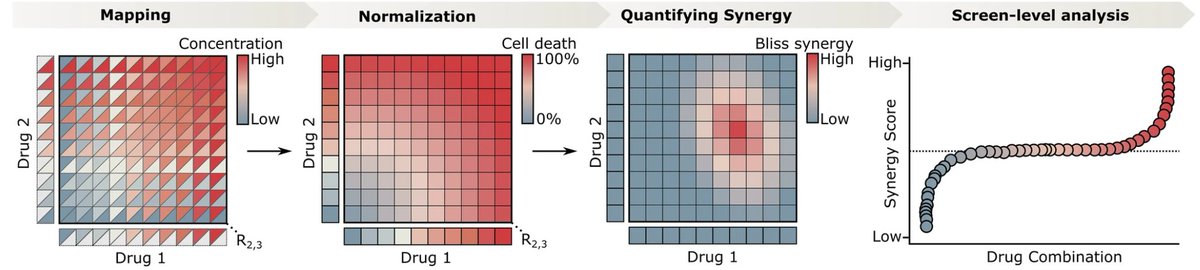
St. Jude researchers developed Combocat, a machine learning-powered platform that rapidly screens drug combinations at scale. In a proof-of-principle test, 9,045 drug pairs were screened, uncovering new synergistic therapies. https://t.co/2KXZXX0yCS
I once heard a talk from @JEFworks explaining how she uses Moran's I to measure spatial autocorrelation in spatial transcriptomics. I wondered if this might be applied to these 9000+ synergy matrices. It turned out to be a valuable filtering metric!
To scale higher, we developed the "sparse mode" of Combocat, which introduces several tricks to dramatically boost throughput...like use of 1536-well plates, and generating 'sparse' matrices.
Beyond throughput, Combocat emphasizes data quality and interpretability. Various QC and filtering options are used to enable direct comparisons of results across experiments.
Lastly, Combocat is fully open-source. We provide code, documentation, and example workflows at
https://t.co/eFDfYGyEZW
Have an interest in drug combinations? Reach out!
Dose density is important. Combocat's "dense mode" screens combinations in a 10×10 dose format - in triplicate.
We tested > 800 combos this way in various cell models like cancer, 'normal', and bacteria.
Drug combinations are central to modern medicine, but their discovery is still highly limited by scale, cost, and analytical complexity.
Combocat addresses this by integrating experimental design, automation-friendly layouts, and standardized analysis into a single framework.
Excited to introduce Combocat, an open-source platform for large-scale drug combination screening and analysis published today in @NatureComms :
https://t.co/QJDyu1LjW4
Brief overview..🧵
This year at the Bringing Chemistry to Medicine symposium, I got to discuss how drug combination discovery can be accelerated.
Had several great discussions while presenting this poster, which spans the fields of computational and chemical biology. A very inspiring symposium!
Had the incredible opportunity to lead a team in the St. Jude #KIDS25 Biohackathon.
Over just 3 days, we developed machine learning approaches to predict cancer dependencies from methylation data. Everyone put in a ton of effort, and we all learned a lot!💻