Daniel Griffin & Vincent Racaniello lament about the new ACIP charter, how administration of the HPV vaccine has eliminated cervical cancer deaths in young women, global economic burden of infectious disease, restoring trust in vaccinology, and more. 📺 https://t.co/L51BPxqqP9
The HPV vaccine has completely eliminated cervical cancer deaths among young women in some nations.
A groundbreaking study published in The Lancet has confirmed that zero women aged 20 to 24 died of cervical cancer in England between 2020 and 2024.
This marks the first time in recorded history that no deaths have been registered in this age bracket, representing a 100% decline in mortality compared to historical averages. Experts hail the achievement as an extraordinary victory for the school-based Human Papillomavirus (HPV) vaccination program, which was launched in the UK in 2008. The researchers estimate that the vaccine has already saved hundreds of young lives across England, a number set to grow exponentially as younger, immunized generations reach adulthood.
Despite the stunning triumph of the vaccine, health advocates warn against growing public complacency. In recent years, England's adolescent vaccination coverage has slipped below 80%—well underneath the 90% target recommended by the World Health Organization to completely eliminate cervical cancer. Public health officials emphasize that maintaining high immunization rates is crucial to preventing avoidable deaths and maintaining herd immunity. This research provides concrete, population-level evidence that a single, highly effective shot can virtually eliminate a major cancer, emphasizing the vital importance of robust public health infrastructure and vaccine outreach.
source: Sasieni, P., & Falcaro, M. (2026). Cervical cancer mortality trends following HPV vaccination in England, 2001-24: an analysis of population-based mortality data. The Lancet.
🚨 Oral sex has overtaken smoking as the primary driver of throat cancer.
In a significant shift in oncology, the human papillomavirus (HPV) has replaced tobacco and alcohol as the leading cause of oropharyngeal cancer. This specific strain, most commonly HPV-16, targets the tonsils and the back of the throat, where it can persist and replicate. While the body clears most HPV infections, persistent cases can trigger cellular changes that evolve into malignancy over time. Currently, HPV is responsible for approximately 70% to 85% of all throat cancer diagnoses in several Western nations, marking a public health turning point.
Research indicates that the risk of contracting this cancer is directly linked to sexual history, as the virus is primarily transmitted through oral sex. Studies show that a higher number of lifetime sexual partners correlates with a greater risk of infection, with men being significantly more susceptible to oral HPV than women. Public health experts emphasize that HPV vaccination remains the most effective preventive measure, particularly when administered to young adults, alongside increased awareness of the risks associated with oral transmission.
source: The Conversation. HPV-related throat cancer: Oral sex is now a leading risk factor. The Conversation.
Swiss farmers planted flowers between their crops and watched pest damage drop by over half. The UK is now running the same trial across 15 farms. The reason this works is embarrassingly simple.
A Swiss study on winter wheat found that fields with wildflower strips had 40 to 53% fewer leaf beetle pests than fields without. Crop damage dropped 61%.
The mechanism is simple. Wildflowers feed hoverflies, lacewings, parasitic wasps, ladybugs, and ground beetles. Those insects eat the aphids, beetle larvae, and caterpillars that farmers would otherwise spray for. A few meters of wildflowers hosts an unpaid pest control crew that would jump at the chance to whoop some aphid ass.
In apple orchards where no insecticides had been used for five years, plots with wildflower alleyways had 9.2% damaged fruit. Control plots without flowers had 32.5%.
The UK is now running a five-year trial across 15 farms placing 6-meter flower strips through the middle of fields, not just at the edges, because the beneficial insects can't reach the center of a large field otherwise.
This works the same way in a backyard vegetable garden as it does on a commercial farm. Plant native flowering species near your tomatoes, beans, and squash. The pests still show up, but the predators show up too.
Study doi: 20151369
1/ Today, the Global Policy Strategy (GPS) team is publishing Ethereum Basics for Governments and Institutions, a non-technical primer to equip the leaders making policy and deployment decisions with an understanding of how Ethereum works, how it's governed, and how it compares with perceived alternatives.
Death threats against me. A subpoena from Congress. Interviews cancelled and censored. A source indicted. Witnesses killed. Read the book that the corrupt national security state and criminal actors within it have fought tooth and nail to suppress. Now available in paperback.
Real-time proving moves to viable infrastructure. This unlocks synchronous composability.
In a talk at @EthPrague, @jbaylina revealed how @ziskvm solved the fundamental bottleneck in zero-knowledge proving: latency.
The @ziskvm team has been asking: Can we prove an Ethereum block in real time?
The answer, with benchmarks: Yes. Under 3 seconds from bundle to proof.
Basically it's the technical spine of the @etheconomiczone framework to reunify fragmented Layer 2s through synchronous composability.
So let's dive into it
Zero-knowledge proving is parallelizable... except for the one thing that matters most: execution.
When you prove a program, you must execute it step-by-step. You can parallelize witness computation (turning execution traces into constraints), GPU cryptography (Fourier transforms, polynomial commitments etc), and proof aggregation. But execution itself is serial.
This creates a hard ceiling: You cannot prove faster than the code executes.
For Ethereum blocks (thousands of transactions), this means minutes of latency. For cross-chain composability, minutes are unacceptable. You have 12 seconds per Ethereum slot to:
1. Bundle transactions from multiple rollups
2. Prove they're atomic (all succeed or all fail)
3. Settle on Ethereum mainnet
The math doesn't work. Unless you solve the execution bottleneck.
Zisk's innovation is smart. Don't speed up execution. Parallelize everything else so much that execution becomes irrelevant.
The five techniques they have
1. Pipelining: prove while preparing
2. Precompiles: offload to native code
3. Transpilation: Run RISC-V at Intel speeds
4. Memory Logging: Enable multi-process execution
5. Distributed Proving: Cluster-ccale parallelization
More importantly: Proving can be decentralized. No central coordinator needed—just minimal, deterministic coordination.
So, why this matters for @etheconomiczone?
The @etheconomiczone is a framework to unify fragmented Layer 2s through synchronous composability.
The problem it solves: Today, if you want to swap on your fav DEX (Ethereum) and borrow from lending market (let's say on Arbitrum) in one transaction, you can't. You bridge and take risk. (async, risky, slow etc).
The EEZ solution:
1. Bundle transactions from both L2s and Ethereum
2. Prove they're atomic (execution tables)
3. Settle on Ethereum
For this to work, proving must be fast enough to fit in Ethereum's block time. @ziskvm makes this feasible.
Without real-time proving: EEZ becomes another bridge ecosystem (async, complex, risky).
or
With real-time proving: Atomic composability is possible within 12 seconds.
What's next
- v1.0 beta coming in weeks
- Formal verification is ongoing
- Security audits are underway
- This is bleeding-edge, not battle-tested like Ethereum
- The team has 5+ years building Hermez and Polygon zkEVM in production
- The code is open-source and testable now
@jbaylina's message is super clear. The technical bottleneck is solved. It works. Now let's decentralize it and handle edge cases.
The @etheconomiczone is no longer a vision. It's a technical feasibility with real benchmarks. Now the work is hardening, auditing, and decentralizing. But the core breakthrough is proven.
Totally worth a watch ↓ link ↓
Ever wanted to read Karl Marx's Capital past the 'Marxist Economics' equations and jargon to get to the real Marx? Do it now! Capital as if imperialism mattered!Reading Capital With Radhika Desai : 1. Mandel Introduction and Marx and... https://t.co/ymO7dlWVNH via @YouTube
There’s a new show in town. Get in, we’re heading into the darkest corners of the internet to map and dissect the digital front of Reaction, one piece of propaganda, one spin, and one content creator at a time.Episode 1 - Charlie Kirk. On all podcast apps: https://t.co/VDCHo4FjS0
The U.S. public loves to imagine itself as one election away from redemption.
That fantasy is one of the empire’s most useful products.
It allows every crime to be reclassified as temporary deviation instead of structural expression.
Four years later the bombs continue, the sanctions continue, the vetoes continue, the bases remain, the myth survives, and the public gets to feel disappointed instead of implicated.
That cycle is not democratic self-correction.
It is imperial emotional management.
The US terror war on Cuba never ends.
The CIA invaded Cuba in 1961.
The US tried to assassinate revolutionary leader Fidel Castro 638 times.
The US bombed Cuban sugar mills and burned cane fields.
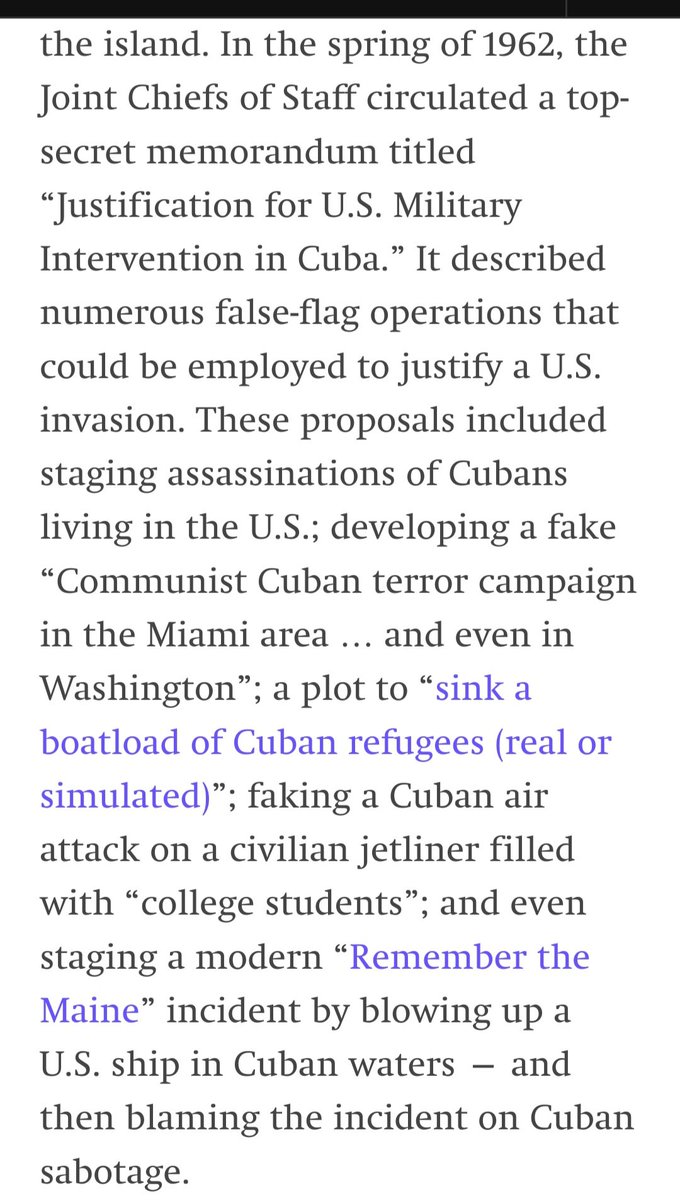
The Pentagon even prepared plans to launch false-flag attacks on Cuba. As this report notes:
"In the spring of 1962, the Joint Chiefs of Staff circulated a top-secret memorandum titled 'Justification for U.S. Military Intervention in Cuba.' It described numerous false-flag operations that could be employed to justify a U.S. invasion. These proposals included staging assassinations of Cubans living in the U.S.; developing a fake 'Communist Cuban terror campaign in the Miami area … and even in Washington'; a plot to 'sink a boatload of Cuban refugees (real or simulated)'; faking a Cuban air attack on a civilian jetliner filled with 'college students'; and even staging a modern 'Remember the Maine' incident by blowing up a U.S. ship in Cuban waters — and then blaming the incident on Cuban sabotage".
Source: https://t.co/8XsD3c9Wdm