Teddy Afro's "Das Tal": A National Lament, a Wound to the Conscience, and a Declaration of Freedom!
Art has the divine power to express the deep pain of a people that the speeches of politicians cannot. In his new single, "Das Tal," artist Tewodros Kassahun (Teddy Afro) has captured the atmosphere of grief hanging over Ethiopia, the broken unity, and the cry for justice in a way that stirs the soul. This work is not just music; it is a historical artifact in which a wounded people weeps in its own melody, argues, and reclaims its identity.
The opening line, "No one can reach you... where does one go to mourn a country that has died?" illustrates the difference between personal grief and national grief. A person will not lack a place to cry for their personal affairs, but when a country collapses and its existence is threatened, he tells us that the ground on which to stand and mourn becomes empty. While we have a historical chain that has strengthened Axum and Lalibela in one rock, today, when he describes the country's difficulty in walking, he vividly portrays the decay of the state structure and the risk of disintegration by saying, "The pillar is tilted and the roof is leaking."
Singing about becoming a stranger in one's own homeland, the verse "In the land where I grew up, in the village where I grew up, I became a stranger like a country that does not exist" exposes the bitter reality that citizens are displaced from their homes because of their identity and are considered refugees in their own country due to ethnic and tribal politics. "Abay is ahead in words for trickery, how painful it is to be betrayed after believing!" is an expression of the great regret the people feel when they are faced with alienation and betrayal instead of the hope they had for change and peace. He argues that betrayal, like receiving a rock after lending gold, is a pain that cannot be ignored in silence.
The verse "I said tomorrow is better than today, I was robbed of my own cry" describes today's suppression of freedom of expression and the campaign to silence citizens' voices. Especially when he mentions Addis Ababa (Addis Sheger), after confirming that the city belongs to all of us by saying "Isn't the whole country full?", he boldly criticizes the exclusionary and divisive politics that are being implemented today when he says, "They came in the middle and stopped us from the edge." The artist's heart is broken by the fact that Ethiopianism is being pushed aside in a country built by heroes with patriotism, and that a country that has not bowed down to the enemy is being made to lower its flag today.
Teddy moves from lamentation to determination. In the verse, "My one soul is never greater than my country," he proclaims that the existence of a country is more important than personal life, and shows the sacrifice paid for history and identity. His response to the rulers, saying, "The womb does not teach the child its mother," confirms that no one can teach us the essence of Ethiopianism and that our identity is a living truth in our blood. His repeated call to "Raise my flag" is a declaration of freedom to restore the trampled honor, the imprint of history, and the stolen identity.
Overall, "Das Tal" is a reflection of the current state of Ethiopia. This work is not only a lament for the country, but also an artistic arm that awakens those who are asleep, comforts those who are pushed aside, and enables a generation standing on truth to reclaim its identity.
#AmharaGenocide #StandForTruth #BreakTheSilence #humanrights @antonioguterres@UNGeneva@AlJazeera@thehill@africa_dne@marcorubio@UN@WIONews
Starting the day with amazing music of my favorite one in a million person Teddy Afro God bless you my dear you make our day brighter that ever the music flows in your blood stream lol huge respect 🫡 🫡#teddyafro#Jember#teddy#dastal#Teddyafro#Ethiopianmusic#teddyArtist
@DocDifferently I think about quitting residency multiple times throughout the day. It is especially hard in the notoriously busy duties. I think of multiple business ideas in my day to day.I could never use my analyzing and quick detailed problem solving skills in my medical profession.
I need someone to explain to me why it’s always “if you can’t pay rent, buy fewer lattes and avocado toasts” and not “if you can’t pay your employees a living wage, buy fewer yachts and real estate”.
Explain it to me like I’m in kindergarten.
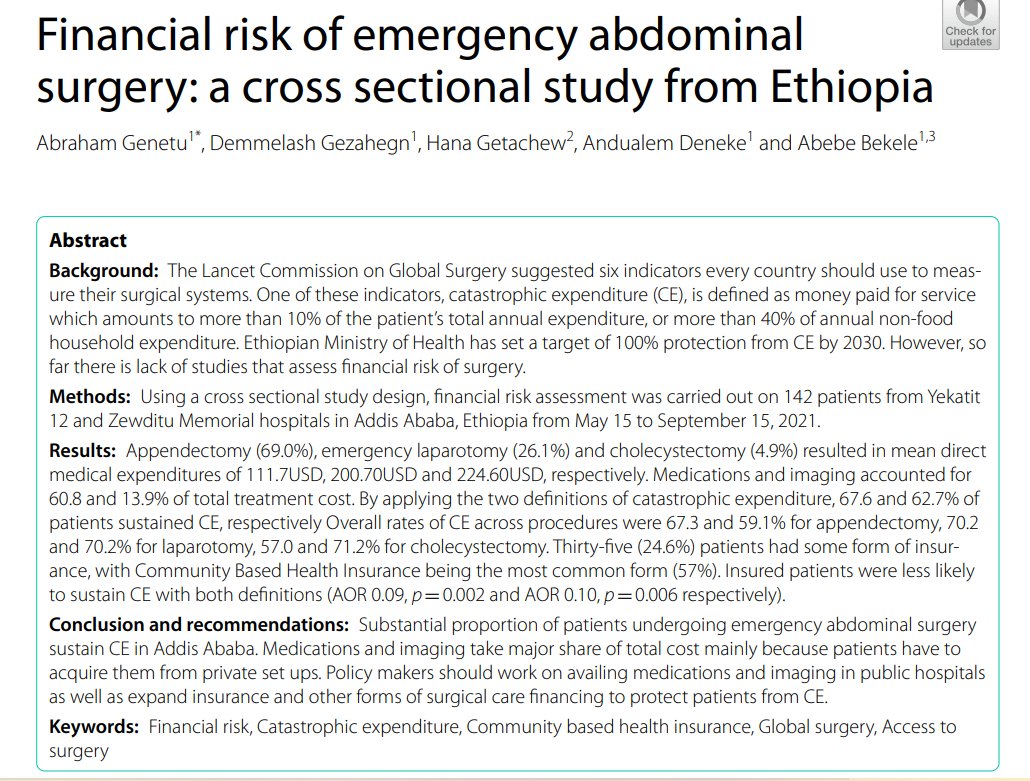
Two-thirds of patients treated at two public hospitals in Addis sustained catastrophic expenditure from having emergency abdominal surgery. Physical availability is not enough if not affordable.