@DavidDack I run over 2500km a year, and get 2 pairs for every year. A light, uptempo trainer for race day and quality sessions, and a regular every day trainer for easy sessions. The lighter shoe might lose it's pop by 800km, but the other keeps going and going and going .
@hjluks@JohnAllenBain I am so fortunate where i live that I can leave the house, cross the road, then get on a path and I can travel for tens of miles with almost no roads - just well maintained paths. Far further than I can possibly run or ride.
@HankFrank The strategy that seems to work for me is 10 miles 'easy', then 10 miles at proper consistent marathon pacing, then the last 10km with whatever I've got left. Gives a negative split and no 'third quarter' mental meltdown either.
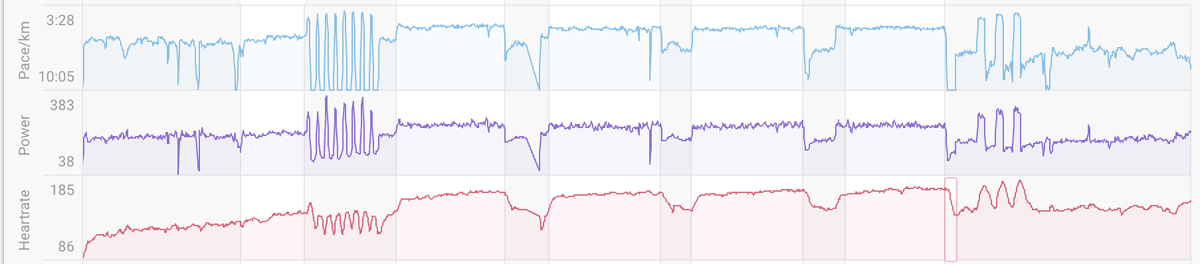
@Brady_H Every run I do, the first 25-30 minutes is easy pace. The last 25-30 minutes is easy pace. The bit in between might just be more easy pace or might have some intensity. And... I record it all as one activity to wreck my Strava stats. Meh.
@Alan_Couzens Arguably for many runners, they can monitor their heart rates and still be running close to threshold because they have convinced themselves... that.... .... their... bree... thing... is... con..... ver.... saish... onal....
@Alan_Couzens Since metabolic fitness is built through muscle contractions, then the aim has to be 'as many muscle contractions as you can' and you can do many many many many more at low intensity than high intensity.
@Alan_Couzens My understanding is that 7 hours of high intensity will give stronger adaptations than 7 hours of low intensity. But... I can't do 7 hours of high intensity a week, but I can do 7+ hours of low intensity with a sprinkling of high.
@Brady_H As with sooooo many things, lactate isn't the problem. *Too much* lactate is the problem.
Blood lactate levels are simply the mismatch between lactate production and the capacity of mitochondria to use it as a fuel.