As Bitcoin investors, it can be difficult or at least strange to get into the mind of a Bitcoin-preferred investor, and that may lead to misconceptions about how Bitcoin preferreds (aka Digital Credit) are priced.
But one thing we may have to come to understand is that we are not the ones setting the price on these securities. And our bullish conviction that Bitcoin will appreciate, however confident we are that the market will eventually acknowledge this reality, does not even affect the Digital Credit price as much as it is easy to imagine.
You see, a preferred investor almost certainly does not think that Bitcoin is going to appreciate substantially, otherwise they would position themselves on the other side of the bet and own the common equity, or at least own Bitcoin itself.
I realize I am speaking in vast generalities here, and there are going to be cases where Bitcoin bulls have a reason to own Digital Credit, but from a modeling perspective it makes sense to go with the assumption that the typical preferred investor does not think Bitcoin will appreciate; and as you will see, the math on the required dividend to support that assumption works out much closer than you might think.
That said, in an effort to continue enhancing the "Runoff Present Value" method of valuing Bitcoin Preferreds (as inspired by @khingoei's work on this subject), incorporating a Monte Carlo simulation gets the estimation much closer to actual market value.
The following diagram goes through the process of deriving the fair dividend rate for a theoretical Bitcoin preferred with 60% amplification, assuming no Bitcoin appreciation, and averaging the present value of thousands of simulated NAV depletions to pay dividends, with 40% Bitcoin volatility.
This results in an estimated required dividend rate of 12%, which is remarkably close to the 13.2% effective rate of SATA, which happens to currently be at 60% amplification.
(For the quant nerds: a simulation with no Ito-correction results in a 16.23% required dividend, and a symmetric arithmetic-price process results in a 14.23% required dividend)
What all of this goes to show is that the generalized assumption that the typical Bitcoin preferred investor expects no Bitcoin appreciation is substantiated, both deductively and empirically.
The other observation to take away is that larger leverage/amplification ratio increases the required dividend; it decreases the expected dividend lifetime from the perspective of the preferred investor, and requires shifting the cumulative dividends earlier in the schedule so as to compensate for lost present-value of assumed-lost dividends in later years. This adequately explains, at least deductively, why Strategy and Strive have had to increase their dividends as their amplification ratios increased over time.
This also suggests that a lever these Bitcoin Treasuries can pull in order to reduce the cost of capital (perhaps quite significantly), is to allow the amplification to decrease as Bitcoin appreciates.
Bitcoin Treasuries with prefs: @Strive@Strategy@BitcoinTCAB
(Maybe soon 👀: @smarterwebuk )
As Bitcoin investors, it can be difficult or at least strange to get into the mind of a Bitcoin-preferred investor, and that may lead to misconceptions about how Bitcoin preferreds (aka Digital Credit) are priced.
But one thing we may have to come to understand is that we are not the ones setting the price on these securities. And our bullish conviction that Bitcoin will appreciate, however confident we are that the market will eventually acknowledge this reality, does not even affect the Digital Credit price as much as it is easy to imagine.
You see, a preferred investor almost certainly does not think that Bitcoin is going to appreciate substantially, otherwise they would position themselves on the other side of the bet and own the common equity, or at least own Bitcoin itself.
I realize I am speaking in vast generalities here, and there are going to be cases where Bitcoin bulls have a reason to own Digital Credit, but from a modeling perspective it makes sense to go with the assumption that the typical preferred investor does not think Bitcoin will appreciate; and as you will see, the math on the required dividend to support that assumption works out much closer than you might think.
That said, in an effort to continue enhancing the "Runoff Present Value" method of valuing Bitcoin Preferreds (as inspired by @khingoei's work on this subject), incorporating a Monte Carlo simulation gets the estimation much closer to actual market value.
The following diagram goes through the process of deriving the fair dividend rate for a theoretical Bitcoin preferred with 60% amplification, assuming no Bitcoin appreciation, and averaging the present value of thousands of simulated NAV depletions to pay dividends, with 40% Bitcoin volatility.
This results in an estimated required dividend rate of 12%, which is remarkably close to the 13.2% effective rate of SATA, which happens to currently be at 60% amplification.
(For the quant nerds: a simulation with no Ito-correction results in a 16.23% required dividend, and a symmetric arithmetic-price process results in a 14.23% required dividend)
What all of this goes to show is that the generalized assumption that the typical Bitcoin preferred investor expects no Bitcoin appreciation is substantiated, both deductively and empirically.
The other observation to take away is that larger leverage/amplification ratio increases the required dividend; it decreases the expected dividend lifetime from the perspective of the preferred investor, and requires shifting the cumulative dividends earlier in the schedule so as to compensate for lost present-value of assumed-lost dividends in later years. This adequately explains, at least deductively, why Strategy and Strive have had to increase their dividends as their amplification ratios increased over time.
This also suggests that a lever these Bitcoin Treasuries can pull in order to reduce the cost of capital (perhaps quite significantly), is to allow the amplification to decrease as Bitcoin appreciates.
Bitcoin Treasuries with prefs: @Strive@Strategy@BitcoinTCAB
(Maybe soon 👀: @smarterwebuk )
Khing's article illuminates how Bitcoin preferreds get priced by the market. Looking at these valuations from a similar but slightly different lens reveals what is a potential oversight/weakness in how these preferreds are designed, but which is easily remedied.
Khing used a PV calculation with the current dividend rate as the discount rate.
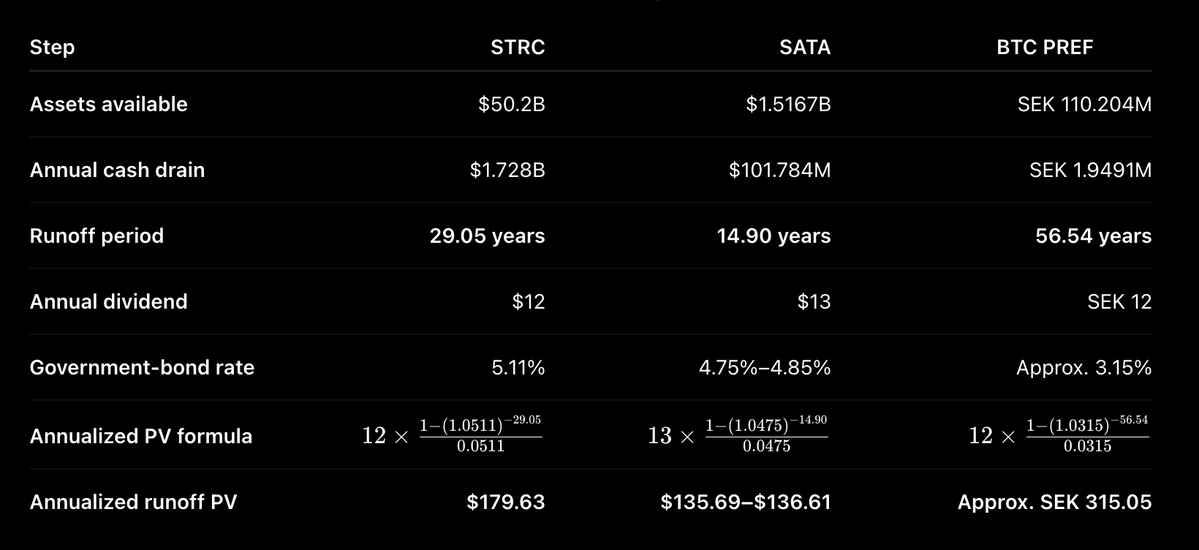
However, another way to look at this would be to calculate a "Runoff PV" as a baseline, which would be defined as "The present value of future dividends assuming the issuer sold its current assets today and used the proceeds to fund payments until exhausted, with future payments valued using the return available on a government bond of similar duration."
This of course doesn't factor in changing dividend rates, Bitcoin price movements, competing senior claims, and other factors that make the preferred riskier, but it is an interesting baseline, especially to compare these preferreds to each other.
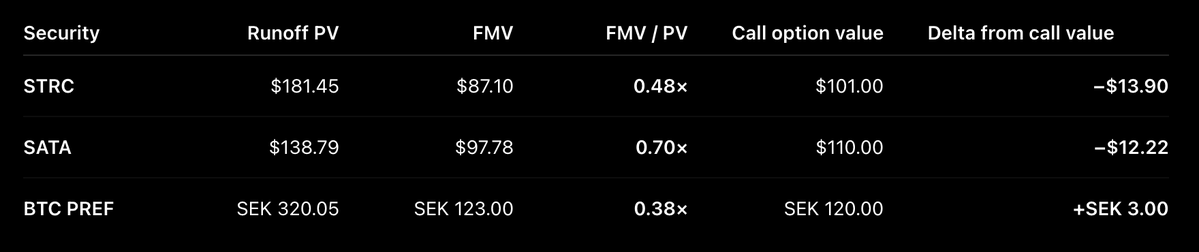
When we calculate these Runoff PVs (as can be seen in the attached image) what we see is that each Runoff PV exceeds the current market price, with SATA having the highest FMV/PV at 0.7x - meaning SATA is currently priced closest to its "Runoff PV". Meanwhile STRC is at a FMV/PV of 0.48x.
Of all of the reasons that these securities would be trading at such a discount to their Runoff PV, the one that sticks out the most is the call option value of each security, which is less than the Runoff PV for every single one of these securities.
The future value of dividends for one of these securities could theoretically be $1 billion, but if the company can buy back the instrument at $100, an investor is highly discouraged from paying any more than that (and this can be reflexive, since current investors know future investors are discouraged from paying more than that).
Strategy has a call option on STRC shares at $101 and Strive has a call option on SATA at $110.
And what do you know? the Delta between the FMV and the call option for each of STRC and SATA is $14 and $12, respectively.
Further evidence of this factor is BTC PREF trading at a 0.38x FMV/PV ratio (a pretty massive discount to Runoff PV), and ultimately trading just a few SEK above the company's redemption price.
Addressing this limitation is incredibly simple and requires no dilution, sold bitcoin, buybacks, or rate increases; it just requires the respective companies to increase the call option value (aka the "redemption price") of these securities.
For example, Strategy could raise the redemption price of STRC from $101 to $110.
Strive could raise the redemption price of SATA from $110 to $115.
Bitcoin Treasury Capital could raise their redemption price from 120 SEK to 130 SEK.
All of these changes give the market an opportunity to price these securities closer to their Runoff PV, rather than being capped at their redemption-price.
@Strategy, @Strive, @BitcoinTCAB
Here is a chart showing the same methodology for all theoretical amplification percentages (Strive is at 60% amplification, and Strategy is at 40% amplification). This does seem to under-state the market price of the respective dividend rates.
This discrepancy could be for a variety of reasons: dividends can be suspended, Strategy has converts, sentiment is bad, the monte-carlo process used to estimated the required dividend is too biased to the upside, or operational expenses and other risks and drag.
What is interesting however is that each company's most-senior preferred is roughly equidistant from this curve.
@emdextreme31@Imaginaryperso_@Giovann35084111 There is tighter structure at the P10 - https://t.co/lzOqMbVEDl
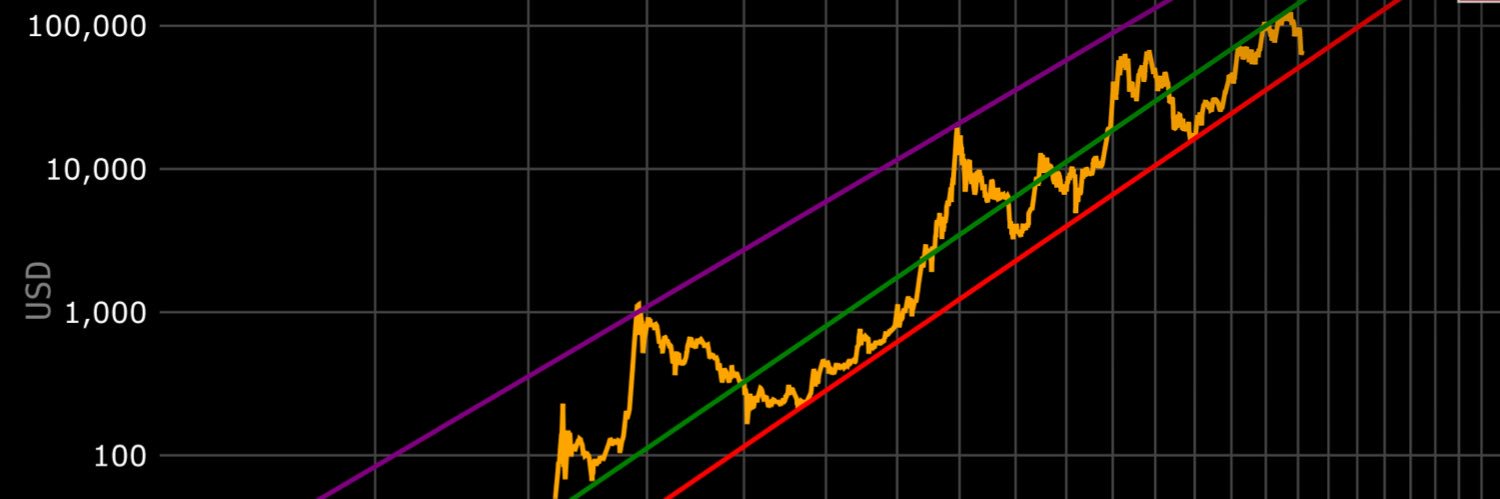
I also think it ought to be measured in terms of market cap as a % of global wealth (or something similar), and is likely an s-curve in log-log space and not a straight line up forever.
$BTC Is Trading at ~$0.13 per $1 of Model-Implied Present Value
25.9% IRR • +$424K NPV per BTC • 7.5× Present Value
I’ve evaluated capital as an engineer, CFO, investor, trader, and business owner.
Treat Bitcoin like a 15-year capital project:
Spot investment: $64.7K
Cost of capital: 10%
Year-15 P10 value: $2.04M
Assume Bitcoin never returns to trend and only compounds along its model-implied P10 floor.
IRR: 25.9%
NPV: +$424K per BTC
Present value: $488K
Purchase price: $0.13 per $1 of present value
PV multiple: 7.5×
Bitcoin pays no dividend.
All modeled appreciation accumulates in the terminal value.
Its model-implied P10 floor is currently rising about $56 per day:
1 BTC: +$20.4K/year
10 BTC: +$204K/year
21 BTC: +$429K/year
100 BTC: +$2.04M/year
The P10 floor is model-derived
@BitcoinTCAB Have you considered increasing the redemption price above 120 SEK?
The Runoff PV of BTC PREF shows tremendous potential to lower the cost of capital, and the redemption price could limit how the market fairly values BTC PREF and sets the fair market yield.
One thing I noticed is that Strategy’s redemption price is much lower than Strive’s. The delta between that and FMV just so happens to be the same for STRC and SATA
Solving STRC par might be as simple as raising the redemption price
@Strategy@saylor@phongle@PunterJeff@ColeMacro
A Runoff PV calculation of Bitcoin preferreds reveals that the redemption price of each security may be limiting the FMV of these securities and hurting the cost of capital.
Luckily there is a fairly simple solution.
Khing's article illuminates how Bitcoin preferreds get priced by the market. Looking at these valuations from a similar but slightly different lens reveals what is a potential oversight/weakness in how these preferreds are designed, but which is easily remedied.
Khing used a PV calculation with the current dividend rate as the discount rate.
However, another way to look at this would be to calculate a "Runoff PV" as a baseline, which would be defined as "The present value of future dividends assuming the issuer sold its current assets today and used the proceeds to fund payments until exhausted, with future payments valued using the return available on a government bond of similar duration."
This of course doesn't factor in changing dividend rates, Bitcoin price movements, competing senior claims, and other factors that make the preferred riskier, but it is an interesting baseline, especially to compare these preferreds to each other.
When we calculate these Runoff PVs (as can be seen in the attached image) what we see is that each Runoff PV exceeds the current market price, with SATA having the highest FMV/PV at 0.7x - meaning SATA is currently priced closest to its "Runoff PV". Meanwhile STRC is at a FMV/PV of 0.48x.
Of all of the reasons that these securities would be trading at such a discount to their Runoff PV, the one that sticks out the most is the call option value of each security, which is less than the Runoff PV for every single one of these securities.
The future value of dividends for one of these securities could theoretically be $1 billion, but if the company can buy back the instrument at $100, an investor is highly discouraged from paying any more than that (and this can be reflexive, since current investors know future investors are discouraged from paying more than that).
Strategy has a call option on STRC shares at $101 and Strive has a call option on SATA at $110.
And what do you know? the Delta between the FMV and the call option for each of STRC and SATA is $14 and $12, respectively.
Further evidence of this factor is BTC PREF trading at a 0.38x FMV/PV ratio (a pretty massive discount to Runoff PV), and ultimately trading just a few SEK above the company's redemption price.
Addressing this limitation is incredibly simple and requires no dilution, sold bitcoin, buybacks, or rate increases; it just requires the respective companies to increase the call option value (aka the "redemption price") of these securities.
For example, Strategy could raise the redemption price of STRC from $101 to $110.
Strive could raise the redemption price of SATA from $110 to $115.
Bitcoin Treasury Capital could raise their redemption price from 120 SEK to 130 SEK.
All of these changes give the market an opportunity to price these securities closer to their Runoff PV, rather than being capped at their redemption-price.
@Strategy, @Strive, @BitcoinTCAB
Khing's article illuminates how Bitcoin preferreds get priced by the market. Looking at these valuations from a similar but slightly different lens reveals what is a potential oversight/weakness in how these preferreds are designed, but which is easily remedied.
Khing used a PV calculation with the current dividend rate as the discount rate.
However, another way to look at this would be to calculate a "Runoff PV" as a baseline, which would be defined as "The present value of future dividends assuming the issuer sold its current assets today and used the proceeds to fund payments until exhausted, with future payments valued using the return available on a government bond of similar duration."
This of course doesn't factor in changing dividend rates, Bitcoin price movements, competing senior claims, and other factors that make the preferred riskier, but it is an interesting baseline, especially to compare these preferreds to each other.
When we calculate these Runoff PVs (as can be seen in the attached image) what we see is that each Runoff PV exceeds the current market price, with SATA having the highest FMV/PV at 0.7x - meaning SATA is currently priced closest to its "Runoff PV". Meanwhile STRC is at a FMV/PV of 0.48x.
Of all of the reasons that these securities would be trading at such a discount to their Runoff PV, the one that sticks out the most is the call option value of each security, which is less than the Runoff PV for every single one of these securities.
The future value of dividends for one of these securities could theoretically be $1 billion, but if the company can buy back the instrument at $100, an investor is highly discouraged from paying any more than that (and this can be reflexive, since current investors know future investors are discouraged from paying more than that).
Strategy has a call option on STRC shares at $101 and Strive has a call option on SATA at $110.
And what do you know? the Delta between the FMV and the call option for each of STRC and SATA is $14 and $12, respectively.
Further evidence of this factor is BTC PREF trading at a 0.38x FMV/PV ratio (a pretty massive discount to Runoff PV), and ultimately trading just a few SEK above the company's redemption price.
Addressing this limitation is incredibly simple and requires no dilution, sold bitcoin, buybacks, or rate increases; it just requires the respective companies to increase the call option value (aka the "redemption price") of these securities.
For example, Strategy could raise the redemption price of STRC from $101 to $110.
Strive could raise the redemption price of SATA from $110 to $115.
Bitcoin Treasury Capital could raise their redemption price from 120 SEK to 130 SEK.
All of these changes give the market an opportunity to price these securities closer to their Runoff PV, rather than being capped at their redemption-price.
@Strategy, @Strive, @BitcoinTCAB
$BTC Is Trading at ~$0.13 per $1 of Model-Implied Present Value
25.9% IRR • +$424K NPV per BTC • 7.5× Present Value
I’ve evaluated capital as an engineer, CFO, investor, trader, and business owner.
Treat Bitcoin like a 15-year capital project:
Spot investment: $64.7K
Cost of capital: 10%
Year-15 P10 value: $2.04M
Assume Bitcoin never returns to trend and only compounds along its model-implied P10 floor.
IRR: 25.9%
NPV: +$424K per BTC
Present value: $488K
Purchase price: $0.13 per $1 of present value
PV multiple: 7.5×
Bitcoin pays no dividend.
All modeled appreciation accumulates in the terminal value.
Its model-implied P10 floor is currently rising about $56 per day:
1 BTC: +$20.4K/year
10 BTC: +$204K/year
21 BTC: +$429K/year
100 BTC: +$2.04M/year
The P10 floor is model-derived
@SmedleyButlerUS The level to which I understand this is that the yield curve can only remain inverted for so long. I’m sensing that there’s more to that in this model in that you can kindof predict when that un-inversion happens?