My contrarian take: Bitcoin will benefit when CLARITY fails. It will be shamelessly clear that the political class has been fully captured, choosing institutional cartels over consumer prosperity
Bitcoin is the best escape hatch from sanctioned debasement and organized plunder
@dailydirtnap Exactly. He may be the dickhead of all dickheads but you might be the smug asshole of all smug assholes. Two eerily similar childless male loser pathways, yelling at each other through the internet lmao
"Bitcoin has no intrinsic value."
Let me translate that.
Nike shoes cost $8 to make. They sell for $180.
The difference?
A swoosh. A story. Collective belief.
A Picasso is paint on canvas.
A Rolex is just a clock.
A Louis Vuitton bag is stitched fabric.
You have never once demanded intrinsic value from anything you paid a premium for.
"Intrinsic value" is a phrase people reach for when they haven't thought about where value actually comes from.
It comes from belief. Always has.
Bitcoin's believers are just the ones who wrote it into unbreakable math.
Beneath its veneer of kindness, empathy, and intellectualism, 'progressivism' is essentially a death cult.
It cuts down entire populations and snuffs out civilisations. But it does so with a smile.
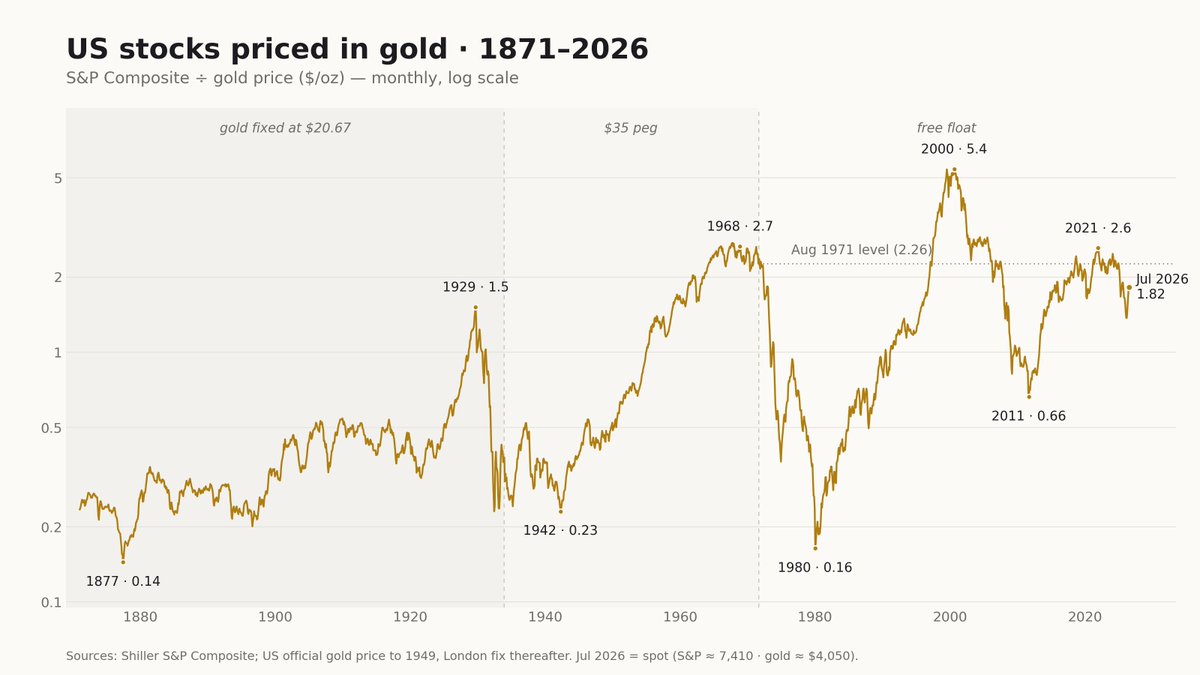
The US stock market peaked 26 years ago.
Priced in gold, the S&P 500 is still down 66% from its 2000 high.
It is LOWER today than the day Nixon closed the gold window.
You just don't see it — because you measure your life in dollars.
Been brushing up on the discourse and I’ve decided that every single person is richer than me is a greedy bastard and every single person poorer than me is a loser. I and only I have the exact right amount of money.
Bitcoin, Perfect Scarcity, Imperfect Critics
Bitcoin’s fiercest critics keep missing the target. The new bear case is not about bugs in the code, but about one public company accumulating a perfectly scarce asset in a world of perfectly elastic money.
Strategy, the artist formerly known as MicroStrategy, has turned its balance sheet into a bitcoin vault. This, we are told, proves structural fragility: a single, promotional buyer supposedly props up the price, concentrates supply, and creates a future liquidation overhang. If that balance sheet ever de‑risks, the story goes, bitcoin and Strategy’s equity go over the cliff together. Never mind that the company controls less than 5% of outstanding bitcoin, a meaningful hoard, but hardly a corner. Many of the loudest market voices are happy to repeat the script, treating bitcoin as little more than a speculative circus act.
Yet in gold, the same behaviour is treated as statesmanlike. Central banks quietly warehouse bullion with opaque disclosures and openly political motives. How soon we forget the Brown Bottom. When they blunder, as with Gordon Brown’s infamous decision to dump UK gold near the secular low, it is remembered as bad timing, not as evidence that gold is unfit to be money.
Bullion trusts exist for the sole purpose of locking metal in a vault. Streaming companies such as Wheaton Precious Metals sign long‑dated claims on future production, giving shareholders geared exposure to the same finite resource. No one concludes that this pattern of hoarding renders gold “uninvestable.” It is simply how a reserve asset lives.
The double standard is not accidental. Implicit in the consensus is that central‑bank hoarding is respectable, while bitcoin hoarding is suspect. Markets yawn when official institutions add a few more tonnes of gold. They scoff when the Sec of the Treasury Scott Bessent in recent testimony, suggest that the United States methodically moving toward a strategic bitcoin reserve. Gold reserves are “prudence.” A bitcoin reserve is “crankery.” Hoarding is fine, apparently, so long as it never threatens to introduce perfect scarcity into a fiat system that depends on its opposite.
Bitcoin perfect scarcity in a fiat world run wild is now ignored, even by high profile pundits.
Seen clearly, Strategy’s accumulation is not a fatal bug in bitcoin, but a tell about its critics.
When gold is cornered by states and vehicles, it is applauded. When less than 5% of bitcoin is accumulated by a listed American company, it is denounced. That asymmetry says less about bitcoin’s weakness than about the political system’s fear of anything it cannot print. And yes the bias of many who should know better.
$MSTR #Bitcoin @theallinpod
I am fully convinced 2019 was the last normal year we ever had. Ever since then, it feels like the simulation broke. Everyone is constantly anxious, time moves both way too fast and barely at all, and nothing actually feels real anymore. The world as we knew it is just gone, and we are all just pretending it’s fine.
On top of introducing a 36% tax on unrealized gains, the Dutch government also wants to push the retirement age as high as 70 years.
They truly hate you, and want you to be a slave to the system until you die.
Early in my career, I worked on the valuation, development, and royalty negotiation of a gold mine. My first task was assessing reserves. Unlike Bitcoin, gold reserves like oil reserves are price dependent. What counts as a “reserve” expands and contracts with price. Bitcoin’s supply does not. That difference matters enormously.
This is why the paper-spot system has worked for gold:
Gold’s physical supply is elastic at the margin. Higher prices convert resources into reserves, encourage new production, and justify higher costs. Settlement can be deferred, audits are slow and expensive, and delivery is often optional. Paper claims can roll indefinitely because the system can adapt.
Bitcoin is the opposite.
Its supply is perfectly inelastic and precisely known. No higher price creates new reserves. No delay creates new coins. When settlement is demanded, claims must clear against a fixed, deliverable quantity.
That’s why paper markets can persist in gold but why the same structure is structurally unstable in Bitcoin.
Gold absorbs stress through geology, time, and cost.
Bitcoin absorbs stress through price.
That is why the paper-spot dynamic endures in gold, and why by the mechanics already laid out, it is likely to break in Bitcoin.
Gold survived millennia because no alternative could outperform it under analog conditions. Once computation and cryptography arrived, the constraint lifted.
The Lindy clock resets when a new medium performs the same function with less trust.
Bitcoin is that reset.
Szabo wrote about all this already.
Satoshi also mentioned this would happen.
This debate was already coded.
They laughed at six-figure Bitcoin.
Now the banks are calling it.
• Citigroup: $133K
• JPMorgan: $165K
• Standard Chartered: $200K
The same institutions that built the old system are now front running the new one.
This will be historic.