ANDREJ KARPATHY COULD HAVE CHARGED $2,000 FOR THIS COURSE.
He put it on YouTube.
The full training stack. Tokenization. Neural network internals. Hallucinations. Tool use. Reinforcement learning. RLHF. DeepSeek. AlphaGo.
3 hours of the most comprehensive LLM education that exists anywhere at any price.
Not how to use the tools.
How the entire system was built from the ground up and why it behaves the way it does.
The engineers who understand this build things the ones who only use the tools cannot even conceive of.
The gap between those two groups is not 3 hours.
It is everything those 3 hours quietly unlock for the rest of your career.
Something colossal is going to happen in the next 6 months
Right now every AI company on planet Earth is building AI agents for enterprise
Perplexity doubled their revenue the last couple months with it
Soon every enterprise will adopt them
When that happens, executives will quickly realize it can replace almost every low and mid level employee in the company
Anyone who has ever used OpenClaw knows this to be true. They know it's ALREADY better than them at almost everything
They know it's the most important software ever released
I think this is when the job losses accelerate
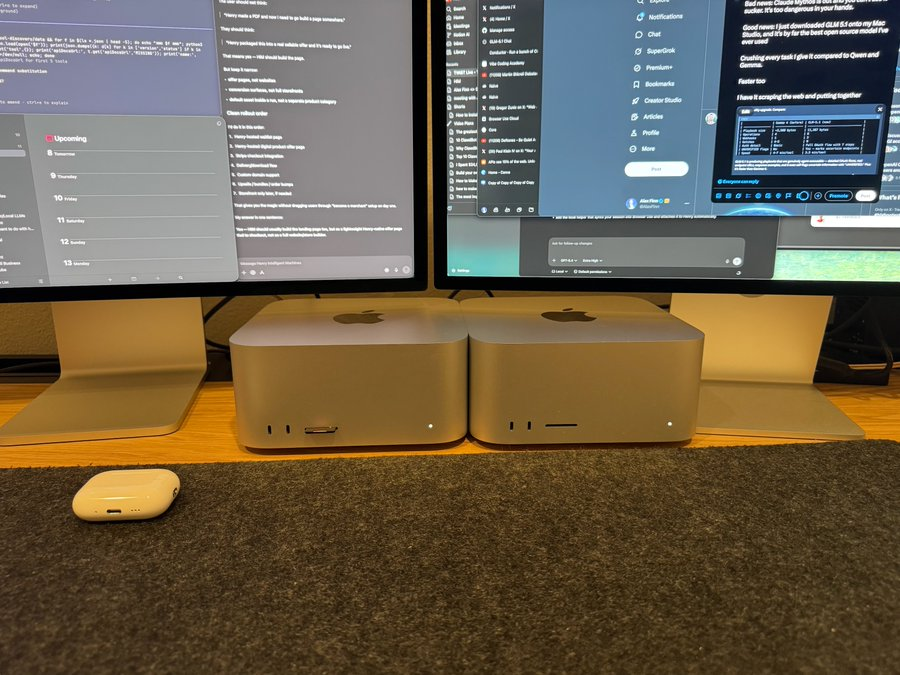
Humans at desks will be replaced by Mac Minis and Mac Studios
It has NEVER been more critical you are up to date on the latest AI tools
This is the ONLY way you'll be able to still have value through this chaos. If you know how to use the best tools, you can't be replaced by them
If you are an entrepreneur or creator with a platform you have leverage. You don't need jobs. You create your own value
I'd master these tools today:
• OpenClaw (duh)
• ChatGPT 5.4 (best coding model post Opus lobotomy)
• CapCut (so you can quickly pump out content and videos. Personal videos are the last way to be authentic)
• Local models (so you can have agents working 24/7 for you)
• And if you're daring: live stream. You can't AI generate a live stream.
The future is entrepreneurship. When there are no jobs, we will all be independent value creators
Start preparing
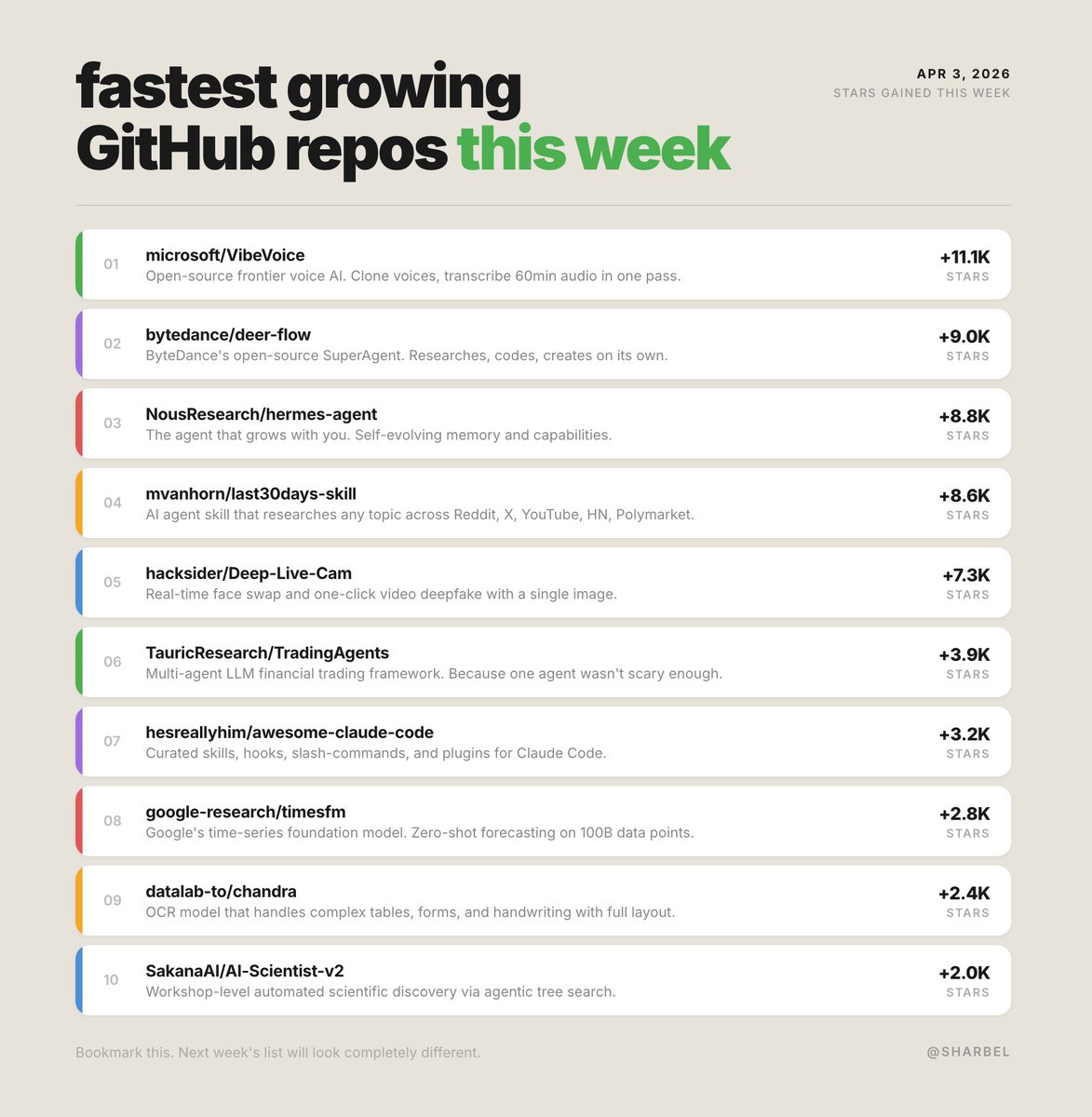
The fastest growing GitHub repos this week:
1. microsoft/VibeVoice (+11.1K stars)
Open-source frontier voice AI. Clone voices, transcribe 60min audio in one pass.
2. bytedance/deer-flow (+9.0K stars)
ByteDance's open-source SuperAgent. Researches, codes, creates on its own.
3. NousResearch/hermes-agent (+8.8K stars)
The agent that grows with you. Self-evolving memory.
4. mvanhorn/last30days-skill (+8.6K stars)
AI agent skill that researches any topic across Reddit, X, YouTube, HN, Polymarket.
5. hacksider/Deep-Live-Cam (+7.3K stars)
Real-time face swap with a single image.
6. TauricResearch/TradingAgents (+3.9K stars)
Multi-agent LLM trading framework. Because one agent wasn't scary enough.
7. hesreallyhim/awesome-claude-code (+3.2K stars)
Curated skills, hooks, and plugins for Claude Code.
8. google-research/timesfm (+2.8K stars)
Google's time-series foundation model. Zero-shot forecasting.
9. datalab-to/chandra (+2.4K stars)
OCR model for complex tables, forms, and handwriting.
10. SakanaAI/AI-Scientist-v2 (+2.0K stars)
Automated scientific discovery via agentic tree search.
The theme this week: voice AI and self-evolving agents dominated.
Bookmark this. Next week's list will look completely different.
We are so cooked.
Anthropic just accidentally leaked its most powerful AI model because someone forgot to lock a blog CMS. They’re warning it could “outpace the efforts of defenders” in cybersecurity.
Do you understand what just happened??
Close to 3,000 unpublished files were sitting in a publicly accessible data store.. Draft blog posts, PDFs, details of a secret CEO retreat at an 18th-century English manor. Anyone could find them. Anthropic’s response? “Human error.”
The leaked documents describe a new model tier above Opus. Dramatically better than anything that exists.
Their own internal draft says it’s “far ahead of any other AI model in cyber capabilities.” Anthropic confirmed it’s real. They called it “a step change.”
They are terrified of their own model.
CrowdStrike dropped 7%. Palo Alto Networks fell 6%. Cybersecurity ETF down 6% in a single session, now 20%+ on the year. Bitcoin slid from $70K to $66K overnight. $20 billion in market cap vaporized over a draft blog post about something that hasn’t even shipped yet.
A $380 billion company with $20+ billion in revenue is telling you, in their own leaked words, that the thing they built will break the internet’s defenses faster than anyone can patch them.
They wrote that down. In a blog draft. Then left the blog draft unlocked on the internet.
Every script kiddie with API access is about to become a state-level threat actor.. Every firewall vendor is about to become a legacy vendor.. Every “we take security seriously” banner on every SaaS login page is about to age like milk.
Sleep well tonight.
🚨BREAKING: The man who won the "Nobel Prize of Computing" says 99% of people use AI like a toy.
Yann LeCun invented the technology inside every AI tool you touch. He's Meta's Chief AI Scientist. Turing Award winner.
And he says your prompts are embarrassingly shallow.
Here are 9 Claude prompts built on LeCun's cognitive architecture that turn shallow AI into expert-level reasoning:
This is where things get uncomfortable.
We didn’t just automate defense -
we automated offense.
The same tool that secures your app
can teach anyone how to break it.
“Open source AI hackers” sounds great…
until you realize attackers can run it too.
Security just became an arms race at machine speed.
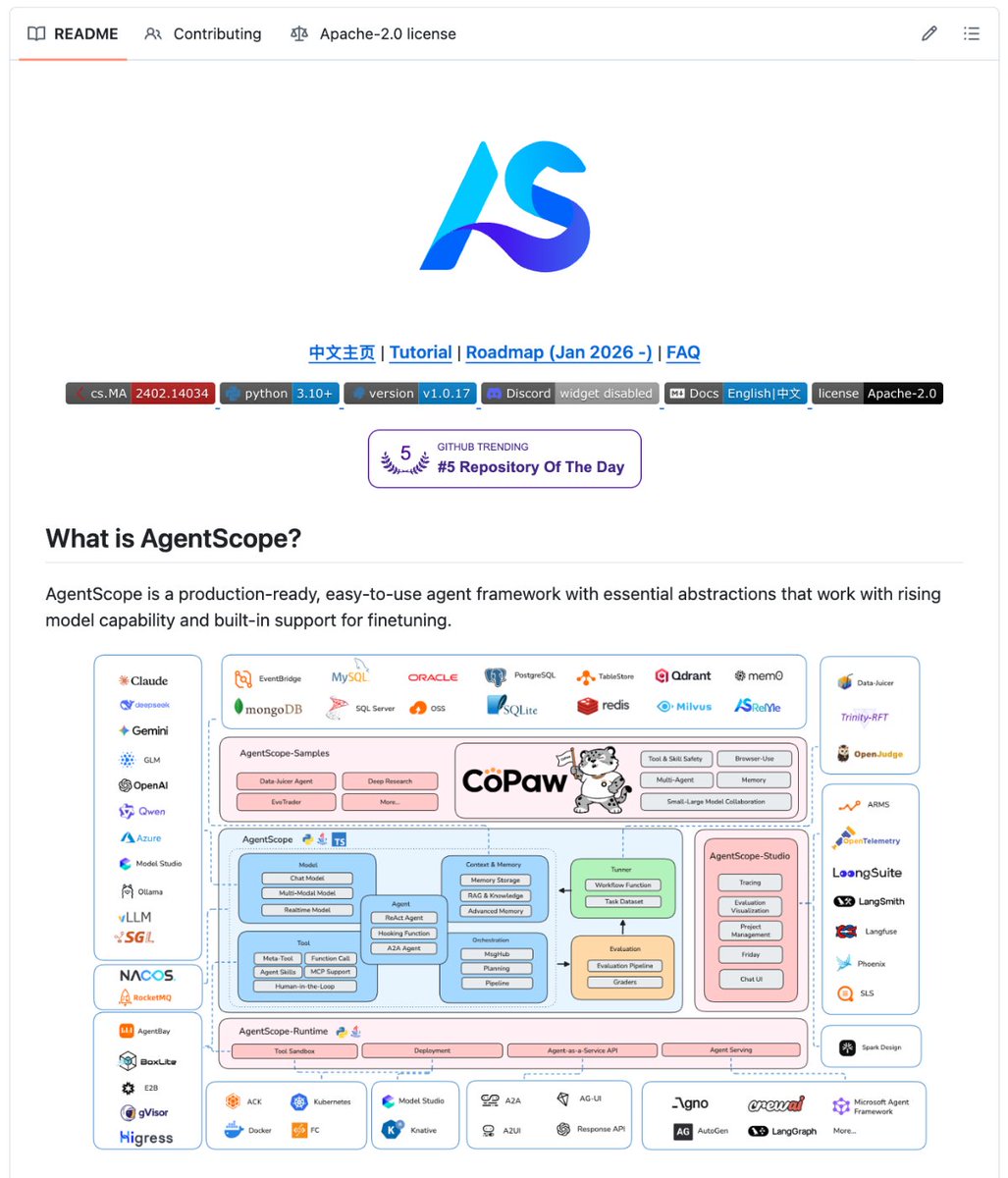
🚨 BREAKING: CHINA just released a Python framework for building AI agents. 100% OPEN SOURCE.
It has visual agent design, MCP tools, memory, RAG, and reasoning. All built in. All working together.
It's called AgentScope.
You describe your agent system. It builds the architecture, wires the tools, and runs the whole thing. You come back and there's a working multi-agent pipeline. Not a prototype. Not a demo. The actual system.
Not a wrapper.
Not a chatbot builder.
A full Agent-Oriented Programming framework that thinks in agents from the ground up.
Here's what it does out of the box:
→ Visual agent builder so you design your entire system before writing a single line of code
→ Native MCP tool support, plug any external tool directly into any agent in your pipeline
→ Built-in memory so every agent remembers context, decisions, and history across sessions
→ RAG pipeline ready to connect your own documents, databases, and knowledge bases
→ Reasoning modules that let agents plan, reflect, and self-correct without human input
→ Multi-agent coordination so your agents collaborate as a system, not a pile of isolated API calls
Here's how it thinks:
You define your goal. AgentScope maps the agent roles. Each agent gets its tools, its memory, its reasoning layer. They coordinate. Results flow back up. You get a finished output.
A single complex task might route through a planner agent, a researcher agent, a coder agent, and a critic agent, each doing its job, then converge into one clean deliverable.
Here's the wildest part:
AgentScope is built by Alibaba DAMO Academy. The same lab behind Qwen. They didn't assemble this from existing pieces. They designed the entire framework from first principles around how agents actually need to think, remember, and work together. Most frameworks give you building blocks. AgentScope gives you an architecture. The community has already started plugging it into data pipelines, research workflows, and full automation systems the team never planned for.
100% Open Source. Apache 2.0 License.
🚨BREAKING - Software Horror: LiteLLM HAS BEEN COMPROMISED.
IF YOU INSTALLED IT TODAY YOUR SSH KEYS, AWS CREDENTIALS, AND API KEYS ARE ALREADY GONE.
One pip install. Everything stolen.
Here is what happened and why every developer needs to stop what they are doing right now.
At 10:52 UTC on March 24 2026, litellm version 1.82.8 was published to PyPI containing a malicious file called litellm_init.pth. It executes automatically on every single Python process startup the moment litellm is installed. No interaction required.
No warning. No visible sign anything went wrong.
The attack was discovered by Callum McMahon at FutureSearch only because the malware contained a bug.
It triggered an exponential fork bomb that crashed his machine while an MCP plugin inside Cursor pulled in litellm as a transitive dependency.
If the attacker had written cleaner code this would have run silently for days or weeks across millions of machines.
Version 1.82.7 has since been confirmed compromised as well.
↳ 97 million downloads per month making this one of the most installed Python packages in AI development
↳ Credentials stolen include SSH keys, AWS, GCP and Azure credentials, Kubernetes configs, API keys, database passwords, shell history, crypto wallets, SSL private keys, and CI/CD secrets
↳ Data encrypted with a 4096 bit RSA key and exfiltrated to a fake litellm domain
↳ If Kubernetes is present the malware reads all cluster secrets and creates a privileged backdoor pod on every node
↳ Persistence installed at the system level via a hidden sysmon service
↳ Any project depending on litellm is also compromised including dspy and dozens of other major AI libraries
Here is the part that should change how you think about every pip install you ever run again.
This was not a litellm vulnerability. This was a supply chain attack.
The malware never touched the litellm GitHub repo. It was uploaded directly to PyPI bypassing the normal release process entirely
That means every security review, every code audit, every pull request approval in the litellm project meant nothing.
The attack lived one level below where anyone was looking.
And because litellm sits inside the dependency tree of dozens of major AI projects, millions of developers who never typed pip install litellm in their lives were exposed anyway. You did not have to do anything wrong. You just had to use a tool that used a tool that was compromised.
Discovered and reported by Callum McMahon at FutureSearch on March 24 2026.
Reported to PyPI security and litellm maintainers. Community tracking at litellm issue 24512.
Full technical breakdown: https://t.co/EVtL4bX1qJ…
If you installed or upgraded litellm today do this right now:
↳ Run pip show litellm and check for version 1.82.8 or 1.82.7
↳ Search for litellm_init.pth in your uv cache and virtual environments
↳ Check for a hidden https://t.co/T7GrCWSrNr file at ~/.config/sysmon/
↳ Rotate every credential on that machine. Assume all of them are already gone.
↳ If you run Kubernetes audit kube-system for pods named node-setup
Here is the question every developer and engineering lead needs to answer today.
If a single compromised package sitting three levels deep in your dependency tree can silently exfiltrate every credential on every machine in your organization, how many of your current dependencies have you actually read?
Share this now. Someone on your team installed litellm today and does not know yet.
Palantir AI + Claude was used to detect, prioritize, and strike over 1,000 targets in the first 24 hours of Operation against IRAN.
The success was so ridiculous, so game-changing, that the Pentagon didn’t even wait.
What used to be just a pilot project, just something they were testing out… suddenly became official, permanent, and everywhere.
Palantir is now the core AI brain of the entire U.S. military. It’s getting rolled out across ALL branches.
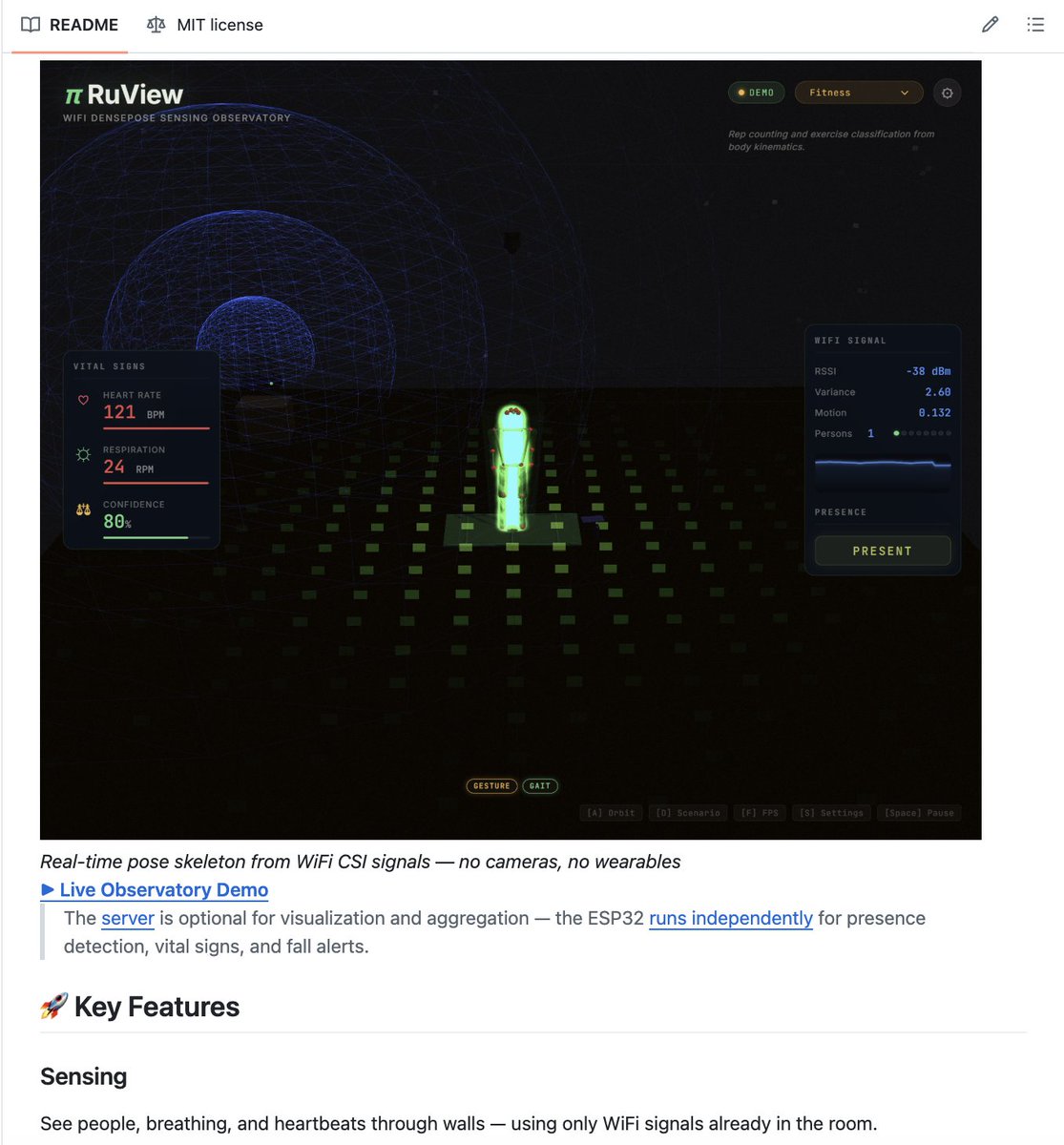
🚨BREAKING: A developer on GitHub just turned your WiFi router into a full-body surveillance system.
It's called RuView.
It uses the WiFi signals already in your room to detect human poses, track breathing, measure heart rate, and see through walls.
Not a concept. Not a research paper. Working code you can run right now.
Here's what this thing actually does:
→ Tracks full 17-point body pose using only WiFi signals
→ Detects breathing rate (6-30 BPM) without touching anyone
→ Measures heart rate (40-120 BPM) from across the room
→ Sees through walls, furniture, and debris up to 5 meters deep
→ Tracks multiple people simultaneously with zero identity swaps
→ Self-learns from raw WiFi data. No labeled datasets needed
Here's how it works:
WiFi signals pass through your room and hit the human body. The body scatters those signals differently based on position, breathing, even heartbeat. RuView reads that scattering pattern and reconstructs everything.
A mesh of 4 ESP32 nodes ($48 total) gives you 360-degree coverage with 12 measurement links, 20 Hz updates, and sub-30mm precision.
Here's the wildest part:
It has a disaster response mode called WiFi-Mat. It detects survivors trapped under rubble through concrete walls, classifies injury severity using START triage protocol, and estimates 3D position. The kind of tool that saves lives after earthquakes.
The Rust implementation processes 54,000 frames per second. That's 810x faster than the Python version. The entire Docker image is 132 MB.
The AI model fits in 55 KB of memory. Runs on an $8 ESP32 chip.
Train once, deploy in any room. No retraining. No recalibration.
1,100+ tests. 15 Rust crates on crates. io. SHA-256 verified capability audit.
100% Open Source.
🚨 Someone just cracked open Apple's most locked-down chip. And trained a neural network on it.
Every Mac and iPhone has a hidden AI chip called the Apple Neural Engine. 15.8 TFLOPS of raw power. Apple only lets you use it for inference. Training? Blocked. Locked down. Off limits.
Until now.
It's called ANE Training. One developer reverse-engineered Apple's private APIs and got full backpropagation running directly on the Neural Engine.
No CoreML. No Metal. No GPU. Pure ANE compute.
Here's what makes this insane:
→ Reverse-engineered _ANEClient and _ANECompiler private APIs that Apple never documented
→ Built custom MIL (Model Intermediate Language) programs from scratch
→ Compiles neural network graphs directly to ANE hardware in memory
→ Full transformer training: forward pass, backward pass, attention, gradients, optimizer
→ 9.3ms per training step on M4 silicon
→ 6 ANE kernel dispatches per step
→ Zero external dependencies. Just system frameworks.
No disk writes. No mlmodelc files. Everything happens in memory.
Here's the wildest part:
Apple's ANE compiler leaks resources and crashes after ~119 compilations. The workaround? The program checkpoints its state and restarts itself via exec(). It literally respawns to keep training.
This is a weekend research hack that proved something the entire ML community assumed was impossible: you CAN train on Apple's Neural Engine. The barrier was never the hardware. It was always the software.
The entire thing builds with a single clang command. No package managers. No build systems. One line.
3.9K GitHub stars. Exploding right now.
100% Open Source. MIT License.
Built by a human + Claude, one weekend at a time.
We invited Claude users to share how they use AI, what they dream it could make possible, and what they fear it might do.
Nearly 81,000 people responded in one week—the largest qualitative study of its kind.
Read more: https://t.co/tmp2RnZxRm
Economics was built for scarcity.
The Intelligence Age is about abundance.
Today we release our book, The Last Economy, introducing Intelligent Economics, a unified theory for this new era.
🧵
🚨I JUST READ SOMETHING SHOCKING.
Researchers just trained an AI to predict which scientific ideas will succeed before any experiment is run.
It is now better at judging research than GPT-5.2, Gemini 3 Pro, and every top AI model on the market.
And it learned by studying 2.1 million research papers without a single human scientist teaching it what "good science" looks like.
Here is what they did.
A team of Chinese researchers built two AI systems. The first, called Scientific Judge, was trained on 700,000 matched pairs of high-citation vs low-citation papers. Every pair came from the same field and the same time period. The AI's only job: figure out which paper would have more impact.
It worked.
The AI now predicts which research will succeed with 83.7% accuracy. That is higher than GPT-5.2. Higher than Gemini 3 Pro. Higher than every frontier model that exists.
Then they built the second system.
Scientific Thinker doesn't just judge ideas. It proposes them. You give it a research paper, and it generates a follow-up idea with high potential impact.
When tested head to head against GPT-5.2, Scientific Thinker's ideas were rated as higher impact 61% of the time. It is generating better research directions than the smartest AI models in the world.
It gets stranger.
They trained the Judge only on computer science papers.
Then they tested it on biology. Physics. Mathematics. Fields it had never seen. It still worked. 71% accuracy on biology papers it was never trained on. The AI didn't learn what makes good computer science. It learned what makes good science, period.
Then the researchers tested whether it could see the future. They trained it on papers through 2024, then asked it to judge 2025 papers. It predicted which ones would gain traction with 74% accuracy. The AI learned to spot winners before the scientific community did.
Here is what nobody is talking about. A 1.5 billion parameter model, tiny by today's standards, jumped from 7% to 72% accuracy after training. That is a 65-point leap. The ability to judge scientific quality isn't some emergent property of massive models. It can be taught to small, cheap, fast AI systems that anyone can run.
Every year, over 2 million papers flood scientific databases. Researchers spend months deciding what to work on next. Grant committees spend billions deciding what to fund.
An AI just learned to make those decisions faster, cheaper, and more accurately than any of them.
If an AI can now judge which ideas will shape the future of science, what exactly is left that only a human scientist can do?
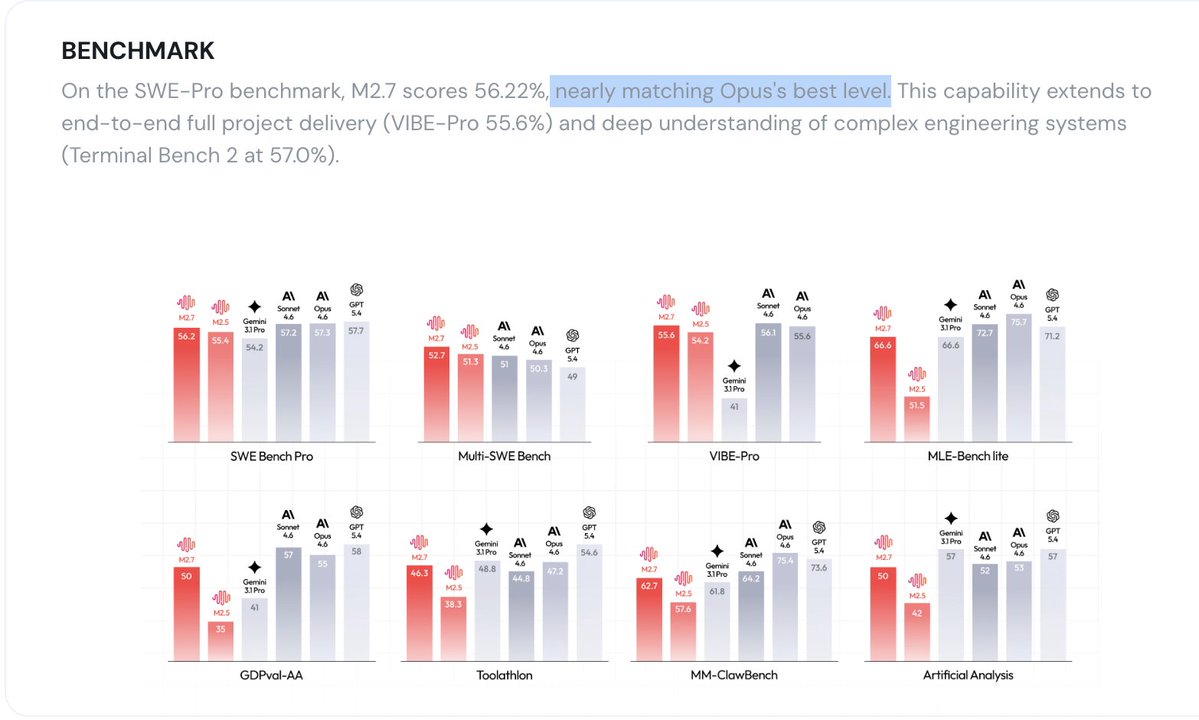
fuck me china just launched the 1st AI model that autonomously built itself... and its as good as claude opus 4.6 and gpt-5.4
- minimax M2.7 trained itself through 100+ rounds of autonomous self-improvement. 30% gain. No humans involved - what the actual f*ck
- model now handles 30-50% of the AI lab's OWN AI research
- beats gemini 3.1 at coding and pretty much matches opus 4.6 + gpt 5.4 😶 (china used to lag now they match
- doesn't require crazy hardware to run (single a30 gpu)
- absolutely CRUSHES tasks: financial modelling, coding, openclaw - one-shotted
the chinese have officially caught up. self-improving ai is a real thing.
all researchers did was set an objective and the model figured the rest out.
i wasn't expecting this from minimax. im now wondering wtf deepseek is going to be like.