Our run-rate revenue has surpassed $30 billion, up from $9 billion at the end of 2025, as demand for Claude continues to accelerate. This partnership gives us the compute to keep pace.
Read more: https://t.co/XgSjL0And7
Oxford University researchers have discovered the densest element yet known to science...
The new element, Governmentium (symbol=Gv), has one neutron, 25 assistant neutrons, 88 deputy neutrons and 198 assistant deputy neutrons, giving it an atomic mass of 312.
These 312 particles are held together by forces called morons, which are surrounded by vast quantities of lepton-like particles called pillocks.
Since Governmentium has no electrons, it is inert.
However, it can be detected because it impedes every reaction with which it comes into contact.
A tiny amount of Governmentium can cause a reaction that would normally take less than a second, to take from 4 days to 4 years to complete.
Governmentium has a normal half-life of 2 to 6 years.
It does not decay, but instead undergoes a reorganisation in which a portion of the assistant neutrons and deputy neutrons exchange places.
In fact, Governmentium's mass will actually increase over time, since each reorganisation will cause more morons to become neutrons, forming isodopes.
This characteristic of moron promotion leads some scientists to believe that Governmentium is formed whenever morons reach a critical concentration.
This hypothetical quantity is referred to as a critical morass.
When catalysed with money, Governmentium becomes Administratium (symbol=Ad), an element that radiates just as much energy as Governmentium, since it has half as many pillocks but twice as many morons.
This indie dev is making a game where you can literally play as Ancient Egyptian wall art.
- Switch between a 3D archaeologist and living 2D art
- Survive puzzles that fight back
- Progress by mastering both worlds
It’s called Fresco. This mechanic is genius.
I've been teaching 100,000 fake students for 2 weeks.
and used them to build the best AP prep system in the world.
I took Qwen 3 8B models and gave them simulated human memory.
Now every night thousands of simulated students start with zero knowledge of the social sciences. Their only training is our adaptive curriculum. They work through it, then take a full AP (advanced placement) practice exam.
The first batch averaged a 3 on their exam. (~45th percentile)
Then the agents looked at where they failed, and improved the algorithm. Again, and again, and again.
Two weeks later, the average is 4.43 (~80th percentile)
This is such an insane number because the curriculum they worked through is ONLY basic knowledge and comprehension.
They were never taught how to build an argument, contextualize evidence, or even shown the exam rubric.
...And yet they're averaging 80th percentile on an exam that requires all of it.
Basically built a machine learning feedback loop for edtech.
Spoke about this at @clawcon & @sxsw last week. This is just the beginning.
I am Canadian.
My grandparents came to this country as immigrants, looking for a better life.
They arrived with nothing, and were given nothing by the government; nor did they ask for anything.
My grandfathers worked hard. One opened a business with partners, the other worked for a large company. My grandmothers stayed home and raised their families.
They learned English. They paid taxes. They followed the rules and the laws of their new land. They continued to freely practice their religion and continue their traditions, while also embracing Canadian values and immersing themselves in Canadian society.
My parents were born here. They, too, had the freedom to practice their religion, celebrate their holidays, continue their parent’s traditions, while living a Canadian life.
I grew up here. I stood and sang Oh Canada every morning. Never loved the song, but always sang it proudly. I celebrated Canada Day. I learned about Canadian history, Canadian geography, Canadian government. I leaned about Canada.
I went to school with people from different countries; different religions; different cultures; different skin colours. We all played together. We all hung out together. We were all friends.
I grew up in one of the safest countries in the world. We worried about nothing.
I grew up in one of the friendliest countries in the world. Canada was known for being polite; saying “sorry”; for being amenable.
Nobody hated us. We had a great reputation in the world. When American kids travelled they’d often put the Canadian flag on their backpack because they’d be treated better.
Canada was great. A great place to live. A great place to raise a family.
I don’t recognize our country anymore. The hate, the rhetoric, the violence, the lack of safety and security.
This is not the Canada my grandparents immigrated to.
This is not the Canada I grew up in.
This is not the Canada I planned to raise children in.
We are at war right now. Us. Canadians. Here in Canada.
We are at war with an ideology that wishes to wipe out and destroy us and everything we stand for.
They wish to replace Canada with an Islamic state and Sharia law, forcing everyone to convert to Islam or be killed.
I’m not making this up. They’ve told us.
If we want to save Canada, we need to stand up against them. We need to speak up against them.
We need to be contacting our elected officials and telling them that they need to save Canada.
We have to be united. Right now, we cannot let things like our opinion on the war divide us. If we do, Islam will win.
We have to focus on coming together.
As Canadians.
To fight for our country.
Canada.
The Canada we were born in or chose to come to.
The Canada we helped to build.
The Canada we know and love.
The Canada we need.
I am Canadian.
And I will not stay silent or stay still while my Canada is destroyed.
Dominik Tarczyński, MEP: ” The lowest unemployment in the European Union is in Poland. The highest GDP growth after COVID in the European Union is in Poland. One of the lowest debts in the European Union is in Poland. So don’t give us this rubbish about the need for ‘educated immigration.’
There have been zero terrorist attacks in Poland. Why? Because there is no illegal migration in Poland.
Learn from Poland. Be like Poland.”
Today, we're taking Manus out of the cloud and putting it on your desktop.
Introducing My Computer, the core feature of the new Manus Desktop app. It’s your AI agent, now on your local machine.
Introducing Adaptive Computer.
We put AI inside of an always-on personal computer that it uses to get work done.
Schedule agents. Create software. Automate anything.
As part of the launch, we’re giving one free month of Adaptive to users.
Retweet, like, and comment ‘Adaptive’ to get it.
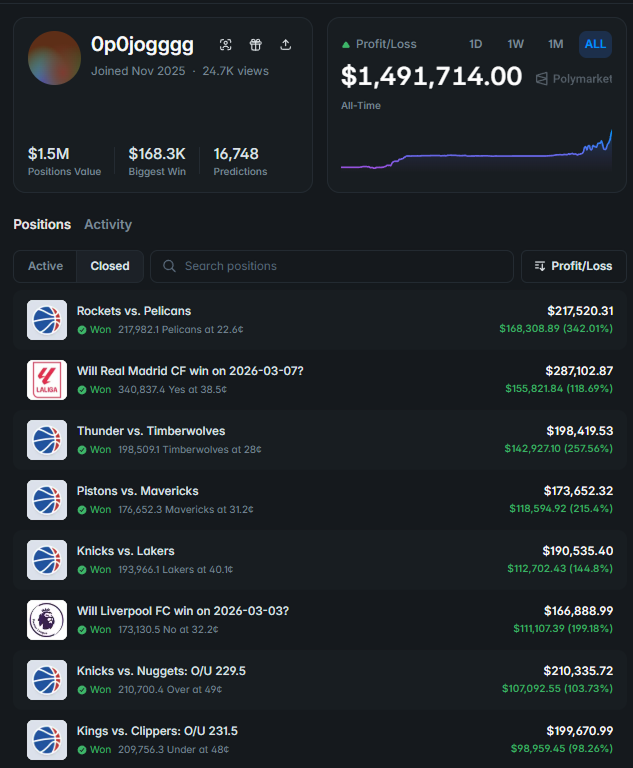
Someone trained a swarm model on 3 years of NBA data and deployed it on Polymarket.
Result: $1.49M.
The interesting part is that he didn’t build a better model.
He built a better crowd.
The system uses MiroFish, an open-source engine that simulates thousands of AI agents, and feeds it raw sports data.
Inputs include:
• Player stat vectors - points, rebounds, assists, eFG%, usage rate across multiple seasons
• Team form metrics - last 10 games, pace, home/away splits, defensive ratings
• Matchup history - head-to-head results, positional mismatches, referee tendencies
• Injury probability models based on medical reports and recovery timelines
• Line movement tracking to detect where sharp money moves before tip-off
Wallet →
https://t.co/jrIOWWPUvo
Copytrade →
https://t.co/xwVKYk3j6y
MiroFish generates 4,096 simulated agents — analysts, bettors, insiders, oddsmakers.
They argue, form clusters, shift opinions.
Eventually a consensus emerges.
That consensus is fed into a 12-layer transformer model trained on 16,695 historical predictions.
The model compares the swarm consensus with live Polymarket odds.
If the gap exceeds the Kelly threshold, the system enters.
Example:
Lakers priced at 40¢
MiroFish consensus: ~62%
One position: $190,823.
The edge isn’t the data.
Every serious trader has data.
The edge is simulating how thousands of people process that data - before the real crowd does.
We just open-sourced Paperclip: the orchestration layer for zero-human companies
It's everything you need to run an autonomous business: org charts, goal alignment, task ownership, budgets, agent templates
Just run `npx paperclipai onboard`
https://t.co/wuDdEmrSMx
More 👇
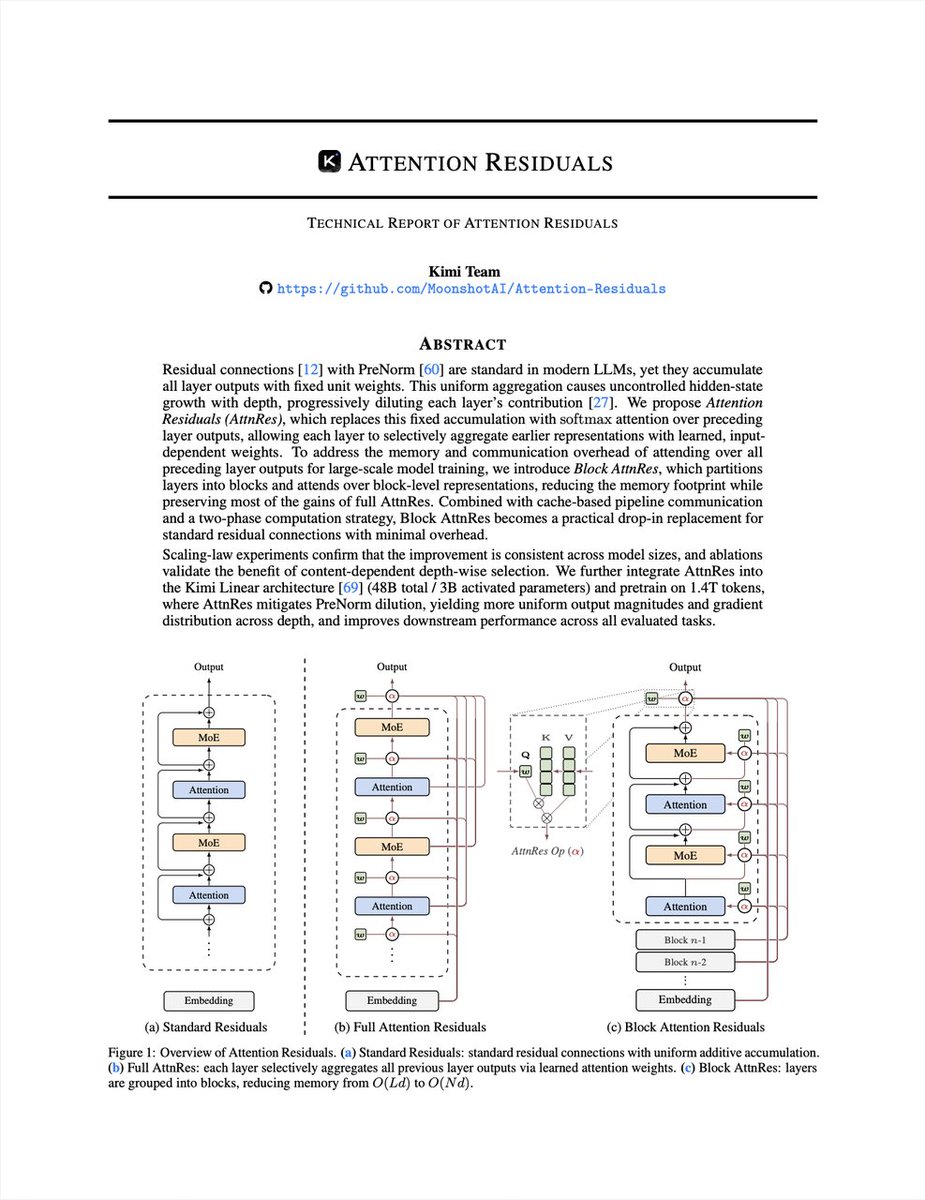
Introducing 𝑨𝒕𝒕𝒆𝒏𝒕𝒊𝒐𝒏 𝑹𝒆𝒔𝒊𝒅𝒖𝒂𝒍𝒔: Rethinking depth-wise aggregation.
Residual connections have long relied on fixed, uniform accumulation. Inspired by the duality of time and depth, we introduce Attention Residuals, replacing standard depth-wise recurrence with learned, input-dependent attention over preceding layers.
🔹 Enables networks to selectively retrieve past representations, naturally mitigating dilution and hidden-state growth.
🔹 Introduces Block AttnRes, partitioning layers into compressed blocks to make cross-layer attention practical at scale.
🔹 Serves as an efficient drop-in replacement, demonstrating a 1.25x compute advantage with negligible (<2%) inference latency overhead.
🔹 Validated on the Kimi Linear architecture (48B total, 3B activated parameters), delivering consistent downstream performance gains.
🔗Full report:
https://t.co/u3EHICG05h
While the world doomscrolls 15-second TikToks and loses its attention span..
YOU SHOULD CHECK OUT THIS NEW REPO
A Chinese college kid built MiroFish in just 10 days, scored $4M funding and ByteDance just dropped the upgrade that turns it into a prediction monster.
Fourth-year student Guo Hanjiang vibe coded MiroFish: thousands of autonomous AI agents simulating entire societies in real time.
See the details in the post below.
Feed it any news, report, or historical data - watch markets, crowds, and politics react exactly as they would.
GitHub went nuclear, he scored $4M funding from Shanda Group, and Polymarket traders are already printing +$120k+ using his SPX and event simulations.
But long runs had one fatal flaw: agents got amnesia, hallucinations, and context overload.
Classic RAG garbage.
Now the same company behind TikTok (via VolcEngine) just open-sourced the fix:
OpenViking - already at 11.6k+ stars on GitHub.
Repo: https://t.co/jf9dWlTkVM
It turns chaotic memory into a clean, structured filesystem:
-> viking://user/memories/ (your habits + past outcomes) -> viking://agent/skills/ (trading and analysis superpowers)
Smart 3-layer hierarchy:
.L0 - 100-token ultra-summary
.L1 - quick overview
.L2 - full details (opened only when needed)
Agents browse folders intelligently instead of dumping everything.
Result:
> No more forgetting crucial facts from the start of a simulation
> Way fewer hallucinations
> Massive API token savings
> Self-updating memory - agents get smarter after every run
MiroFish + OpenViking = absolute nuclear edge for @Polymarket and event prediction.
I will use it for my private bot.
Thousands of agents now run with perfect long-term memory, stay sharp for 100+ steps, and deliver hyper-accurate probabilities.
This combo is about to change the game for anyone trading predictions.
The irony is insane: the company that killed human attention with short videos just gave AI agents eternal, structured, self-evolving memory.
Who’s already running this combo on Polymarket?
Save this.
The real alpha just dropped.