This is the first step.
Together with NEOL, we’ve begun deploying SERV Reasoning into real government-grade AI workloads, already live with the UAE government.
NEOL uses AI agents to surface the right people, relationships, and institutional knowledge for governments and large institutions making high-stakes decisions.
For that to work, “usually right” isn’t enough.
The agent needs to be reliable, reproducible, and auditable.
SERV Reasoning enabled NEOL to move from brittle prompt-based agents to structured reasoning graphs their team can inspect, test, and improve systematically, reaching 100% accuracy on key production agents.
That matters because when a government client asks why a certain person was recommended, NEOL can now point to the reasoning structure behind the decision.
Not a black box.
Not a guess.
A traceable decision process.
This is the beginning of something much larger.
Every enterprise, government, and public institution trying to deploy AI into serious workflows will run into the same wall: agents that are too unreliable, too opaque, and too difficult to audit.
That is exactly the wall SERV Reasoning was built to break through.
Our aim is to keep expanding what we unlock with NEOL, deepen the relationship across more institutional use cases, and bring this same reasoning infrastructure to the enterprises and governments that need AI they can actually trust in production.
The future of institutional AI cannot run on todays infra, it needs specialized AI reasoning that can be tested, audited, reproduced, and trusted.
That is the institutional gap SERV is plugging.
Another independent benchmark from SERV Reasoning Private Beta:
serv-nano at 100% accuracy, while being 5x more cost-efficient and faster than raw Google Gemini
More cost-efficient
Faster
Reliable
Single-line swap and no vendor lock-in. no brainer for anyone building agents
So happy I found $SERV before the herd.
This is the one.
I’ve unstaked most of my crypto, and once I can sell in a week or two, I’m going full port into $SERV as my biggest holding. $TAO is my biggest position right now, but that’s about to change.
The technology I see in $SERV is absolutely mind-blowing, and honestly, I don’t think anything can compete with it. Maybe I’m wrong — but I’m willing to take that chance.
The crypto ecosystem is full of noise.
Riddled with vapourware and projects that lack product market fit.
Its not so often that im excited by much being built outside of Ondo.
I must say however, that im rather impressed by the @openservai team and their recent successes.
The fact that $VIRTUAL is 13x larger than $SERV is truly astounding. SERV is in a league of its own and people would realize this if they did an ounce of research
we're witnessing a clear trend: a multi-trillion dollar market running on infrastructure that's getting more expensive every cycle
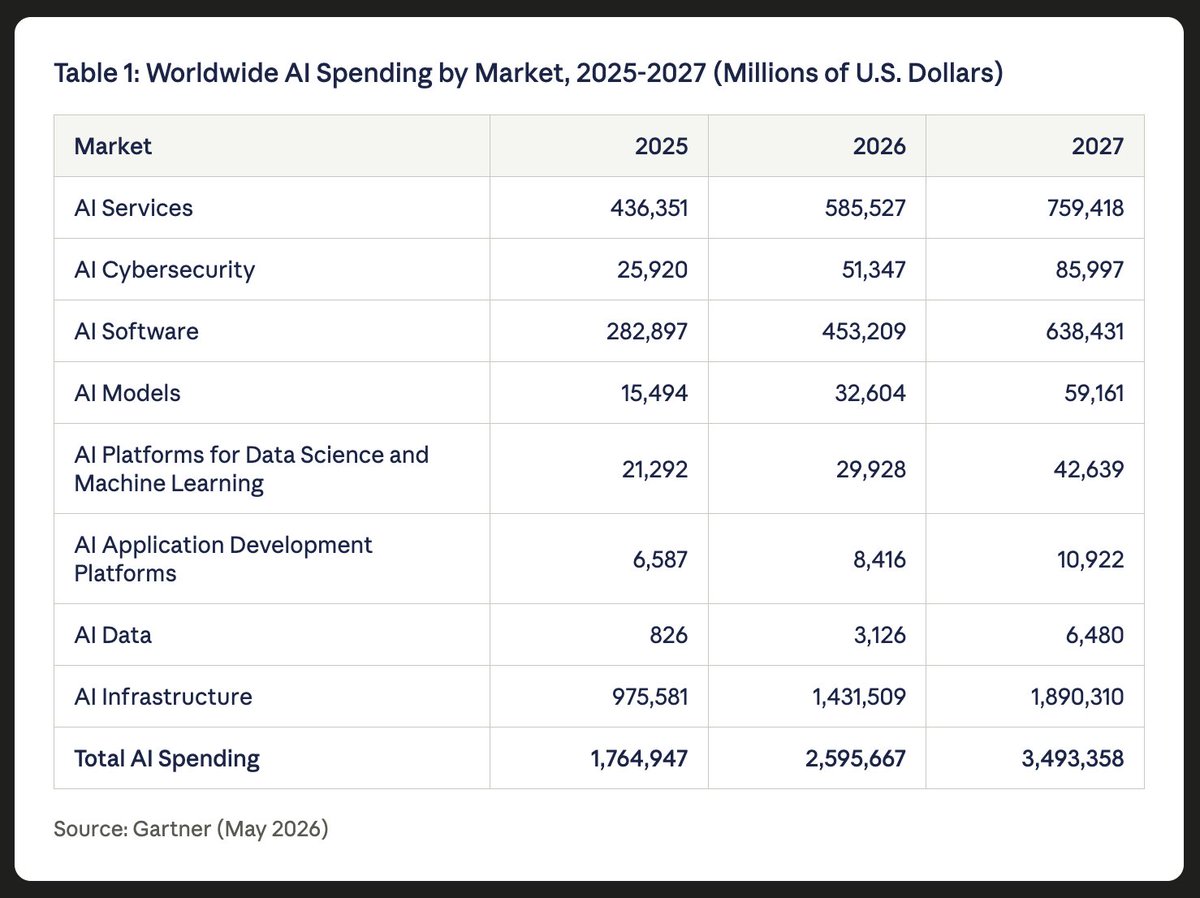
just read Gartner's latest AI forecast:
- $2.59T market in 2026 (+47% YoY)
- $3.5T in 2027
while frontier model prices keep climbing:
GPT-5: $10/M -> GPT-5.4: $15/M -> GPT-5.5: $30/M
it's clear enterprise will be looking for cost-savings while adopting AI at large scale.
this puts ethereum:0x40e3d1a4b2c47d9aa61261f5606136ef73e28042 at the center of the AI agent economy - delivering up to 100x better performance-per-dollar in enterprise benchmarks, with no vendor lock-in.
with a single-line swap, you plug any frontier model into SERV Reasoning and the economics flip in your favour: agents become not just efficient, but also reliable and fully auditable.
it's why most enterprises in SERV Reasoning Private Beta are already moving over, once they try it
UAE gov is using SERV tech in production; Akretic (security layer for finance, healthcare, government, defense), treasury infra (BILLZ), agentic OS for the food industry (GastroSight), agent compliance layer (ThoughtProof) - AND MANY MORE - all switching their entire stacks
private beta already crossed 100K+ requests last week.
incredible foresight + PMF from @openservai
SERV is on its way to become the AI infrastructure for The Fortune 500.
Akretic is yet another example validating it.
They are a security layer for finance, healthcare, government & defense -sectors with the strictest reliability requirements in AI.
They just plugged into SERV and got blown away.
"It has done a better job than several of the other frontier models."
- Sean Williams, founder of Akretic.
This is what the next decade of Enterprise AI runs on.
SERV is inevitable.
The fact that $VIRTUAL is 13x larger than $SERV is truly astounding. SERV is in a league of its own and people would realize this if they did an ounce of research
A month ago I told you that you should pay attention to hard workers like $SERV
Now? People are finally starting to PAY ATTENTION, because $SERV is one of the only REAL, DOXXED, AI builders with a REAL user base of serious companies.
This deserves a true adoption
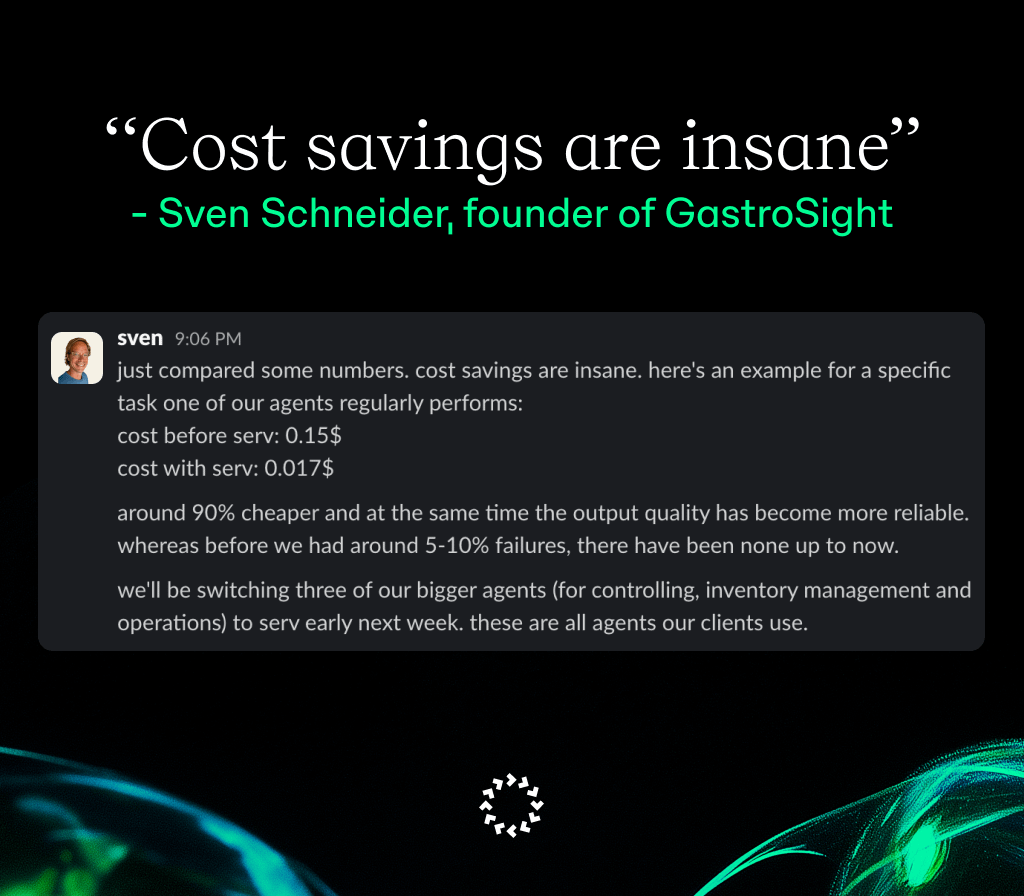
Another enterprise is moving to SERV.
GastroSight runs agentic OS for the food industry. 11 locations live, 5 new chains signed.
Scaling aggressively, the bottleneck is obvious: cost compounds, failures stop being tolerable.
They moved to SERV with one line of code. Result 👇
ethereum:0x40e3d1a4b2c47d9aa61261f5606136ef73e28042 101 Thesis
If you're wondering why @openservai started moving, start here.
The market is not just buying "an AI coin." It is only just starting to realise what SERV actually is: agent infrastructure for Fortune 500 enterprises and global governments, already used in production with UAE gov.
Independent benchmarks from early Private Beta of SERV Reasoning engine just landed, and they look insane: as high as 107x better performance per dollar vs frontier models.
People are beginning to see what's happening here. Billions of agents are about to run the global economy. They need infrastructure that actually works.
---
TLDR
Most agent projects are still wrappers. They can talk, tweet, call some APIs, maybe run a cute workflow. But the hard problems in any serious deployment are agent reliability, cost and auditability.
They deliver slop at scale - if an agent is 95% accurate per step, a 100-step workflow only succeeds ~0.6% of the time.
Thats fine for demos, but dogshit for finance, healthcare, public sector, compliance, or any regulated workflow where money and accountability are involved.
OpenServ is attacking that bottleneck with SERV Reasoning, and the insane benchmarks from early private beta, with proof of the tech working are why the market is beginning to wake up.
---
The Problems: agents break, cost a lot, and you can't trace or verify their decisions.
The AI market spent years obsessing over model IQ. Bigger model -> better benchmark -> nicer chatbot.
But production agents, when used in any real environment, do not fail because they cannot write a clever paragraph. They fail because they drift, hallucinate, burn tokens, lose state, take wrong branches, and then build on their own mistakes over and over again.
More intelligence helps, but it does not fix the architecture. It also multiplies the cost, as 'thinking' models simply burn more tokens. Meanwhile, enterprises and governments need agents that can finish the job thousands of times, cheaply, with enough proof that a serious buyer can check and trust what happened.
The data is brutal: Dataiku report says 87% corporations want to deploy agents while McKinsey shows that 80% of enterprise AI displays super risky/unpredictable behaviour. That gap creates a massive opportunity.
Globally, developers spend $300- 500M per week on LLM compute - large enterprises represent a meaningful slice of that. And yet, most of these calls end up being useless AI slop, not fitting for serious deployments.
---
The Solution: SERV Reasoning
OpenServ has been building around these exact pain points since early 2023, before agent coins were even a clean category.
At its core sits its proprietary agent reasoning engine, built by a team with NVIDIA, Amazon AI, and 20+ years of ML systems experience.
Besides the reasoning engine, the platform offers an end-to-end solution for autonomous agents: no-code workflow builder, agent SDK, tokenisation rails, post-launch ops with the AI Co founder stack, coordination, memory, comms, handoffs.
Basically: an entire operating system for autonomous agents.
---
How SERV Reasoning Works
Instead of letting a model freestyle through chain-of-thought and hope for the best, SERV pushes reasoning through structured graphs.
Bounded paths. Defined branches. An extra verification layer around what the agent actually did. Sharded graphs surfacing inference traces.
In plain English: less token waste, fewer weird detours, outputs that stay more consistent when the stakes are real, plus the ability to trace back agent decisions.
This is not just raw inference. Inference platforms sell API calls that simply burn your money to predict the next word. OpenServ is trying to sell reliability per dollar: can the agent finish the job correctly, cheaply, and with enough proof for enterprise buyers to trust it?
Under the hood, the pitch is developer-simple: it's a single-line swap to plug SERV into existing OpenAI/Anthropic-style flows and use the reasoning engine.
---
Where We Are Now: Private Beta Receipts
The recent repricing started because private beta receipts are already proving it works extremely well. Check recent posts by OpenServ to find specific proof points, like this article: https://t.co/hS1e9r92Ql
ThoughtProof, which works on agent verification for banking, compliance and onchain settlement, ran SERV against its production stack. They reported 107x performance per dollar vs baseline, with zero failed calls on a 120-case PLV faithfulness eval.
Then ICM Analytics switched its market intel stack to SERV Reasoning. They instantly saw 16x faster inference, 9x better efficiency, and more signals surfaced across revenue, P/E and adoption tracking.
Then Neol - their agents reached 100% reliability with SERV Reasoning, now live in production with the UAE government.
That last one is the part I think people are still heavily underweighting. Crypto is used to "partnerships" that mean a logo on a website. This is different: reasoning infrastructure in government-grade workflows.
Are you beginning to understand it yet?
---
The Kill Shot: Privacy AI for Regulated Environments
OpenServ recently announced it is shipping TEE-backed inference with cryptographic attestations: sealed memory, signed execution proofs, verifiable model integrity and private inference for regulated users.
Translation: if AI is going into healthcare, finance, public sector or compliance, "trust me bro" is not enough to run customer / patient / citizen data through it.
You need to prove that the data doesn't leak anywhere, how it ran, where it ran, and whether the model/data path can be trusted.
This is exactly the profile OpenServ is chasing: serious institutions with real data, real risk, and no tolerance for black-box agent chaos.
---
Roadmap: Whats next?
P0: enhancement engine ✅ (done)
P1: private beta (👈 YOU ARE HERE)
P2: public API (next)
enterprise private inference
shadow agents
verification hints
graph sharding
P3: SERV-native fine-tuned models
P4: purpose-built SERV model
P5: maLLM R&D
---
The Team
Greg Ivanov just joined as key advisor: Ex-Head of Partnerships at Google who helped scale Google Play into one of the biggest developer ecosystems on earth.
The broader OpenServ bench includes AI/SaaS, CTO with 20+ years in machine learning, NVIDIA PhD researcher, Amazon AI product lead, JPM finance veterans, TRON/TON/Stellar marketing pros and distributed systems people.
It's an AAA team assembled for targeting developers, enterprises, crypto founders and government-grade workflows. Show me another crypto team with this level of experience and network tier.
---
The Tokenomics
25% of platform rev → buyback and burn.
Three main flows feed it:
1) Enterprise contracts and API usage. The heavy hitter.
2) SERV Build - developers shipping agents that run reasoning calls. Every call, more revenue, more burn.
3) SERV Launch - permissionless tokenization layer. Every TGE, every fee, all routes back to main token.
Now get this: as mentioned earlier, developers globally spend $300- 500M per week on LLM compute (and the trend is only accelerating). SERV is the cheaper, auditable layer underneath that curve - every dollar that flows through it burns the token.
Then, we have the L3 SERV-native agentic blockchain catalyst which is a bit further out. It's when reasoning moves on-chain, and every API call settles in directly as the gas of the agent economy.
When that ships, every agent inference in the network is burning the token, permanently.
At the time of writing, SERV is still under 100M which is honestly bizarrely undervalued.
For agent reasoning/orchestration infra serving governments, that is a drop in the ocean. The comp people keep reaching for is $Virtual, which became a multibillion-dollar agent launchpad. $VVV crossed a billion fdv on private inference alone.
But OpenServ's pitch is far broader: not just 'launch a memecoin and call it an agent' or 'talk to a chatbot privately' - but build production agents, fund them, operate your agents on autopilot, coordinate them, and upgrade the reasoning layer underneath to production-grade.
It's a multibillion-dollar monster in the making.
---
The Thesis:
1. Agent reliability is broken and the cost is prohibitive
2. SERV Reasoning attacks that bottleneck
3. Private beta receipts already prove that it works
4. Privacy/auditability opens enterprise/government
5. Base + Solana gives crypto distribution
6. Valuation is tiny vs the category its in
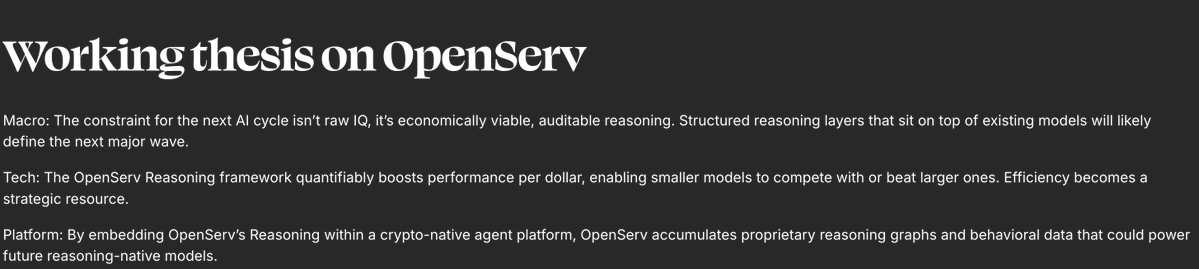
The market does not need every part of the roadmap finished to reprice this. It just needs to see that OpenServ has a real shot at becoming the reasoning and orchestration layer for autonomous businesses, Fortune 500 enterprises and governments.
---
And THAT, dear sir,
is why is beginning to move.
---
Btw, team is very active with the community on TG and often drops fresh alpha there.
Join here to frontrun ecosystem news: https://t.co/JSXD7bx9Ke
Already owned a bunch of $SERV but added over the past week as I finally went down the rabbit hole after many friends told me to look into it further & ngl the PA seems reasonable for what they bring to the table (see quoted tweet about them casually bringing in the guy who scaled GooglePlay).
To some degree, AI's real adoption curve relies on every enterprise & government deploying fleets of AI agents. Orchestration makes people use inexpensive models to save hundreds of millions of dollars, but these inexpensive models hallucinate far more often and fall apart in high-stakes enterprise environments. So thats a real problem many enterprises will face, especially in the early stages of AI Rollouts.
SERV's proprietary reasoning engine offers a solution to that: It provides Fortune 500 enterprises agent infrastructure so they can actually run fleets of AI agents at the scale they need. With a way better cost efficiency structure (up to 122x), better reliability at scale (Consistency / no drift) & Total auditability (compliance wise a game changer).
Their architecture isn't Chain-of-Thought like OpenAI/Anthropic but a graph-based bounded reasoning blueprint, where reasoning follows a structure. Something frontier labs won't build (as their business mostly relies on premium pricing & max token usage) - therefore it's kind of a unique selling proposition as well, hard to compete with.
Chart looks pretty good for a turn-around and I think FA wise it's severely undervalued (at the peak of the AI narrative, $VIRTUAL - basically a "better launchpad" for AI Agents - reached $5bln valuation, while $SERV currently sits at less than $30m with far more tech moat), easy to understand and fits the AI narrative which helped other majors to outperform the rest of the Altcoin market already.
I've so many times that $SERV is one of the BEST and SERIOUS low-mid caps IMO and I'll keep saying it.
One of the main reasons I liked this project in the first place was the very big DOXXED team they have, on top of the fast execution and an actual AI tech that they are building.
I'll say it again -> $SERV is always delivering in a shitty and slow market, just think what they are capable of when we have the liq back in the market?