The dashboard is starting to look like an intermediate step.
PostHog calls it self-driving. Amplitude calls it self-improving.
Both are converging on the same product loop. Observe behavior. Find something worth improving. Make the change. Measure the result. Learn. Repeat.
Coding agents made changing software cheap. Analytics has the context to decide what should change.
Jacob's examples make the category feel a lot more real.
Hanging out with @poteto@n2parko@clairevo and the @bot team to get Amplitude setup on Grok Bot today.
We're pretty permissive on AI tooling, but even so Grok Bot automatically takes action so getting the security right is the biggest blocker. Spent the first 20 minutes making sure we don't shoot ourselves in the foot.
It always feels like you're drowning as an executive and you don't have time to spend messing around with your tooling setup. I think they've gotten the interface right as you're able to take action right away.
Love this piece and I believe your case for optimism is well stated @Jacob__Newman.
My issue with much of the slop is that it lacks passion, personality and beauty. And yes, great business writing has these things (e.g. Howard Marks, Nassim Taleb).
We risk batting dull, uninspired, highly logical takes back and forth while we humans yawn with arms outstretched and reach for the next cup of coffee.
AI's taste will no doubt exponentially improve, but we find ourselves at a painful moment for the humans forced to consume its unfiltered output.
New: Ramp's top SaaS vendors for August 2026
1/ This month, we saw continued growth in model serving / routers as more firms shift spend to cost-saving + open source AI.
2/ A few underrated areas of growth: a lot of competition for AI customer service / sales / voice agents, and seemingly no clear winner in this category given how many different competitors show up on this list month-over-month.
3/ Plus, 9% of firms are using AI to generate images and video for marketing and advertising.
That's about half the adoption rate of Figma, and growing quickly.
The winning formula, it seems. Inspiring. "And they’re both defined by iteration. It doesn’t matter if you get it wrong the first time, or the second, or the third—even the tenth or the twentieth. Just keep on going. If you’re moving in the right direction faster than anyone else, you’ll probably win."
For new sales people it’s really really really easy to default to the dancing monkey routine when you are demo’ing a prospect
Remember this by heart:
The one who asks the questions is in control of the conversation
Your default state should be to ask a clarifying questions when asked a question
The context you receive here will tell you exactly what and more importantly WHY you need to show them whatever feature you were about to go into
Trust me nobody cares about any single feature you show them in a demo
They only care about the impact and business implications that feature does for their business
Without asking those clarifying questions and getting that important context
You’ll end up framing things in a way that makes you a dancing monkey and will lose you the call
Remember:
The one who asks the questions is in control
Today @databricks we're publishing a detailed analysis of techniques we used to drastically reduce our internal AI spend while aggressively growing adoption. Savings come from layering in several techniques, which combine to drive unit costs down as much as 90% in some scenarios. Tl;dr, the wins come from:
1. Shifting defaults to more efficient models, including OSS models such as GLM. Maximum intelligence models simply aren't needed for many coding tasks, and "good enough" models are quickly becoming very cheap. We shift traffic between models using Unity AI Gateway. Approximate savings: 50% or more.
2. Using smart routing to automate model selection. Routing can further squeeze efficiency by dynamically selecting the model or harness that can most efficiently execute a particular task. Our task-level routing leverages @omnigent_ai. Approximate savings: 30%.
3. Providing user visibility and adaptive budgeting. Every user can see how much they spend, and users receive hints on how to contain spend. Heavy spenders encounter progressive friction as they ratchet spend above certain levels. Approximate savings: 10%.
4. Managing context bloat by pruning tool call results and tuning harness settings. Extraneous context costs $$ and delivers no value. Tuning cache settings also help lower average token costs. Approximate savings: 10%.
As our CFO @_balaji_km mentioned at earnings today, we’re seeing some very interesting trends on AI costs. I think it’s another signal that we’re coming to the end of the so-called ‘tokenmaxxing’ era.
Here’s what’s been happening behind the scenes.
Since the beginning of the year we’ve more than quadrupled the number of people using frontier AI tools. That’s thousands of engineers using them every single day. During that same period, our cost per token has declined.
You might expect costs to rise as adoption accelerates. We've seen the opposite. Not because we've restricted access, but because we've treated efficiency as an engineering problem rather than a budget problem. A few examples:
• Caching and reuse: We use optimizations to improve our prompt cache hit rate that reduce our input token spend.
• Better defaults and tooling: We tuned default model settings, context sizes and developer workflows so teams get the same results with fewer tokens and lower-cost inference.
• Visibility drives efficiency: We gave engineers real-time visibility into their AI usage and costs per hour.
• Experimenting with open-weight models: we continuously evaluate new models and deploy the best option for each use case.
This is the future of applied AI at enterprise scale. The next phase, whatever we call it, will not be characterized by who spends the most tokens, but about how people use them as efficiently as possible.
Credit to all the engineers at @Uber who are helping to build this future. 🚀
Meeting with @vijayeraji and the (former) @statsig team at OpenAI’s Seattle office today. It’s the first time we’re all meeting together in person. It’s uncanny how similar the approaches to product and company building are.
It’s an honor to continue their work at @Amplitude_HQ!
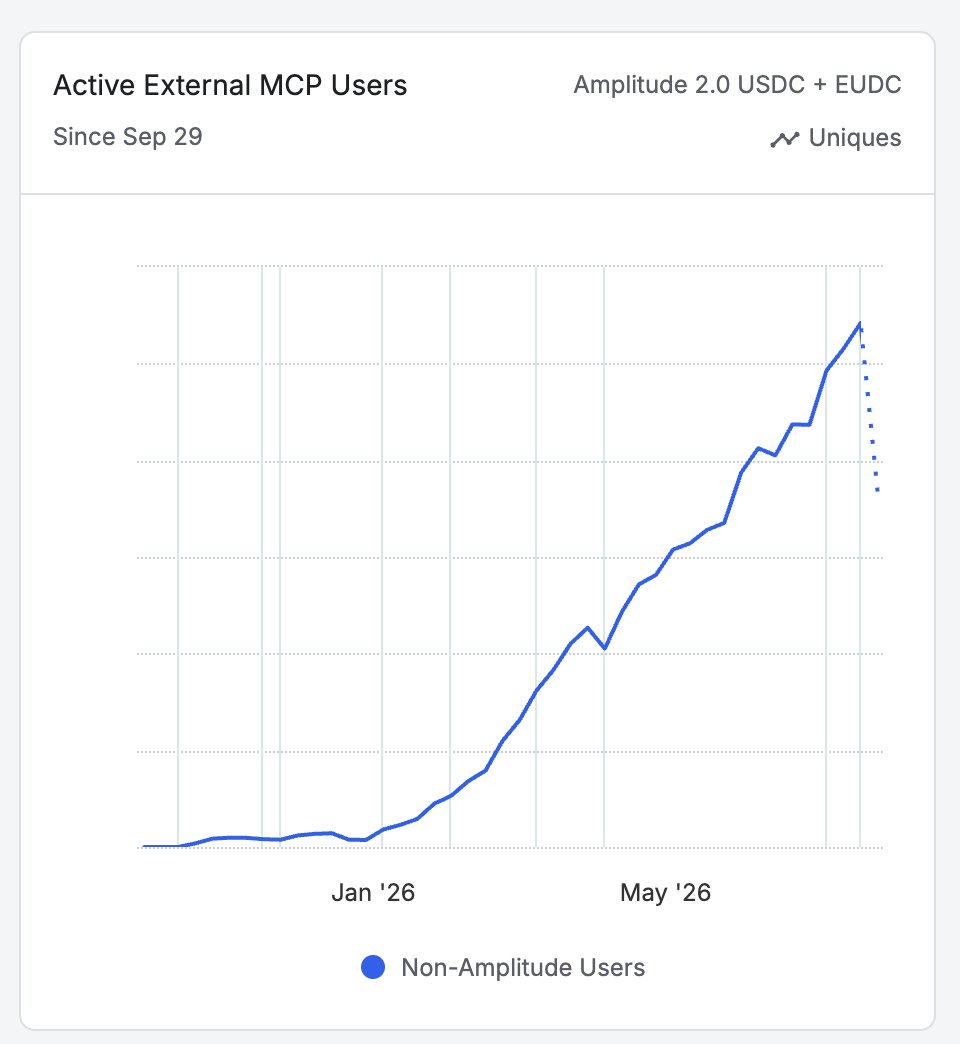
MCP is driving big growth in Amplitude usage across our customers.
One of our goals at the start of the year was to have 50% of analytics queries be done through AI. MCP is on track to blow that out of the water.
Mark Cuban says enterprise AI is much more complex than anyone expected, which is why Microsoft is hiring back 6,000 people.
"AI is a lot harder to implement than anybody expected"
"You can do an agent pretty straightforward… All easy peasy. And we just assumed at the enterprise it’d be just as easy. It’s hard"
"CEOs have no clue what is going on. None whatsoever. And that’s not going to change"
"If you need to have forward deployed engineers, that tells you all you need to know about AI… Yet here you have Microsoft hiring 6,000 people. You have Anthropic, OpenAI, all saying they’re going to deploy to these companies, which tells you AI is hard"
@ndrewpignanelli 99% of tech twitter has no idea where most enterprises are at right now. I just saw a company with 5bn in annual revenue onboard onto slack for the first time after using exclusively email.
Workflows like this make sense to most people.
I've been hanging out with teh @Amplitude_HQ devex team on their AI eng strategy and they're proof that investing in platform works to accelerate velocity (3x PRs, 7x faster cycle time, bugs down > 50%)
My favorite things they've done
- risk scored auto approved PRs
- leaders at the top of the AI usage board (@wadechambers has one of the best exec-ai-brains on the market)
- adding HC to devex to make everyone else cook
Ofc, led by a leaned-in CEO @spenserskates who is deeply invested in letting the team rip.
A great read 👇