Omnigent Deep Dive + Patio Social 🌤️
Join us for a midday technical talk on the architecture, governance, and real-world deployment of the open-source meta-harness for AI agents, then mingle over food and drinks on the @Databricks Seattle patio!
📅 Wed, July 29
🕛 12:00–1:30 PM PT
🔗 RSVP: https://t.co/reHzGw7iiK
#Omnigent #SeattleTechWeek
Your coding agents do not share sessions, memory, or policies.
This video walks through what a meta-harness changes and how Omnigent works: composition, governance, shared sessions, and a live demo.
▶️ Watch: https://t.co/MzuvokRYLa
#Omnigent#AIAgents@engineerrprompt
Using multiple coding agents every day? The harder question is how they work together.
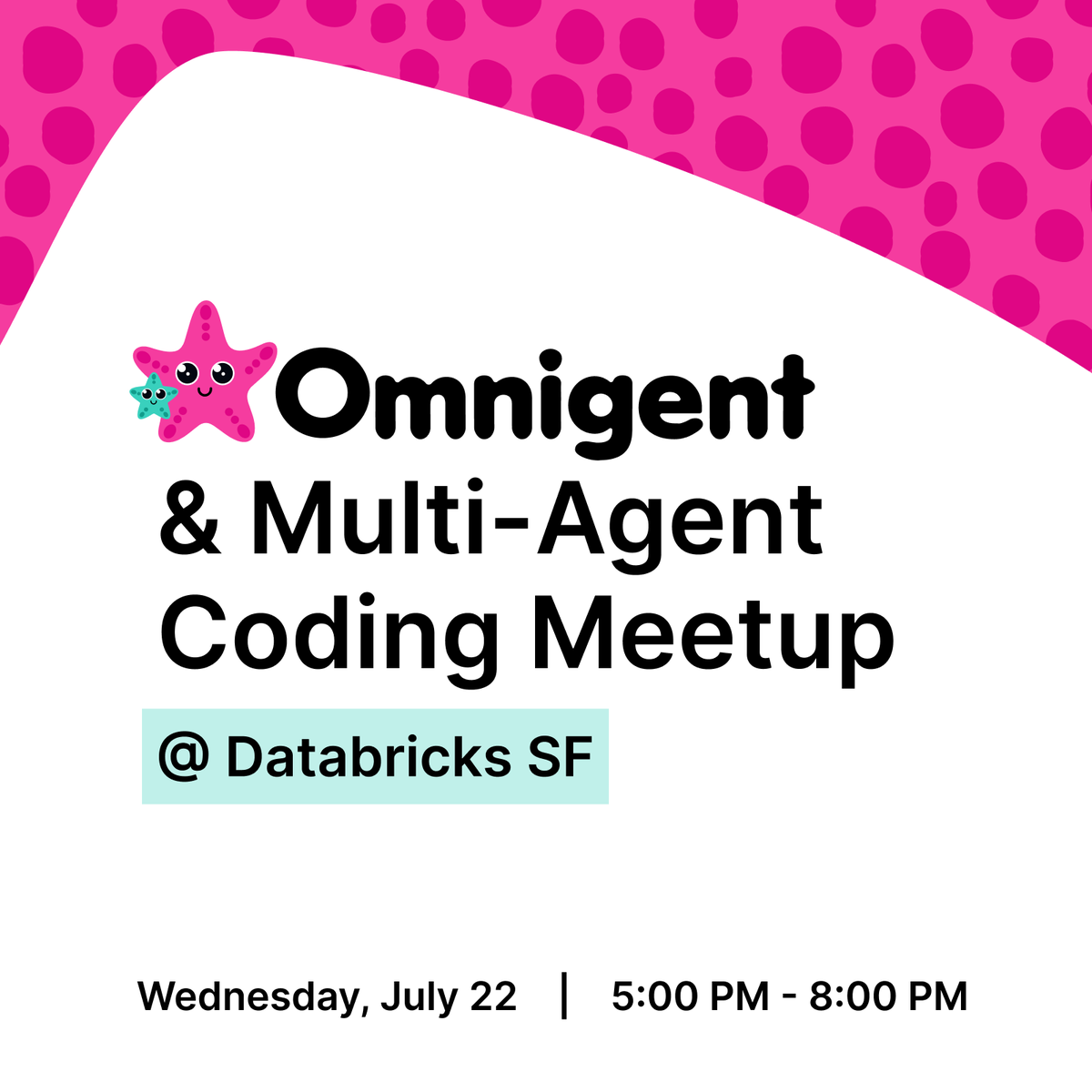
Join us on July 22 from 5 to 8pm PT at the @databricks SF office for a meetup on multi-agent coding workflows. ⬇️
🤝 Omnigent talk: Claude Code, Codex, Cursor, OpenCode, Pi + more
🎤 Panel with engineering leaders from @DoorDash & other AI-forward teams on orchestration, supervision, sandboxing, governance
🍕 Bites + dessert
Register: https://t.co/Gx0oztztXQ
#Omnigent #AIAgents #GenAI
Allow, deny, or ask on every tool call doesn't scale. Omnigent Contextual Policies track what an agent has done in a session (reads, spend, risk) to decide what happens next. Works over Claude Code, Codex, Pi, and custom agents. 👇
Most coding agents have very limited features for controlling security: just a list of actions to allow, deny, or ask users on. In @omnigent_ai, we introduced Contextual Policies, which can track *state* about a session to manage both security and cost in a far more flexible way.
Omnigent v0.4.0 is live 👇
🔌Harness plugin SDK (bring your own agent)
🧠 Model router picks harness + model per turn
🤹 Polly fans work to Cursor, Hermes, OpenCode
🪢 Native-harness parity + cost/polish fixes
uv tool install --force "omnigent==0.4.0"
https://t.co/KbnU9sborI
#Omnigent #OpenSource
Databricks ranks #1 on NVIDIA’s SOL-ExecBench kernel leaderboard, in the L1 single operation track, powered by KDA (Kernel Design Agents) 🎉
What’s crazy is: we 100% leveraged AI agents to beat the competition.
This is a sneak peek at recursive self-improvement. The core frameworks we used were KDA, Humanize, and Omnigent: Claude writes code, Codex reviews. Together, they enabled agents to run autonomously for as long as possible. The key is setting up the right framework to let the agents cook.
This work was driven by @leshenj15 at Databricks, in collaboration with NVIDIA and MIT HAN Lab’s @LigengZhu and @DongyunZou03 .
Databricks AI is like a neolab. Join us if you’re cracked!
We are happy to announce #Omnigent v0.3.0!
Major new features
🤖 Seven new agent harnesses: #Hermes (SDK + native TUI), #GitHub#Copilot (SDK), #OpenCode, #Goose, #QwenCode, #Kiro, and #KimiCode; plus #Antigravity promoted to a full SDK + native #agy CLI harness
🪢 Native-harness parity across the fleet: compaction, cost/token tracking, resume, true fork with history, in-session model switching, and tool-approval / AskQuestion web cards, for #cursor, #codex, #qwen, #pi, #hermes, #goose, and #opencode
🖥️ Omnigent Desktop: now manages the server + runner automatically
🗂️ Projects workspace:vgroup sessions into Projects and drag between them, plus a Settings surface and per-harness run-mode memory
🧭 Intelligent model router to pick the right model per turn
📦 More deploy & sandbox targets: host on #Databricks Apps + #Lakebase #Postgres, #AWS #Bedrock provider, on-demand #Kubernetes runner #Pod sandbox, and a #boxlite managed host
🪟 Native #Windows support
🕵️ Custom #Agent Creation UI
🔌 In-app #MCP management from Agent Info, sys_session_share agent-facing session sharing, and web UX polish — shortcuts overlay, pinned-session hotkeys, image lightbox
Read details about this release: https://t.co/k6f5Nc1koM