Time for a science lesson. 🤟🤓🫴🧪
I have received a number of comments from folks today asking me to stop using the term “fossil fuels” because they argue that coal, oil, and natural gas don’t form from fossils or “dinosaur juice.” One follower even said I am undermining my otherwise good work by using it.
I also often hear the claim, “Scientists have found abiotic liquid hydrocarbons on Saturn’s moon, Titan, therefore oil isn’t a fossil fuel.”
This is a flawed line of reasoning.
First, let it be clear that the term “fossil fuels” does not mean that our petroleum products are derived from dinosaur remains. And dinosaurs aren’t the only specimens that leave fossils.
The term “hydrocarbon” is a broad term that is used to categorize any organic compound that is composed of hydrogen (H) and carbon (C) atoms.
Hydrocarbons, such as ethane (C₂H₆) or methane (CH₄), can be liquid if conditions are cold enough under the right pressure:
• C₂H₆ boils (becomes a gas) at –88.6°C (–127.5°F).
• CH₄ boils at –161.5°C (–258.7°F).
Given that the surface temperature on Titan hovers around –179°C (–290.2°F), it is indeed cold enough for oceans of C₂H₆ and CH₄ to exist on its surface. But just because hydrocarbons can be liquid at those temperatures does not make them “oil.”
Oil is far more chemically involved than C₂H₆ or CH₄. Crude oil is made up of a series of complex hydrocarbons, far more complex than anything encountered in space thus far in our discoveries.
All oil is hydrocarbons, but not all hydrocarbons are oil.
Got it? 🤔
Coal and oil are produced by long-dead biomass. More specifically,
🌿 Coal forms from decaying terrestrial plant material. Trees, ferns and other vegetation in swamps or bogs get buried beneath sediment, and the waterlogged conditions create peat. Over millions of years, that peat is buried and hardens due to pressure compaction.
🦠 Oil [and natural gas] both form from the remains of marine microorganisms such as algae and plankton. The remains accumulate on the seafloor, where over millions of years, they are subject to heat and pressure, forming a solid substance called “kerogen.” Over time, kerogen will undergo thermal cracking and eventually break down into complex liquid (oil) and gas (natural gas) complex hydrocarbons.
Scientists have not found either coal or oil on any other celestial body. It is true that natural gas may form abiotically since, as I mentioned previously, oceans of C₂H₆ and CH₄ have been discovered on Titan, but that’s it.
Calling C₂H₆ or CH₄ on Titan “fossil fuels” would be incorrect, but liquid C₂H₆ and CH₄ are neither coal nor oil.
The term “fossil fuel” is a fine moniker if used properly because that’s what coal and oil are.
And in the context of the global warming debate, arguing about the origins of fossil fuels is irrelevant.
I appreciate the pro-nuclear sentiment but the "nuclear-is-carbon-free" slam is only a thin slice above "Death Cult" thinking.
Our world, including nuclear power plants, are 100% reliant on fossil fuels. There is no credible evidence that CO2 emissions have affected anything other than boosting plant growth, including the agriculture that 8 billion people need to survive.
Less Global Fire
Halfway through 2026, the world has burned at record-low levels
Every continent is below average, and Africa, Americas, and Europe are at record lows
Media only shows when stuff is burning, leaving us badly informed on climate change
https://t.co/iDqlYckvRT
☎️ 5 Minuten die 30 Jaar Klimaatpropaganda Vernietigen.
(Richard Lindzen, Emeritus Professor Meteorologie aan het MIT (Massachusetts Institute of Technology), een van de grootste wereldexperts in atmosferische dynamiek, planetaire golven, moesson en atmosferische fysica.
Hij heeft honderden peer-reviewed wetenschappelijke artikelen gepubliceerd en was decennialang een van de meest gezaghebbende figuren op dit gebied.)
Eindelijk: de boeren dreigen heel Nederland PLAT TE LEGGEN met de grootste protesten OOIT tegen kabinet Jetten!
Doe een ❤️ & RT als je de boeren daarin steunt!
There is no energy transition to renewables
"Rather than replacing fossil fuels, renewables are adding to the overall energy mix"
Energy Institute Statistical Review 2025
https://t.co/ccGfTfQ85g
https://t.co/mS2nxOCFjW
Threads&refs:
https://t.co/hbRLyyQ1St
Het is warm in Europa. Meteen klinkt weer: "klimaatverandering". Meteoroloog Chris Martz wijst op een veel simpelere verklaring: een hardnekkig omega-blok in de straalstroom dat hete Saharalucht naar Europa voert. Voor het weer: luister naar meteorologen, niet naar sensationele clickbait van media.
#Klimaat #Weer
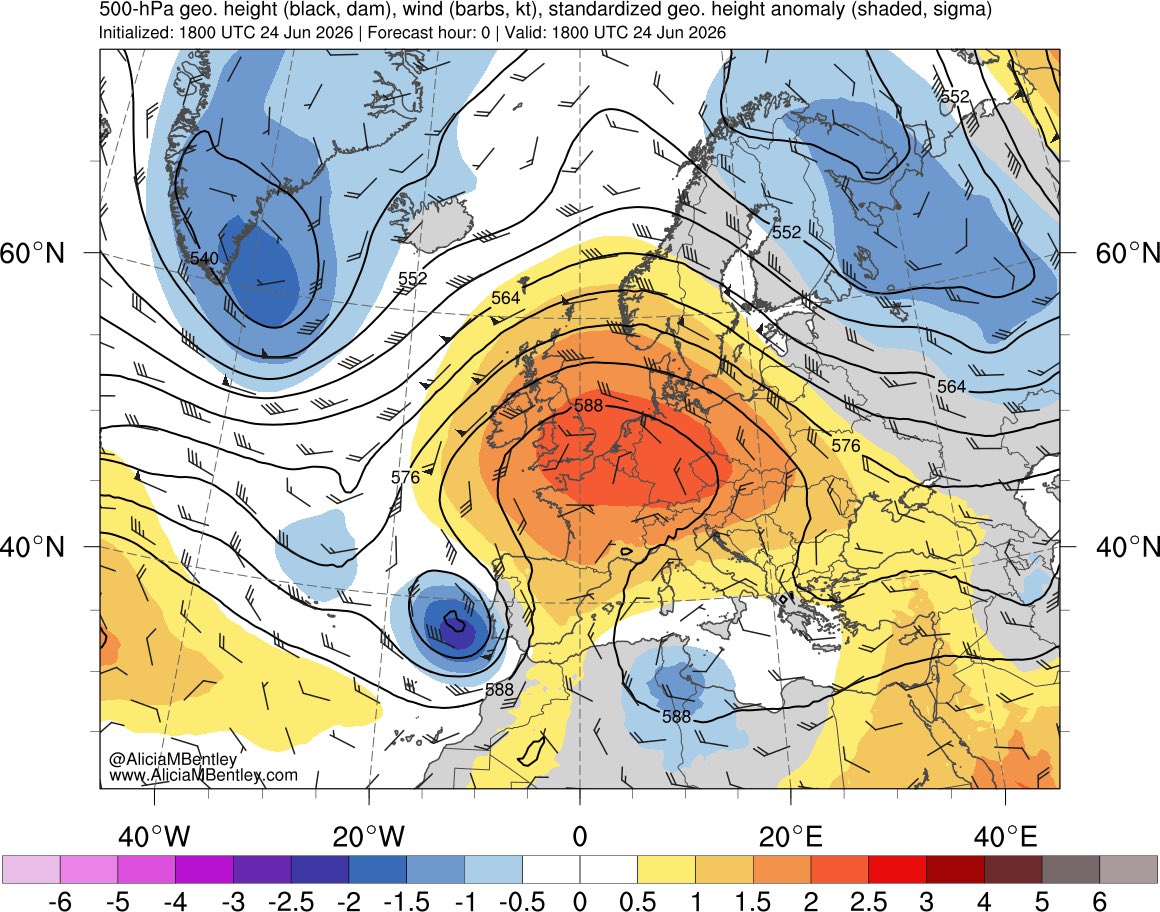
Why is it hot in Europe this week?
Well, it has to do with the “omega block” in the jet stream. Omega blocks get their name because they resemble the Greek uppercase letter omega, Ω.
You can see that in the synoptic setup. The map below on the left shows the 500 mb geopotential height anomaly at 18z. The contour lines resemble the Ω shape due to an enormous high-pressure ridge in the mid-troposphere that is sandwiched between two low-pressure systems to its east and west.
Hot Saharan air has been advected—that is, horizontally transported—northward into western Europe due to anticyclonic (clockwise) airflow, and as that air mass moves north, it is compressed adiabatically beneath the ridge where air is sinking.
This process is natural and has nothing whatsoever to do with climate change or greenhouse gas emissions. In fact, there are quite a few studies suggesting that reduced latitudinal baroclinicity (north-to-south temperature gradient) caused by Arctic amplification could reduce the frequency of mid- and high-latitude blocking events (e.g., Hassanzadeh et al., 2014; Woollings et al., 2018).
🔗 https://t.co/NGsFsRKpEt
🔗 https://t.co/M7h3vg232H
There is, however, debate about this.
Europe has seen an unusual amount of these extreme heat events since 2019, but most other areas of the globe have not. The notable exception was the June–July 2021 Pacific Northwest heatwave in North America, but even that wasn’t as rare as previously thought.
🔗 https://t.co/rNRFfJohs4
The most likely explanation for this boils down to a combination of two things:
1️⃣ Undiagnosed changes in atmospheric circulation patterns.
2️⃣ Increased absorbed solar radiation at the surface due to reduced stratiform low- and mid-level cloud cover (increased sunniness), some of which is likely due to reduced atmospheric aerosol concentrations from the EU’s strict pollution regulations.
The overall increase in the “global mean temperature” (which mostly affects overnight lows) has very little to do with this event. Even in a “pre-industrialized” climate, a record-breaking heatwave would still be happening. Heck, the “global mean temperature” fell today despite the heat cranking up in Europe.
This is mostly weather systems moving around. When you have a chaotic system with two turbulent fluids interacting with each other (the atmosphere and ocean), wild things can happen.
Get your weather information from real meteorologists, not sensationalistic clickbait news outlets like BBC News or the Daily Mail.


![ChrisMartzWX's tweet photo. Time for a science lesson. 🤟🤓🫴🧪
I have received a number of comments from folks today asking me to stop using the term “fossil fuels” because they argue that coal, oil, and natural gas don’t form from fossils or “dinosaur juice.” One follower even said I am undermining my otherwise good work by using it.
I also often hear the claim, “Scientists have found abiotic liquid hydrocarbons on Saturn’s moon, Titan, therefore oil isn’t a fossil fuel.”
This is a flawed line of reasoning.
First, let it be clear that the term “fossil fuels” does not mean that our petroleum products are derived from dinosaur remains. And dinosaurs aren’t the only specimens that leave fossils.
The term “hydrocarbon” is a broad term that is used to categorize any organic compound that is composed of hydrogen (H) and carbon (C) atoms.
Hydrocarbons, such as ethane (C₂H₆) or methane (CH₄), can be liquid if conditions are cold enough under the right pressure:
• C₂H₆ boils (becomes a gas) at –88.6°C (–127.5°F).
• CH₄ boils at –161.5°C (–258.7°F).
Given that the surface temperature on Titan hovers around –179°C (–290.2°F), it is indeed cold enough for oceans of C₂H₆ and CH₄ to exist on its surface. But just because hydrocarbons can be liquid at those temperatures does not make them “oil.”
Oil is far more chemically involved than C₂H₆ or CH₄. Crude oil is made up of a series of complex hydrocarbons, far more complex than anything encountered in space thus far in our discoveries.
All oil is hydrocarbons, but not all hydrocarbons are oil.
Got it? 🤔
Coal and oil are produced by long-dead biomass. More specifically,
🌿 Coal forms from decaying terrestrial plant material. Trees, ferns and other vegetation in swamps or bogs get buried beneath sediment, and the waterlogged conditions create peat. Over millions of years, that peat is buried and hardens due to pressure compaction.
🦠 Oil [and natural gas] both form from the remains of marine microorganisms such as algae and plankton. The remains accumulate on the seafloor, where over millions of years, they are subject to heat and pressure, forming a solid substance called “kerogen.” Over time, kerogen will undergo thermal cracking and eventually break down into complex liquid (oil) and gas (natural gas) complex hydrocarbons.
Scientists have not found either coal or oil on any other celestial body. It is true that natural gas may form abiotically since, as I mentioned previously, oceans of C₂H₆ and CH₄ have been discovered on Titan, but that’s it.
Calling C₂H₆ or CH₄ on Titan “fossil fuels” would be incorrect, but liquid C₂H₆ and CH₄ are neither coal nor oil.
The term “fossil fuel” is a fine moniker if used properly because that’s what coal and oil are.
And in the context of the global warming debate, arguing about the origins of fossil fuels is irrelevant.](https://pbs.twimg.com/media/HMWEUaQWkAALKX7.jpg)








![ChrisMartzWX's tweet photo. Time for a science lesson. 🤟🤓🫴🧪
I have received a number of comments from folks today asking me to stop using the term “fossil fuels” because they argue that coal, oil, and natural gas don’t form from fossils or “dinosaur juice.” One follower even said I am undermining my otherwise good work by using it.
I also often hear the claim, “Scientists have found abiotic liquid hydrocarbons on Saturn’s moon, Titan, therefore oil isn’t a fossil fuel.”
This is a flawed line of reasoning.
First, let it be clear that the term “fossil fuels” does not mean that our petroleum products are derived from dinosaur remains. And dinosaurs aren’t the only specimens that leave fossils.
The term “hydrocarbon” is a broad term that is used to categorize any organic compound that is composed of hydrogen (H) and carbon (C) atoms.
Hydrocarbons, such as ethane (C₂H₆) or methane (CH₄), can be liquid if conditions are cold enough under the right pressure:
• C₂H₆ boils (becomes a gas) at –88.6°C (–127.5°F).
• CH₄ boils at –161.5°C (–258.7°F).
Given that the surface temperature on Titan hovers around –179°C (–290.2°F), it is indeed cold enough for oceans of C₂H₆ and CH₄ to exist on its surface. But just because hydrocarbons can be liquid at those temperatures does not make them “oil.”
Oil is far more chemically involved than C₂H₆ or CH₄. Crude oil is made up of a series of complex hydrocarbons, far more complex than anything encountered in space thus far in our discoveries.
All oil is hydrocarbons, but not all hydrocarbons are oil.
Got it? 🤔
Coal and oil are produced by long-dead biomass. More specifically,
🌿 Coal forms from decaying terrestrial plant material. Trees, ferns and other vegetation in swamps or bogs get buried beneath sediment, and the waterlogged conditions create peat. Over millions of years, that peat is buried and hardens due to pressure compaction.
🦠 Oil [and natural gas] both form from the remains of marine microorganisms such as algae and plankton. The remains accumulate on the seafloor, where over millions of years, they are subject to heat and pressure, forming a solid substance called “kerogen.” Over time, kerogen will undergo thermal cracking and eventually break down into complex liquid (oil) and gas (natural gas) complex hydrocarbons.
Scientists have not found either coal or oil on any other celestial body. It is true that natural gas may form abiotically since, as I mentioned previously, oceans of C₂H₆ and CH₄ have been discovered on Titan, but that’s it.
Calling C₂H₆ or CH₄ on Titan “fossil fuels” would be incorrect, but liquid C₂H₆ and CH₄ are neither coal nor oil.
The term “fossil fuel” is a fine moniker if used properly because that’s what coal and oil are.
And in the context of the global warming debate, arguing about the origins of fossil fuels is irrelevant.](https://pbs.twimg.com/media/HMWEUabXsAEOmf5.jpg)