New Opinion article: @bjornhs, @LJ_Wilcox and Robert Allen highlight an urgent need for more research into the complex climate effects of regional changes in aerosol emissions
https://t.co/J2pxLMGtUE
Check out Catherine Toolan's first PhD (preprint) paper. Comments welcome! https://t.co/2zsSjapdOY inter-model differences and biases in CMIP6 simulations of PM<sub>2.5</sub>, aerosol optical depth, and precipitation over Africa /wi @LJ_Wilcox@bjornhs et al.
2023 temperatures fall in line with historical trends, with warm anomalies typical of El Niño, indicating dominance of sea surface temperature variability and regional forcing.
Read this paper by @bjornhs et al. at: https://t.co/8Ezluwilan
Hva er egentlig sammenhengen mellom luftforurensning og nedbør og hvordan påvirker det klimaet? Det vet forskerne stadig mer om! @gunnarmy og @bjornhs har bidratt til denne vitenskapelige gjennomgangen i @NatureGeosci
https://t.co/9MMzSi9PQA
Maybe @Nature should stop ignoring the role of rapid aerosol reductions in its communication on near term warming?
As that's where most risks are, as written in @Nature
https://t.co/J8X3NShRN7
@RARohde@JoeriRogelj
https://t.co/RkDDFinf8O
@ggpersad@bjornhs@LJ_Wilcox
Interested in climate change and ecosystems? Read about DTR-changes (Daily Temp. Ranges) and their correlation with global ecosystems. Paper with You-Ren Wang, @bjornhs, @daghes et al. from @CbaOslo, @NHMOslo_Science, @EmeraldNorway and @CICERO_klima https://t.co/ry6FR5zEpL
@AndrewIWilliams @DWatsonParris Broadly yes, unless you hit a region with a very sensitive pattern effect. (Which Chinese so2 emissions do, in the outflow region.) Other regions tend to all produce very similar patterns - but I agree there's no study (that I know of) specifically for shipping.
@AndrewIWilliams @DWatsonParris The aerosol response for strong perturbations has a ramp up time of a few years, so that part actually fits. But I agree with you it's likely a minor part of the current picture.
Ein klar konsekvens av varmare vatn og varmare luft er meir ekstremnedbør. Det er vanskeleg å varsle og vanskeleg å forebygge. @Nansensenteret@uib@bjornhs@cicero
https://t.co/QIhH4pI0IL
Det kraftige regnværet er en følge av de nyhetene vi har fått servert i uker og måneder nå: Verden blir varmere.
– Når verden blir ekstra varm, så fører det til at vannet fordamper – og det må ned et sted, sier @bjornhs ved @CICERO_klima.
https://t.co/l1sP66AfKK
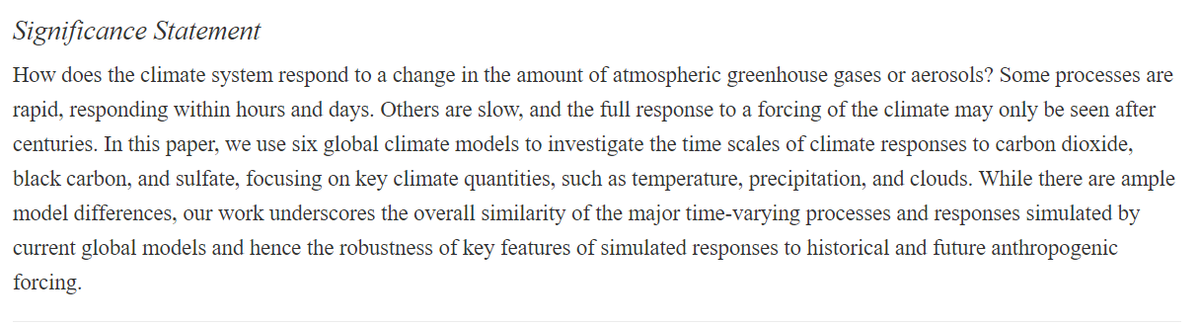
Stjern, C., @piersforster, @HailingJia, C. Jouan, M. Kasoar, @gunnarmy, D. Olivié, @JohannesQuaas, @bjornhs, @MariaSandkorn, T. Takemura, @atvoulgarakis, and C. Wells. "The Time Scales of Climate Responses to Carbon Dioxide and Aerosols", #JClimate, doi: https://t.co/zP3Ps4E0Bm
- Vi i Norge har ikke forstått alvoret i klimakrisen, sa @bjornhs@CICERO_klima på Politisk frokost m. #statsvitenskap@oivinbr@UniOslo#climate. Sol- og vindkraft vil, ifølge ham, være viktigst i det grønne skifet. Samset tok til orde for mer tverrfaglig forskning på klima.