DeepSeek V4 Flash just tied Gemini 3.6 Flash on the intelligence index.
same score. 30x cheaper on output
Google charges $7.50 per million output.
DeepSeek charges $0.28. and it's open weights.
closed pricing makes no sense anymore 😭
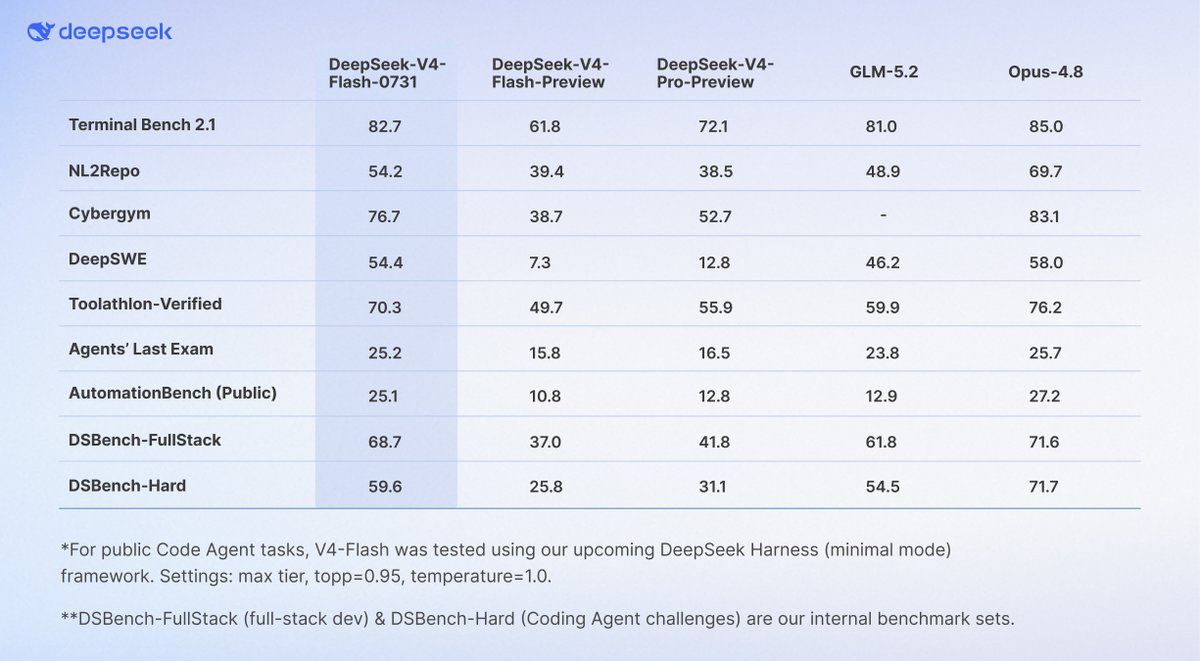
🚀 DeepSeek-V4-Flash Official API is now LIVE in public beta!
🔷 We’ve massively upgraded its Agent capabilities—benchmark scores are now far surpassing the V4-Pro-Preview. Check out the massive performance leap below! 👇
🔷 The official V4-Flash now natively supports the Responses API format and is fully adapted for Codex!
Check out the configuration details in our official API docs: https://t.co/smCwQZMeiq
This is an email I sent earlier today to all employees at Coinbase:
Team,
Today I’ve made the difficult decision to reduce the size of Coinbase by ~14%. I want to walk you through why we're doing this now, what it means for those affected, and how this positions us for the future.
Why now
Two forces are converging at the same time. We need to be front footed to respond to both.
First, the market. Coinbase is well-capitalized, has diversified revenue streams, and is well-positioned to weather any storm. Crypto is also on the verge of the next wave of adoption, with stablecoins, prediction markets, tokenization, and more taking off. However, our business is still volatile from quarter to quarter. While we've managed through that cyclicality many times before and come out stronger on the other side, we’re currently in a down market and need to adjust our cost structure now so that we emerge from this period leaner, faster, and more efficient for our next phase of growth.
Second, AI is changing how we work. Over the past year, I’ve watched engineers use AI to ship in days what used to take a team weeks. Non-technical teams are now shipping production code and many of our workflows are being automated. The pace of what's possible with a small, focused team has changed dramatically, and it's accelerating every day.
All of this has led us to an inflection point, not just for Coinbase, but for every company. The biggest risk now is not taking action. We are adjusting early and deliberately to rebuild Coinbase to be lean, fast, and AI-native. We need to return to the speed and focus of our startup founding, with AI at our core.
What this means
To get there, we are not just reducing headcount and cutting costs, we’re fundamentally changing how we operate: rebuilding Coinbase as an intelligence, with humans around the edge aligning it. What does this mean in practice?
- Fewer layers, faster decisions: We are flattening our org structure to 5 layers max below CEO/COO. Layers slow things down and create coordination tax. The future is small, high context teams that can move quickly. Leaders will own much more, with as many as 15+ direct reports. Fewer layers also means a leaner cost structure that is built to perform through all market cycles.
- No pure managers: Every leader at Coinbase must also be a strong and active individual contributor. Managers should be like player-coaches, getting their hands dirty alongside their teams.
- AI-native pods: We’ll be concentrating around AI-native talent who can manage fleets of agents to drive outsized impact. We’ll also be experimenting with reduced pod sizes, including “one person teams” with engineers, designers, and product managers all in one role.
In short: AI is bringing a profound shift in how companies operate, and we’re reshaping Coinbase to lead in this new era. This is a new way of working, and we need to leverage AI across every facet of our jobs.
To those who are affected
I know there are real people behind these decisions — talented colleagues who have poured themselves into this company and our mission. To those of you who will be leaving: thank you. You’ve helped build Coinbase into what it is today, and I am sincerely grateful for everything you've done.
All impacted team members will receive an email to their personal account in the next hour with more information, and an invitation to meet with an HRBP and a senior leader in your organization. Coinbase system access has been removed today. I know this feels sudden and harsh, but it is the only responsible choice given our duty to protect customer information.
To those affected, we will be providing a comprehensive package to support you through this transition. US employees will receive a minimum of 16 weeks base pay (plus 2 weeks per year worked), their next equity vest, and 6 months of COBRA. Employees on a work visa will get extra transition support. Those outside of the US will receive similar support, based on local factors and subject to any consultation requirements.
Coinbase prides itself on talent density. Our employees are among the most talented people in the world, and I have no doubt that your skills and experience will be highly sought after as you pursue your next chapters.
How we move forward
To the team that is staying, I know this is a difficult day. We’re saying goodbye to colleagues and friends you've been in the trenches with. But here’s what I want you to know as we move forward together:
Over the past 13 years, we have weathered four crypto winters, gone public, and built the most trusted platform in our industry. We’ve made it this far by making hard decisions and by always staying focused on our mission. This time will be no different – nothing has changed about the long term outlook of our company or industry. And most importantly, our mission has never been more important for the world. Increasing economic freedom requires a new financial system, and we’re building it.
The Coinbase that emerges from this will be more capable than ever to achieve our mission.
Brian
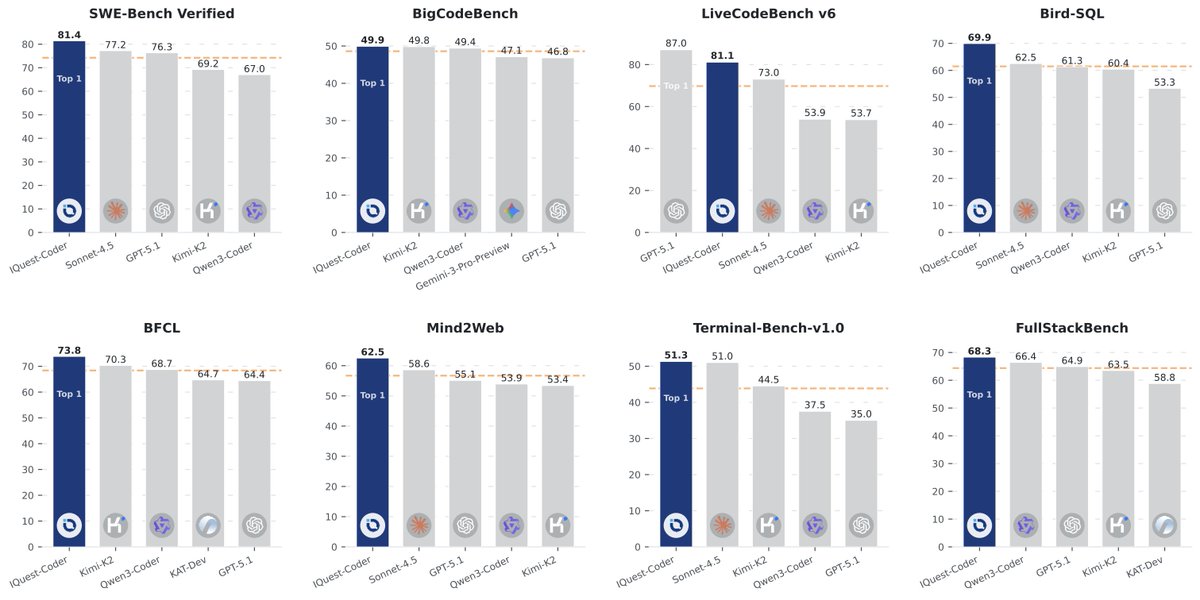
🚨 BREAKING: China's new opensource code model beats Claude Sonnet 4.5 & GPT 5.1 despite way fewer params.
SWE-Bench Verified (81.4%), BigCodeBench (49.9%), LiveCodeBench v6 (81.1%) - with just 40B-param model.
IQuest-Coder from Quest Research, backed by China’s
quant hedge fund giant UBIQUANT.
UBIQUANT has leaned hard into AI for years, running teams like AILab, DataLab, and Waterdrop Lab.
As of Q3 2025, AUM sat at CNY 70–80B ($10.01–11.43B), with about 24% average returns from Jan to Nov 2025, and CNY 463M ($66.18M) paid out in dividends.
Bifurcated post-training delivers two specialized variants—Thinking models (utilizing reasoning-driven RL for complex problem-solving) and Instruct models (optimized for general coding assistance and instruction-following).
Efficient Architecture: The IQuest-Coder-V1-Loop variant introduces a recurrent mechanism that optimizes the trade-off between model capacity and deployment footprint.
Native Long Context: All models natively support up to 128K tokens without requiring additional scaling techniques.
Just finished reading “Hands-On Large Language Models” by @JayAlammar and @MaartenGr. This is a phenomenal book explaining various concepts with nice illustrations. A must read for people working or aspiring to work in the field of Generative AI.
Previously, RAG systems were the standard method for retrieving information from documents. However, if you are not repeatedly querying the same document, it may be more convenient and effective to just use long-context LLMs. For example, Llama 3.1 8B and Llama 3.2 1B/3B now support up to 131k input tokens, making them viable alternatives if your hardware can handle it.
In either case, one big limitation of using LLMs for question answering here is their inability to provide citations.
I just read an interesting paper that aims to address (or improve) information retrieval with fine-grained citations, "LongCite: Enabling LLMs to Generate Fine-Grained Citations in Long-Context QA" (https://t.co/bmHDqNVYUt).
In this paper, the researchers use off-the-shelf LLMs to generate a dataset consisting of long-context QA instances with precise sentence-level citations and then use that dataset to finetune an open-weight LLM to generate answers with citations. The resulting LongCite 8B and 9B models are surprisingly good compared to GPT4o, Llama 3.1, etc.
How does this work? Here is the 4-step procedure for generating the dataset for instruction-finetuning:
(a) Starting with long texts or documents, their method uses an existing LLM to generate a Q&A dataset (a query and its associated answer) using Self-Instruct (Wang et al. 2023; discussed in one of my previous posts).
(b) Next, they use the answer to retrieve several 128-token chunks from the input text for coarse-grained citations.
(c) The LLM then looks for relevant sentences within these chunks to provide more fine-grained sentence-level citations
(d) The researchers filter out Q&A pairs where less than 20% of the statements in the answer don't have citations
The resulting dataset is then used to train an LLM in a conventional (SFT) fashion.
What is the best model for long-context retrieval? @DbrxMosaicAI ran experiments comparing the performance of LLMs, like @OpenAI o1, @AnthropicAI Claude, @GoogleDeepMind Gemini or @AIatMeta Llama in long-context Retrieval Augmented Generation (RAG) tasks.
TL;DR:
💡 Tested on three datasets: Databricks DocsQA, FinanceBench, and Natural Questions.
📈 Evaluated performance across varying context lengths, from 2,000 to 2,000,000 tokens, retrieved from a vector database.
🛠️ GPT-4o was used judge to assess the correctness of the answers.
🤯 Gemini 1.5 maintains RAG performance up to 2 Million Tokens
🦙 Open models like Llama-3.1-405b show performance decreases after 32k tokens
🤏🏻 OpenAI o1 models underperformed at shorter context lengths on certain datasets
🥇 OpenAI's o1-preview achieves the highest average performance (0.763) across context lengths
📉 Most models' performance peaks around 32k-64k tokens and then declines
@_philschmid@OpenAI Wondering why this meta prompt is not invoked automatically behind the scenes based on user’s input rather than user optimizing the prompt and invoking the LLM with optimized prompt. Any thoughts?
The Top ML Papers of the Week (Sep 9 - Sep 15):
- Moshi
- Qwen2.5 Coder
- Diagram of Thought
- Iteration of Thought
- To CoT or not to CoT?
- Agents in Software Engineering
Read on for more: