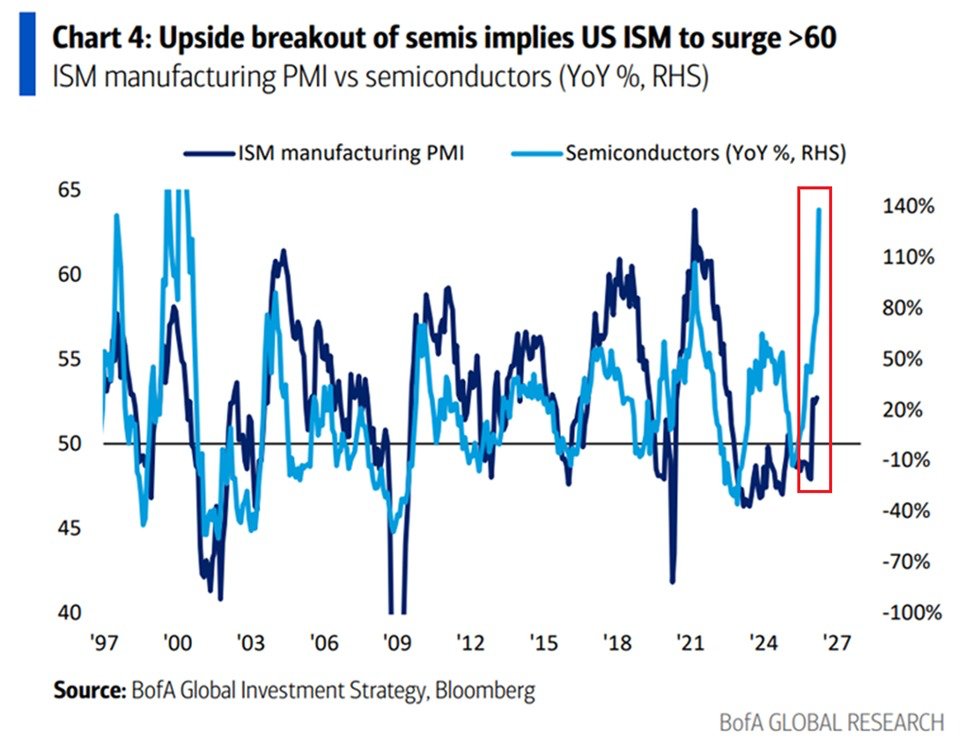
This is unprecedented:
The semiconductor sector, $SOX, has rallied +150% YoY, the strongest 1-year increase since the 2000 Dot-Com Bubble.
This even surpasses the +100% surge during the recovery from the 2020 pandemic.
$SOX has now closed higher for 18 consecutive trading sessions, the longest streak in history, overtaking the previous record of 15 days set in 2014.
Historically, the performance of semiconductor stocks has been a leading indicator for the ISM Manufacturing PMI Index.
If the relationship still holds, the Manufacturing PMI could surge to as high as 60 points, the highest level since 2021.
Excluding 2021, that would be the highest reading in 22 years.
US manufacturing may be on the verge of historic expansion.
Market direction, I agree. But don’t macros broadly and directionally shape how a business is likely to pan out? After all even the best of the managements feel it when the macro tide turns against them.
@kapil_tandon This isn’t India losing out or a sudden global turn against us. India’s population, incomes, and aspirations have grown rapidly, which means high outbound demand for migration. When volumes spike this fast, destination countries tighten scrutiny. I think this is just a trailer.
@Viswana10Sriram@connectgurmeet As they say, Don’t ask the barber whether you need a haircut. Please understand he’s running an equity shop and needs to exude optimism else his business will shut down. It’s us as customers who need to separate wheat from chaff.
@kapil_tandon It’s a crazy mix right now with the AI hype, chip stocks soaring, gold at highs, and dollar strong. Markets seem to be hedging every outcome at once inflation, slowdown, geopolitics, liquidity. Isn’t the screen showing Gold as the last true haven?
@kapil_tandon Don't you think with the government announcing tax cuts worth 2.5–3 trillion rupees, the fiscal space for new infrastructure spending gets constrained? Also the recent efforts of Govt. are more directed towards consumption than infra spending.
Global investors and Promoters continue to reduce exposure while 'Mutual Funds Sahi hai' investors are offsetting outflows. Will the goras come rushing back to chase a speeding boat? The answer lies in earnings growth over the next few quarters.
Flows tell a story that prices alone can’t. Here’s how India’s secondary market flows stack up:
FII: still net negative (-$44B CYTD25)
DII: holding the line (+$62B accelerating inflows)
Retail: losing steam (+$1B CYTD25 vs +$14B last yr)
Promoter+PE: accelerating exits
@InvesysCapital In late 90s, Nasdaq earnings grew 15% while stocks zoomed, clear case of disconnect. Today, AI linked EPS is compounding at 30–40%, not far from the stock moves. Maybe the real bubble is still ahead. The trick is to ride it early and exit before prices detach from fundamentals.
@InvesysCapital Bubble isn’t here just yet. For a true bubble, stock price growth must decouple sharply from earnings growth. So far, AI leaders Msft, Google, Meta and Nvidia are showing earnings expansion that broadly justifies valuations.
And how food inflation evolves, particularly given the heavy rains in Punjab. Looks more likely that 25-50 bps is a given in the next 3-6 months. Good times for markets if this view pans out.
India’s retail inflation (CPI) rose to 2.07% year-on-year in August 2025 up from 1.61% in July. This is a modest uptick but still within the RBI’s target band of 2-6%.Core inflation (excluding food & energy) remains sticky at about 4.1%.
That suggests underlying demand pressures are still present even though headline inflation is subdued. From a policy perspective this print gives the RBI some space. Since inflation is inside the target, any decision to cut rates likely depends more on growth signals
@InvesysCapital Feels like bond market is starting to worry about fiscal side. On the margin think the recent tax cuts on both direct and indirect side may be fueling the concerns of fiscal slippage and higher borrowing.
@InvesysCapital Makes sense. Interesting to see how it works in Indian context though, cos RBI’s active intervention in fx market often muddies the signal.